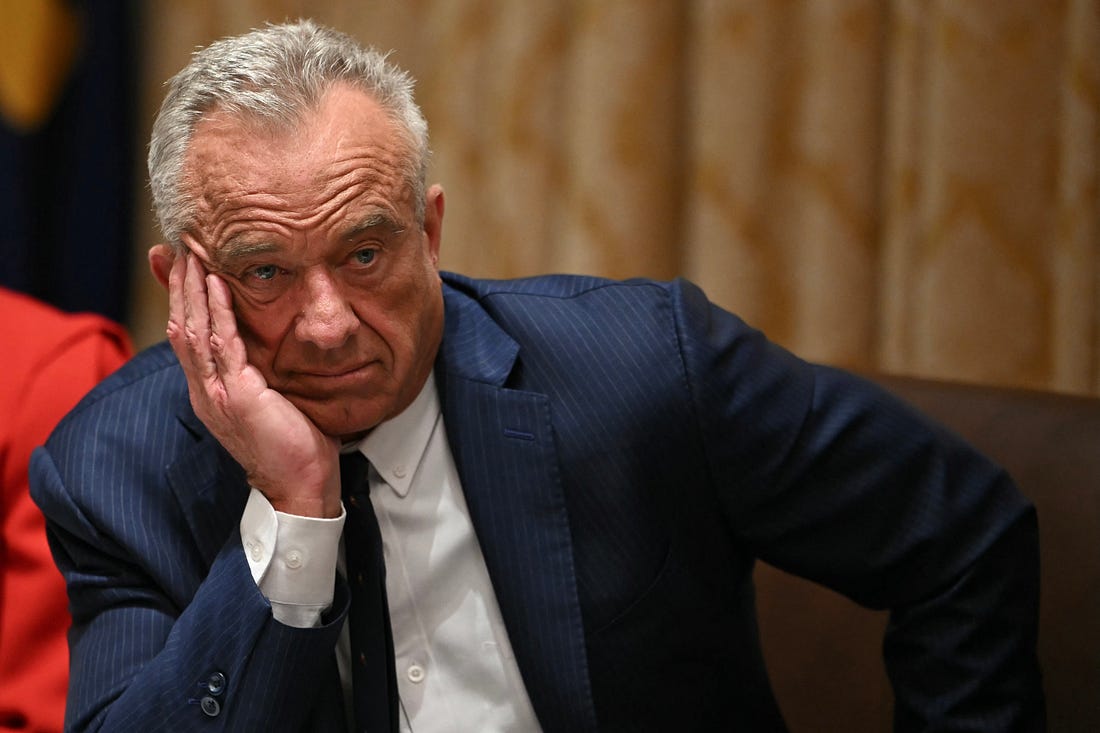
Health and Human Services Secretary Robert F. Kennedy Jr. during a cabinet meeting in the White House on December 2, 2025. (Photo by Andrew Caballero-Reynolds / AFP via Getty Images)
ROBERT F. KENNEDY JR.’S ANTI-VACCINATION campaign seems poised to advance this week when an outside committee he has stacked with vaccine skeptics and opponents considers—and quite possibly endorses—a major shift in policy.
The Advisory Committee on Immunization Practices, which makes non-binding recommendations to the CDC director, will meet in Atlanta on Thursday and Friday. The first major item on its agenda focuses on one of the anti-vax movement’s big targets: the hepatitis B vaccine.
Ever since the 1990s, the federal government has recommended administering the hep B vaccine within twenty-four hours of birth. That’s because scientists and public health experts concluded that early, universal use of the shot was the surest way to prevent a disease that, when acquired by very young children, almost always leads to chronic liver disease, sometimes resulting in cancer and especially painful deaths.
The incidence of hep B among children has fallen by 99 percent since the recommendation took effect, a reduction that ranks among the most significant public health achievements in decades. But critics like Kennedy want to eliminate the recommendation or at least push it back. Even President Donald Trump has weighed in: The first dose, he says, should come at age 12.
Why? Kennedy and his allies have two arguments. They say the vaccine is dangerous. They also contend that a universal recommendation is unnecessary because the typical mode of transmission for newborns is during labor and delivery, which means the vaccine should only be given to babies when the mother tests positive for the virus.
And the whole reason for the birth recommendation is that giving the shot only when the mother tests positive inevitably misses cases—because testing is imperfect, because record-keeping and prenatal care in the U.S. health system are so inconsistent, and because babies can pick up the disease from caregivers.
Among those who will be watching closely to see what the committee decides this week will be Demetre Daskalakis, a former CDC senior scientist who earned national attention in August when he and three colleagues resigned from the agency. I profiled him as an example of the kind of expertise the CDC was losing in RFK’s purge of its career staff, and quoted him warning that Kennedy’s assault on vaccination was just getting underway.
As I discussed with Daskalakis this week in the interview below, a pair of major developments from just the past month suggest he was right...
Join The Bulwark to unlock the rest.
Become a paying member of The Bulwark to get access to this post and other subscriber-only content.
Unlimited access to articles and newsletters including The Triad by JVL and Receipts by Catherine Rampell.
Ad-free editions of our shows (with transcripts) and member-only shows like The Secret Podcast.
Plus community chats and commenting features. Your support helps keep our work sustainable and available to those who cannot afford a membership. Cancel anytime.