|
The Medium identifies essential signals on how technology is shaping creativity, and how creatives are evolving in response.
Why Advertisers Always Beat Creators in AI Content Economics
AI rewards targeting over quality, interactivity over passive content. Advertisers monetize the full engagement loop. Creators share platform revenue splits.
| |||||||||||||||


[Author’s Note: The nice folks at Substack suggested I start writing a single free post per week. This provides an opportunity to share and respond to invaluable reader feedback. This is free for ALL subscribers to The Medium.]
Reader feedback on my last essay, “Why The Future of AI Storytelling Belongs to Advertisers, Not Hollywood,” kept returning to one question: When power laws dictate winners and losers, how do brands and creators land on the right side of the curve?
Craig Elimeliah—Chief Creative Officer at Code & Theory—asked how the economics of the distribution curve could actually work: “basically connecting how AI determines winners vs losers and how brands can land on the right side of that curve”.
Mike Jacobs—Chief Growth Officer at Consortium Brands—answered Craig’s question in his feedback (and without knowing it had been asked). In an algorithm-driven, power law distribution model, “the quality of content goes down as quality of customization and targeting goes up”. A content creator does not need great storytelling that appeals to millions. Instead, they need content that triggers the right response in the right audience—quality can be adequate if targeting is excellent.
Their feedback points to an uncomfortable truth: AI on a platform like Google’s Gemini or within a social platform like Instagram will reward the best targeting before it rewards the best storytelling. That means the algorithm identifies the right person, at the right moment, with content that triggers the desired response—whether that is a purchase, a lead, or a store visit.
So when advertisers-as-creators create content, platforms optimize for conversion and not storytelling quality. That reduces storytelling to one factor among many, and not the determining factor. And when algorithms optimize for engagement metrics rather than narrative quality, they favor interactivity over passive viewing or simple likes.
That implies that generative AI storytelling is less passive and more interactive. Engagement and participation in the story drive the economics more than viewership. Distribution is no longer a decision but a process where both creation and distribution are constantly guided and shaped by both the AI and consumers’ engagement.
This sounds a lot like gaming. A senior executive at a large video game company once explained that while game production begins in a writer’s room (like Hollywood), the final gameplay is guided by AI—within the console, mobile phone, or cloud.
The story is interactive. The story has many outcomes. The consumer’s choices dictate those outcomes and the experiences along the way. Storytelling is far more demanding of the storyteller and the audience. The story must “work” harder to drive a return on investment for the advertiser as creator.
Like gaming, AI content creation and distribution demands more consumer engagement, and more engagement requires the creator to monetize as much of that engagement as possible.
This is how brands land on the right side of the distribution curve: by building interactive storytelling that adapts to consumer engagement rather than broadcasting static content. The algorithm rewards participation. Brands that design for interactivity—like game designers—win. Brands that create passive content—like traditional advertisers—lose.
Individual creators can use this same model—but they will always face worse economics than advertisers. Creators monetize through platforms (e.g., ad revenue splits, subscription cuts or sponsorship deals) and only capture a fraction of value. Advertisers monetize directly (selling products, generating leads or driving foot traffic) and capture value at every point of engagement—the click, the choice, the conversion.
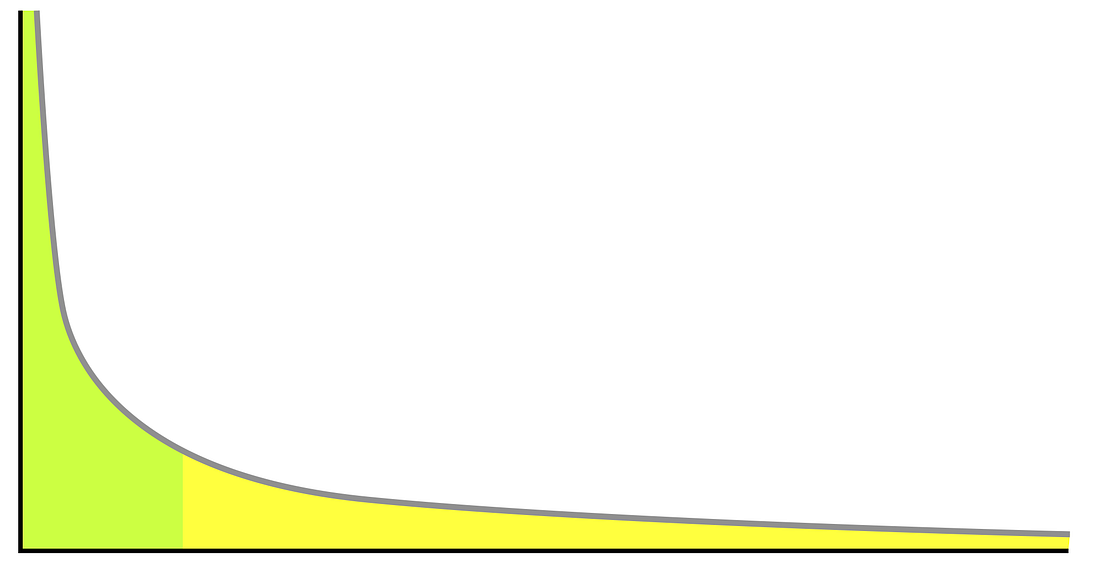 |
In the traditional creator economy, power laws are brutal: as I highlighted last week, only 3 million of YouTube’s 67 million creators (4.4%) monetize their content. In the advertiser-creator economy, power laws are less brutal because success does not require going viral—it requires out-converting competitors in your category. The power law still exists, but the addressable “curve” fragments into micro-segments where more players can win.
The distribution curve rewards participation for both types of creators, but the advertiser’s business model is structurally superior. For this reason, AI platforms will always be incentivized to favor advertiser-creator content over pure creator content. What remains to be determined is which content they will favor on “the right side of the curve”, and how much storytelling will matter to that.
As AI generates more content requiring deeper participation, the economic advantage shifts decisively toward whoever controls the full engagement-to-transaction loop.
