|
 |


This post started out as an update on what we know about Pete Hegseth’s order to strike boats allegedly being used for drug smuggling in the Caribbean. Then, this morning, without warning, as these things happen, the Department of Defense’s Inspector General released the report on Signalgate. More bad news for Hegseth. (Although I haven’t read the full report yet, I have read parts of it, and I’ve given you some preliminary thoughts on what happened here.) It seemed like we would have a nice, neat post for tonight about developments at DoD.
Of course, that’s not how things happen these days. By the end of the day, there was also news that a Virginia grand jury had declined to indict—again after the original indictment was dismissed by a judge because Trump’s appointee Lindsey Halligan wasn’t properly in office—New York Attorney General Letitia James. Then came news the Supreme Court had ruled in the Trump administration’s favor on redistricting in Texas.
If you’re already exhausted two paragraphs into tonight’s post, don’t be too hard on yourself. It has been another one of those days. This post is long—I apologize for that—but it’s written in four parts, so you can read it in digestible chunks. But don’t skip the last one!
Paid subscriptions keep Civil Discourse independent and permit me to dig deeply into fast-moving legal and political developments. If you find this work useful, I’d be grateful for your support. Becoming a paid subscriber helps me keep writing for our whole community.
Signalgate Inspector General’s Report:
The IG’s Report is out on Signalgate, the 2025 incident where a group of senior Trump administration officials, including Defense Secretary Pete Hegseth and Vice President J.D. Vance, discussed sensitive U.S. military strike plans against Yemen in an unapproved Signal group chat, a conversation that was revealed to the public after the editor-in-chief of The Atlantic, Jeffrey Goldberg, was inadvertently added to the group. The incident raised concerns about the use of commercial messaging apps for government communications and the potential for leaks of classified information.
Here’s the executive summary of sorts that’s at the top of the report:
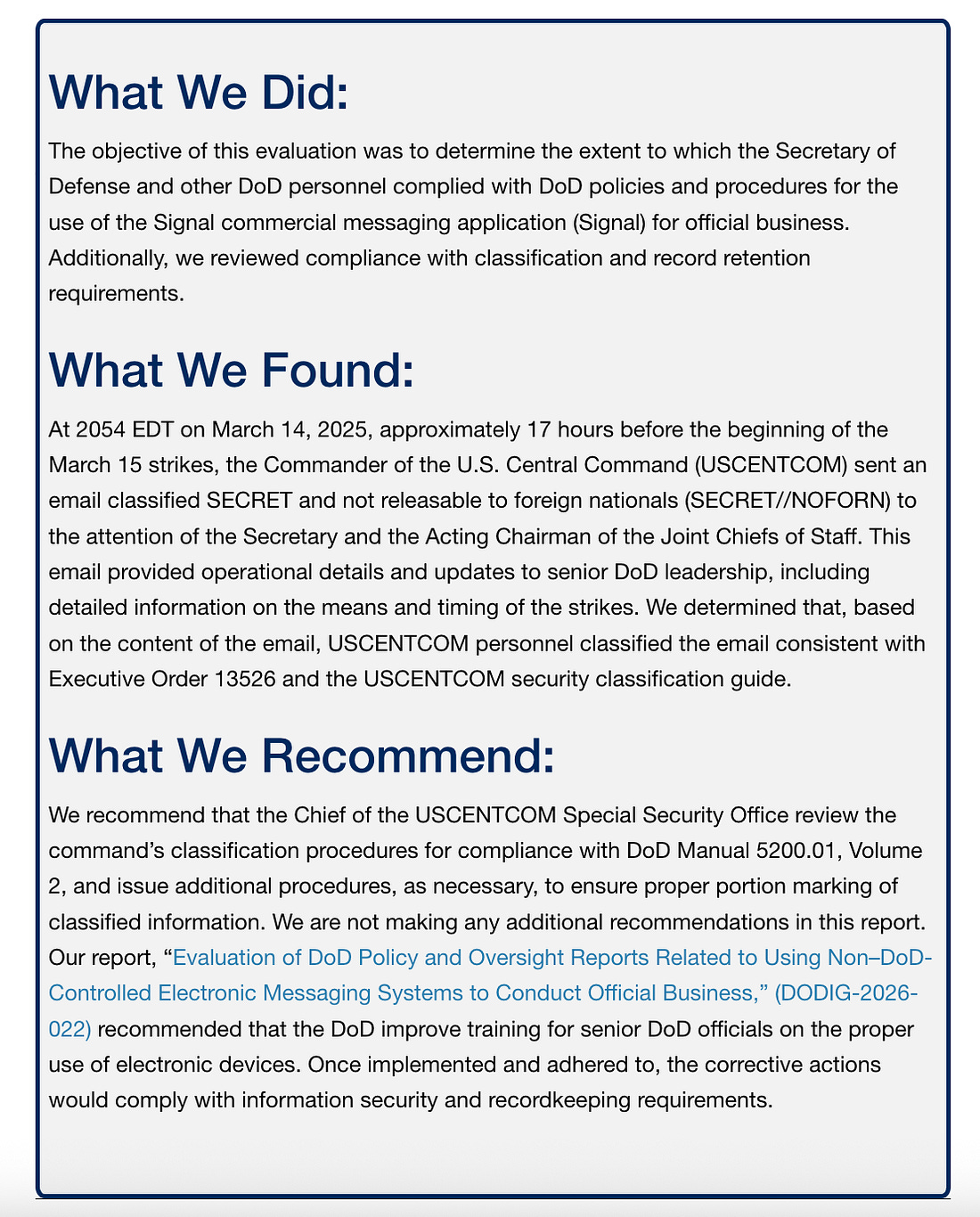 |
The bottom line is that sending information about the Yemen strike through Signal put troops at risk. That should be a full stop right there. It would have been in any other administration. But this president was willing to accept that behavior and keep his Secretary of Defense in place. That Secretary shared classified information on his personal phone (it’s weak sauce to claim he has classification authority so all should be forgiven. Even if Hegseth could declassify it, sending information out in this fashion with American troops’ lives at risk is the height of bad judgment, and there was no legitimate reason to do so).
Moreover, Hegseth did not turnover his phone to the IG and wasn’t cooperative with the investigation. He provided a statement, but he didn’t sit for an interview. None of this is what Americans are entitled to expect from a public servant or what a president should demand of his appointees.
Hegseth claims the IG’s report exonerated him, sort of like Trump claimed the Mueller Report exonerated him. That didn’t happen in either case. The IG’s report says the Secretary used his personal cell phone to send classified information about a strike to people who didn’t all need to see it and, most damning, that he put service members in harm’s way when he did it. It’s clear that he was on base at the time, that he had plenty of secure means of communication. But he chose not to use them.
Let’s underscore it: Hegseth didn’t let the IG see his phone. He was never interviewed; he provided a written statement. The whole matter came to light because Jeffrey Goldberg at The Atlantic, the journalist who was mistakenly added to the chat, alerted us after the danger to troops had passed. He was in the group chat and had the tea.
Inspectors General tend to be at least mildly restrained in their reports, and this one is no exception. But there’s plenty to read into it. An exoneration is not one of the choices. Hegseth endangered troops, violated the Federal Records Act and DoD rules, and was less than helpful and candid in how he responded to the investigation. In any other administration, he would be gone already and we wouldn’t have to consider the ongoing saga of his involvement in the attacks on boats he claims are engaged in narcoterrorism.
Admiral Bradley’s Defense of the Attack:
Admiral Frank M. Bradley was on the Hill today, trying to explain the September 2 military strike that has come into question. The Wall Street Journal reported Wednesday night that Bradley concluded that the survivors of the first strike on the boat were trying to continue a drug run, which made them legitimate targets.
Rep. Jim Himes, the top House Intelligence Committee Democrat said after his briefing with the Admiral that “What I saw in that room was one of the most troubling things I’ve seen in my time in public service.” He continued, “You have two individuals in clear distress, without any means of locomotion, with a destroyed vessel, who are killed by the United States.”
Democratic Senator Jack Reed released this statement: “I am deeply disturbed by what I saw this morning. The Department of Defense has no choice but to release the complete, unedited footage of the September 2nd strike, as the President has agreed to do. This briefing confirmed my worst fears about the nature of the Trump Administration’s military activities, and demonstrates exactly why the Senate Armed Services Committee has repeatedly requested – and been denied – fundamental information, documents, and facts about this operation. This must and will be the only beginning of our investigation into this incident.”
It is clear that this is not going away.
Hegseth is not apologetic for the attacks he has been sanctioning. Nor is he backing down. Tonight, Southern Command posted video of another lethal attack on a boat. Also, don’t forget Hegseth posted this after concerns about his conduct came to light:
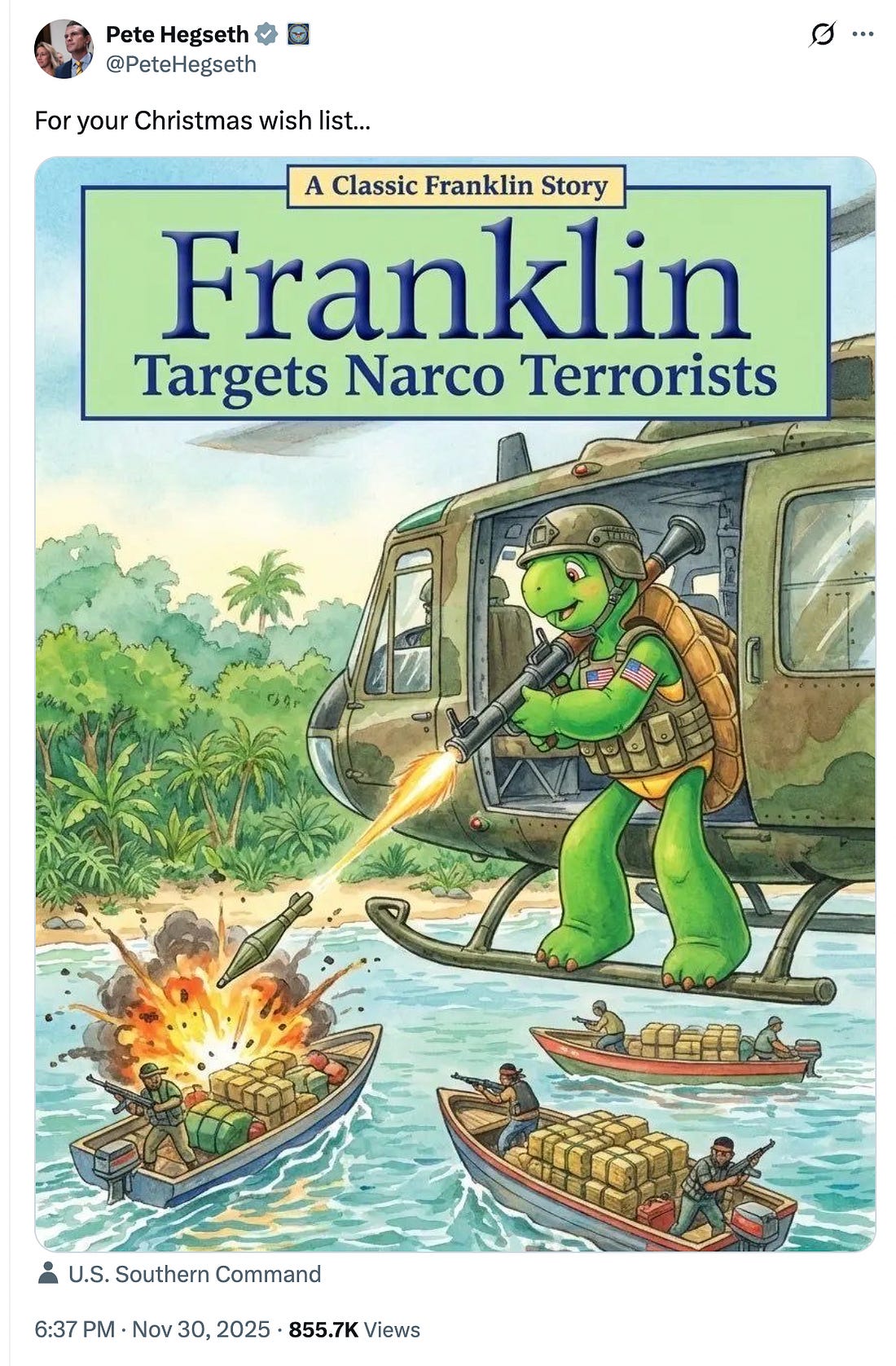 |
He has brazenly embraced the illegitimate title “Secretary of War.” This is exactly why the Senate should have declined to confirm Hegseth in the first place.
And also today…
A Virginia grand jury declined to re-indict New York Attorney General Letitia James today. We don’t know many details. Grand jury proceedings are, of course, secret. But after bringing in ringers, the pros from Dover, prosecutors from Missouri who were willing to indict the case, the grand jury balked, at least for today. There are reports prosecutors may try to indict the case again.
We don’t know if the reports mean the grand jury formally voted and didn’t indict or if they asked for clarification or to hear more evidence from before they vote. What we do know is that this almost never happens. The evidentiary standard prosecutors have to meet to convince a jury to indict is a very modest one: probable cause to believe a crime was committed and the defendant was involved.
 |