Thanks for reading The Briefing, our nightly column where we break down the day’s news. If you like what you see, I encourage you to subscribe to our reporting here.
Greetings!
This could be big news: President Donald Trump said he would allow Nvidia to sell its advanced H200 AI chip to China, in exchange for the U.S. government getting a 25% cut of those sales. That could re-open the Chinese market to Nvidia—if the Chinese government allows its local companies to buy the chips. Chances of that are good. The H200s are for training AI models, and the Chinese government is more willing to let local companies buy those chips than those used for inference, when AI models generate answers. (More on this here).
On a separate topic entirely, shareholders in two underperforming companies were surely cheering corporate takeovers today. One is data analytics firm Confluent. Signs that its business was slowing down had sent its stock plunging by almost half to around $16 over the summer from nearly $30 at the start of the year. IBM came to the rescue on Monday with a $31 a share offer, translating to $11 billion overall. The two companies now look set to live happily ever after. Meanwhile, an intensifying takeover battle for entertainment firm Warner Bros. Discovery suggests shareholders in that company can expect a similarly lucrative ending.
Worries about the shrinking cable business and its competitiveness in streaming dragged WBD stock as low as $7 last year from around $24 when the company was formed from the merger of Warner and Discovery in April 2022. The bidding war now underway has changed the story. Paramount Skydance’s $30 a share cash offer made on Monday morning aimed to disrupt the $27.75 cash-and-stock deal with WBD that Netflix announced on Friday. (The value of Netflix’s offer doesn’t include the stock WBD shareholders will get in the company’s cable channel business, which it is spinning off separately.) Whichever of these two companies wins the bidding, WBD shareholders are coming out of this a lot richer than they were a couple of years ago.
Who’s not getting richer from the drama? That would be shareholders in Netflix, whose stock fell 3.4% to $96.79 on Monday, its lowest point since April, and 21% lower than where it was trading in early October. That’s when co-CEO Greg Peters told a Bloomberg conference in answer to a question about Netflix’s interest in WBD: “One should have a reasonable amount of skepticism around big media mergers; they don’t have an amazing track record over the history of time.” (We are skeptical, Greg, even if you’re not!)
Monday’s sell-off, in particular, might also reflect worries that Netflix will raise its offer to try to match Paramount’s, making an expensive offer even pricier. Or perhaps Netflix shareholders are becoming more miserable about the deal. There’s little sign Netflix is backing away: Peters and his CEO colleague, Ted Sarandos, appeared at the UBS media conference on Monday and talked about their deal as though little had changed (more on that below).
Also not getting richer is Larry Ellison, who together with investment fund RedBird Capital Partners is on the hook for the entire $41 billion equity contribution needed to close the deal. As Paramount pointed out in its offer documents, Ellison has a stake in Oracle worth around $250 billion. But putting some of those billions into an entertainment company that owns lots and lots of cable channels—a slowly declining business—isn’t a recipe for making money.
Synergy Talk
If corporate bluster was an energy source, the rhetoric coming from Netflix and Paramount executives on Monday could power a data center. The top dogs from both companies appeared before Wall Street analysts at different forums on Monday: Paramount CEO David Ellison had a conference call about Paramount’s $30 a share cash offer, while Netflix’s co-CEOs, Peters and Sarandos, appeared at the UBS Global Media and Communications Conference. And both had their messaging polished to a fine sheen.
The chutzpah award goes to Netflix’s Sarandos, who criticized Paramount over its promise of $6 billion in synergies. “Where do you think synergies come from? Cutting jobs. We’re not cutting jobs, we’re making jobs,” Sarandos said. Hmmm. Netflix promised $2.5 billion in synergies, so perhaps Netflix isn’t cutting as many jobs, but job cuts are still likely.
More amusing is how both Netflix and Paramount claim their offers benefit everyone. Ellison, for instance, insisted Paramount’s offer was “pro-Hollywood, pro-consumer and pro-competition future,” while Netflix’s Peters said its offer was “pro-creator…pro workers, pro-growth, pro-innovation.”
Only one of the deals, though, can claim to be pro–Trump family. That would be Paramount’s, as its equity backers include Affinity Partners, the investment firm of President Donald Trump’s son-in-law Jared Kushner. Combined with signals Trump has already sent regarding his concerns about the Netflix deal, as well as his friendship with the Ellisons, Paramount’s edge with his administration may be hard for Netflix to overcome.
In Other News
• Instacart said Monday it would make its app available through ChatGPT, including the ability for shoppers to make purchases through OpenAI’s Instant Checkout feature. Stripe is powering the payment feature, the companies said, although consumers will soon be able to pay for purchases with digital wallets like Apple Pay and Google Pay.
• Google expects to launch its first AI glasses, including an audio-focused model and one with a built-in display screen, in 2026, the company said in a blog post on Monday. Google is collaborating with Samsung and with glasses companies Warby Parker and Gentle Monster on the hardware.
• Chinese startup AgiBot said on Monday the number of humanoids it has manufactured just reached 5,000, hitting a new milestone in its mass production.
Today on The Information’s TITV
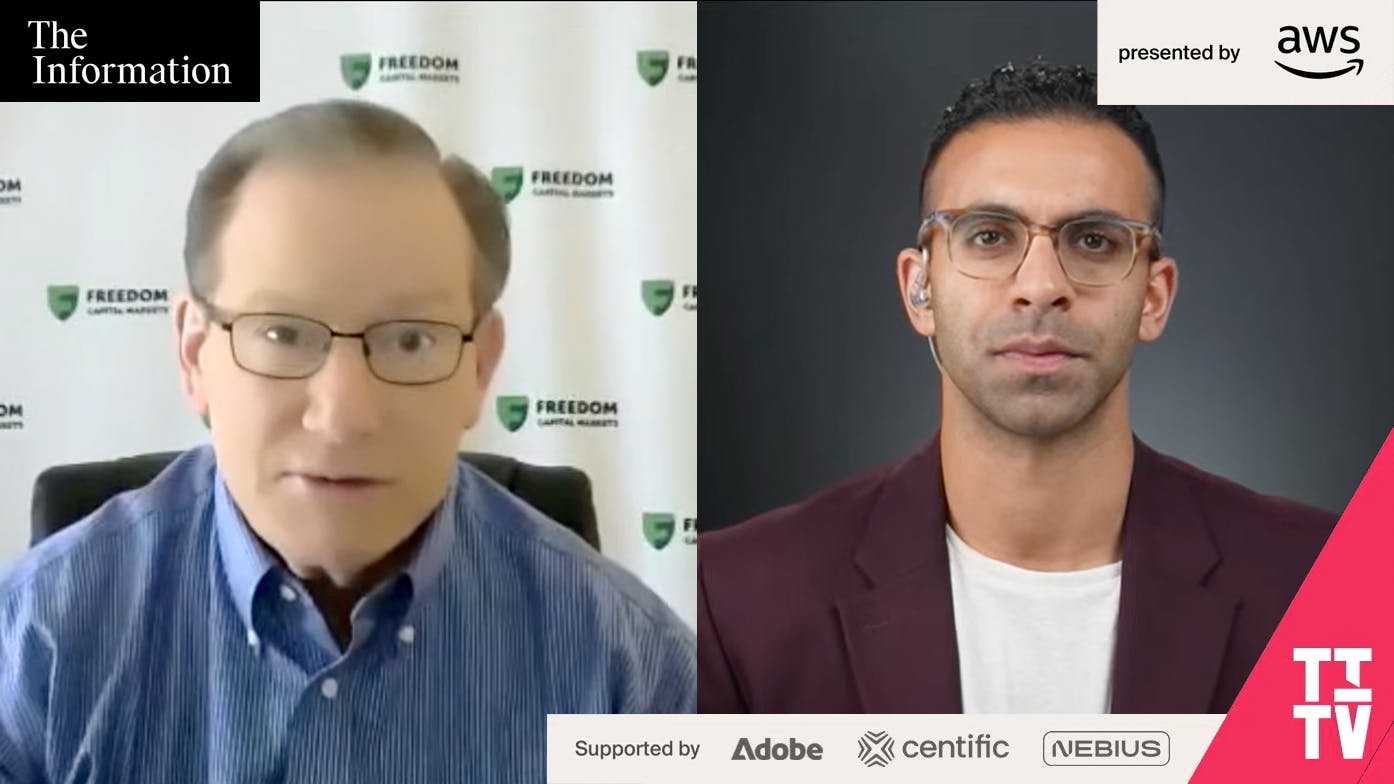
Check out our latest episode of TITV in which we break down IBM‘s Confluent acquisition and preview Oracle and Broadcom’s upcoming earnings.
Recommended Newsletter
Start your day with Applied AI, the newsletter from The Information that uncovers how leading businesses are leveraging AI to automate tasks across the board. Subscribe now for free to get it delivered straight to your inbox twice a week.
Join The Information’s Kevin McLaughlin and executives from Atlassian and Eliza for an inside look at how companies are successfully driving AI adoption and seeing real results.