| | In this edition, how technological advancements can prevent attacks like the one in Bondi Beach. And͏ ͏ ͏ ͏ ͏ ͏ |
| |  | Technology |  |
| |
|
 - Anduril armors up
- SPACs are back
- DOGE 2.0
- Gulf eyes Hollywood
- Patching AI leaks
 Reed’s view on how technology can contribute to public safety and an AI company with a new way to make cashmere. |
|
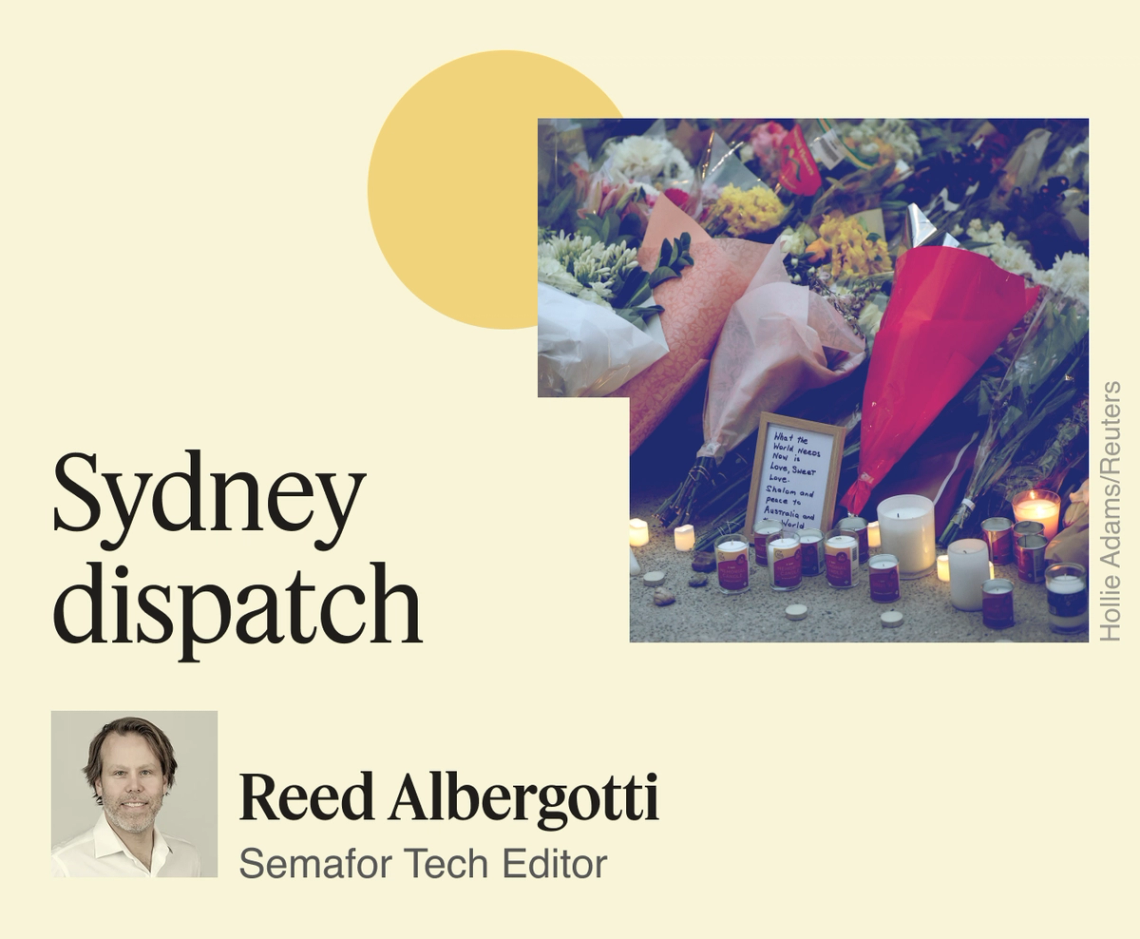 On Sunday, I was sitting at a desk at my brother-in-law’s house in Sydney’s idyllic eastern suburbs, listening to an orchestra of Australian birds while I wrote up a pair of interviews conducted last week: One with Palantir CEO Alex Karp, the other with Anduril CEO Brian Schimpf. It’s tricky writing about these companies because they develop the kind of lethal and spooky technologies that powered the origins of Silicon Valley in the 1950s, but have long been out of fashion with the software companies I usually cover. I was thinking about how to frame the interviews without cheerleading or emotional critiques. As I worked, my wife headed out with our two young children, niece, and nephew to a place she had known since childhood: Bondi Beach. On the way out the door, I asked her if she’d be able to keep all four kids safe in the water. They came home around 5:00 p.m. and we were driving together less than two hours later when we saw police cars and ambulances rushing to Bondi. Just feet from where our car had been parked, two men with several powerful rifles had opened fire on a group of Jews celebrating the first night of Hanukkah, killing 15 and wounding 42 others. That night, I read about the antisemitic incidents that had been on the rise in Sydney, and about the government’s attempt to monitor potential terrorists. It has become painfully clear that they should have stopped this: One of the Bondi shooters had been investigated for ties to the Islamic State. He had also reportedly obtained licenses for several guns, in a country in which there are 15 firearms per 100 people (compared to 120 in the US). About a month before the attack, the two shooters traveled to Mindanao, an island in the Philippines where IS is operating. Hindsight is notoriously clear. After every attack like this, needles in a haystack seem like obvious red flags. But if you want to understand Palantir’s work with intelligence agencies, which has made it successful and divisive, the simple version is: It builds customized software that enables those agencies to find the needles in advance. Governments and security services now face democratization of consumer technology and secure digital communications that make it easier to carry out destabilizing attacks at home and in theatres of war. And so, advanced countries and their contractors build even more powerful capabilities, from signals intelligence to low-cost autonomous weapons. And with those new technologies, the potential for abuse increases. Some civil libertarians argue that governments need to be kept from much of this technology. But political leaders, constantly briefed on threats, tend to want the best technology, and lean on democratic institutions to hold them accountable for using it. Here in Sydney right now, it’s hard not to agree with the case for surveillance. Indeed, Jillian Segal, Australia’s special envoy on antisemitism, had argued for increased data collection and coordination among law enforcement in recommendations submitted in July. But perhaps democracies don’t need to choose between stopping terrorist attacks and civil liberties. Technology can also increase transparency and oversight, identifying and discouraging abuse. But it would require that in democracies, systems of accountability adapt, too. |
|
Anduril CEO: Defense contractors are ‘fighting dirty’ |
 Semafor’s Reed Albergotti and Brian Schimpf. Semafor. Semafor’s Reed Albergotti and Brian Schimpf. Semafor.Anduril helped kick off a new wave of defense tech startups in Silicon Valley. While the Palmer Luckey co-founded startup has been making weapons for a while now, its CEO Brian Schimpf is starting to get somewhat combative himself, telling Semafor in an interview that the company’s competition — like incumbent defense contractors — are “fighting dirty” by planting negative media stories about Anduril’s technology. Anduril makes everything from autonomous submarines to killer drones, all equipped with cutting-edge technology for relatively bargain-basement prices. And for the most part, it doesn’t take government money until it’s ready to sell those products. That turns traditional defense contracting on its head, but the product development cycle means a more trial-and-error approach, the company says. That’s allowed critics to point to specific incidents where Anduril products have failed during testing as evidence that the company isn’t up to the challenge. Watch the interview with Schimpf. → |
|
|
Critical materials firms race to SPAC |
 Jeenah Moon/Reuters Jeenah Moon/ReutersAs the SPAC boom wanes, one set of companies is still using these lightly regulated backdoor paths to a public listing for a new reason: They’re hoping to make the US government a shareholder, Semafor’s Rachyl Jones reports. Of the 25 companies that announced plans this year to go public by merging with a listed, blank-check vehicle, eight are critical materials and nuclear energy companies, according to data from S&P. Many are hoping that going public will attract the attention of President Donald Trump, who has funneled federal money into listed companies seen as crucial to winning strategic battles with China over access to critical supplies and technologies, said Brandon Sun, head of SPACs at investment bank Cohen & Company Capital Markets. The US government’s growing role in the economy has already spilled widely into the public markets, as the most valuable company in the world, Nvidia, sees its stock rise and fall on Department of Commerce announcements about export controls. But the SPAC boomlet hints at something else: Companies that are otherwise not ready or valuable enough to face public markets can persuade promoters and investors to bet on decisions made in Washington about taxpayer dollars. Read more about why these companies are pursuing SPACs here. → |
|
|
Trump administration launches Tech Force |
 Annabelle Gordon/Reuters Annabelle Gordon/ReutersDOGE, the sequel. After the rise and fall of DOGE’s assault on federal agencies, and controversial and ambitious White House moves to support the tech industry, the Trump Administration has decided to do something more familiar: hire a bunch of people from tech to “modernize” the government. This isn’t a new idea — the Obama Administration did something quite similar — and will likely be an ongoing challenge for a government riddled with decades of technical debt. After a slash-and-burn beginning, the administration has now settled on actual, no-brainer government efficiency. There are echoes here of the old line about Hollywood, where every new idea is simply a rebranded old idea — with the additional twist that you favor or oppose it based on your politics. |
|
Gulf eyes AI in entertainment |
| |  | Matthew Martin |
| |
 Eric Gaillard/Reuters Eric Gaillard/ReutersIt has been impossible to ignore the ambitions of Gulf states aiming to become linchpins in the global AI arms race. Saudi Arabia has said it wants to be the third-biggest global compute hub, after the US and China. Abu Dhabi-controlled funds have poured billions into partnerships with Microsoft and BlackRock, and Qatar has invested in AI firms Anthropic and xAI. Each country has created its own AI champion. Clearly, Gulf leaders see AI as a revolutionary technology that will reshape the world economy — much like their peers the world over. But in conversations with senior figures in the Gulf, I’ve noticed another, less remarked upon, tectonic shift underway that they anticipate, and which they are starting to mobilize their vast sovereign funds to monetize: entertainment. In their techno-optimist view, AI revolutionizes our lives: Workers become more productive and richer, the working week gets shorter, and we all get healthier and live longer. That will leave us with more leisure time — and more money to spend enjoying ourselves. Emirati, Qatari, and Saudi funds joining forces to back Paramount Skydance’s $108 billion hostile takeover offer for Warner Bros. Discovery wasn’t just a rare display of cooperation in a region more characterized by economic competition — it was the biggest display of their willingness to put their financial resources behind this investment thesis. |
|
 Semafor will be on the ground in Davos next month for the World Economic Forum, the annual gathering where the world’s most powerful come together to strike deals, tout their good deeds, and navigate the snow — sometimes getting stuck long enough to share a scoop or two with us. We’ll deliver exclusives on the high-stakes conversations shaping the world. Expect original reporting, scoops, and insights on all the deal-making, gossip, and lofty ambitions — with a touch of the pretentious grandeur Davos is famous for. Get the big ideas and small talk from the global village — subscribe to Semafor Davos. |
|
AI’s frontmen are blowing it |
 Shelby Tauber/Pool/Reuters Shelby Tauber/Pool/ReutersThe AI bubble is starting to leak, and the industry’s frontmen are doing a lousy job plugging the holes. Genuine questions about the pace of spending has fueled steep stock-price slides from CoreWeave and Oracle, which together have lost more than $400 billion in market value, about 40%, since mid-October, Semafor’s Liz Hoffman writes. But mixed messages and rookie mistakes from Silicon Valley executives have fueled those concerns, and given the sense that neither this technology nor the companies developing it are ready for primetime. Sam Altman got huffy when a friendly tech investor asked him an obvious question — how OpenAI would pay for the $1.4 trillion in spending commitments it’s made. His CFO Sarah Friar stepped in it a few days later when she suggested the government should “backstop” AI investments, a statement Altman then had to walk back. CoreWeave’s CEO misspoke on the extent of data-center delays on a recent earnings call, forcing his own CFO to clarify — then repeated the mistake on Jim Cramer’s show. Larry Ellison might have made an exception to his no-interviews approach as Oracle’s stock cratered. This technology is changing fast. Humans misspeak. There are always construction delays. (CoreWeave’s were weather-related, according to The Wall Street Journal.) But a generation of CEOs used to acting, and being treated, like small gods, seem unused to the everyday crises of running a business. What will happen when they face real crises? |
|
 Oleksandr Oleksiienko/Kordon.Media/Global Images Ukraine via Getty Images. Oleksandr Oleksiienko/Kordon.Media/Global Images Ukraine via Getty Images.When life gives you chickens, make cashmere. New York-based Everbloom takes fiber materials that would otherwise be wasted in supply chains — including poultry feathers, bedding, and discarded wool — and transforms them into new fabrics, TechCrunch reported. The company says it can replicate materials from polyester to cashmere by running the scraps through a series of machines, with its AI model tweaking how the machines operate and the chemical reactions that alter the fibers within them. The model maps how wasted materials behave on a molecular level under various conditions, like temperature and moisture levels. It then predicts how the fibers will look, feel, and hold before manufacturing them, and recommends specific processes to get the best results out of different materials. It’s a bold experiment, but one that could help the case for upcycled fashion as consumers’ environmental footprints grow. |
|
|


