| | In today’s edition: How Democrats can capitalize on Republicans’ struggles with economic messaging. ͏ ͏ ͏ ͏ ͏ ͏ |
| |  Washington Washington | New York | St. Paul |
 | Americana |  |
| |
|
 - Devil’s in the details
- Democrats’ poll trouble
- Minnesota candidate search
- AI child’s play in Maine
- New York’s Mamdani-moon
|
|
Here’s some joyful news from Dave: My wife and I welcomed our beautiful daughter shortly after Thanksgiving, and she’s settling in at home now. After next week’s edition, we’ll be taking a hiatus until late February, and in the meantime, thank you for reading Americana! |
|
|
| | Elana Schor and Burgess Everett |
| |
 Kevin Lamarque/Reuters Kevin Lamarque/ReutersDemocrats are gearing up to make the midterms all about the cost of living. Which raises a pointed question for us: Do they even need to offer their own policy prescriptions for affordability? Republicans, as we have covered extensively, are struggling to agree on any new solutions to the public’s growing worries about the cost of living — worries that have been emerging in poll after poll, as President Donald Trump hemorrhages support on the economy. The trickier story to tell is how Democrats are capitalizing on Trump’s obvious problems as they prepare to launch their midterm push in earnest. They’re gaining ground with voters who don’t like how Trump is handling the economy, but they have work left to do. Recent polling from The Argument found Democrats had a sizable gap with voters who disapproved of Trump and ranked the cost of living as a top-two issue. Among those voters, 57% disliked the president, but only 50% favored congressional Democrats. And alongside NPR/NBC/Marist polling released today, Marist Institute for Public Opinion Director Lee Miringoff also described Democrats’ support on the economy as less than locked in. “When they don’t have cost of living as a top-two issue, Democrats actually have a better chance of sealing the deal,” Lakshya Jain, head of political data at The Argument, told us. So what can Democrats do to better appeal to voters who now think Trump is mishandling the economy? With apologies to those old enough to remember the party’s “Six for ’06” midterm platform, the answer probably isn’t with a specific agenda. “Democrats have a tendency to love to dive into internal disagreements, especially as they relate to policy that won’t be enacted anytime soon,” Hawaii Sen. Brian Schatz, the Democrats’ chief deputy whip, told us this week. “And I think we should resist that urge. That doesn’t mean we should be a total blank slate.” When it comes to “questions about … the brand of the Democratic Party, what we would do with power,” Schatz added, “a midterm message that has historically been viable is, ‘Have you had enough of this sh*t yet?’” |
|
Congressional generic ballot gap grows tougher for Democrats |
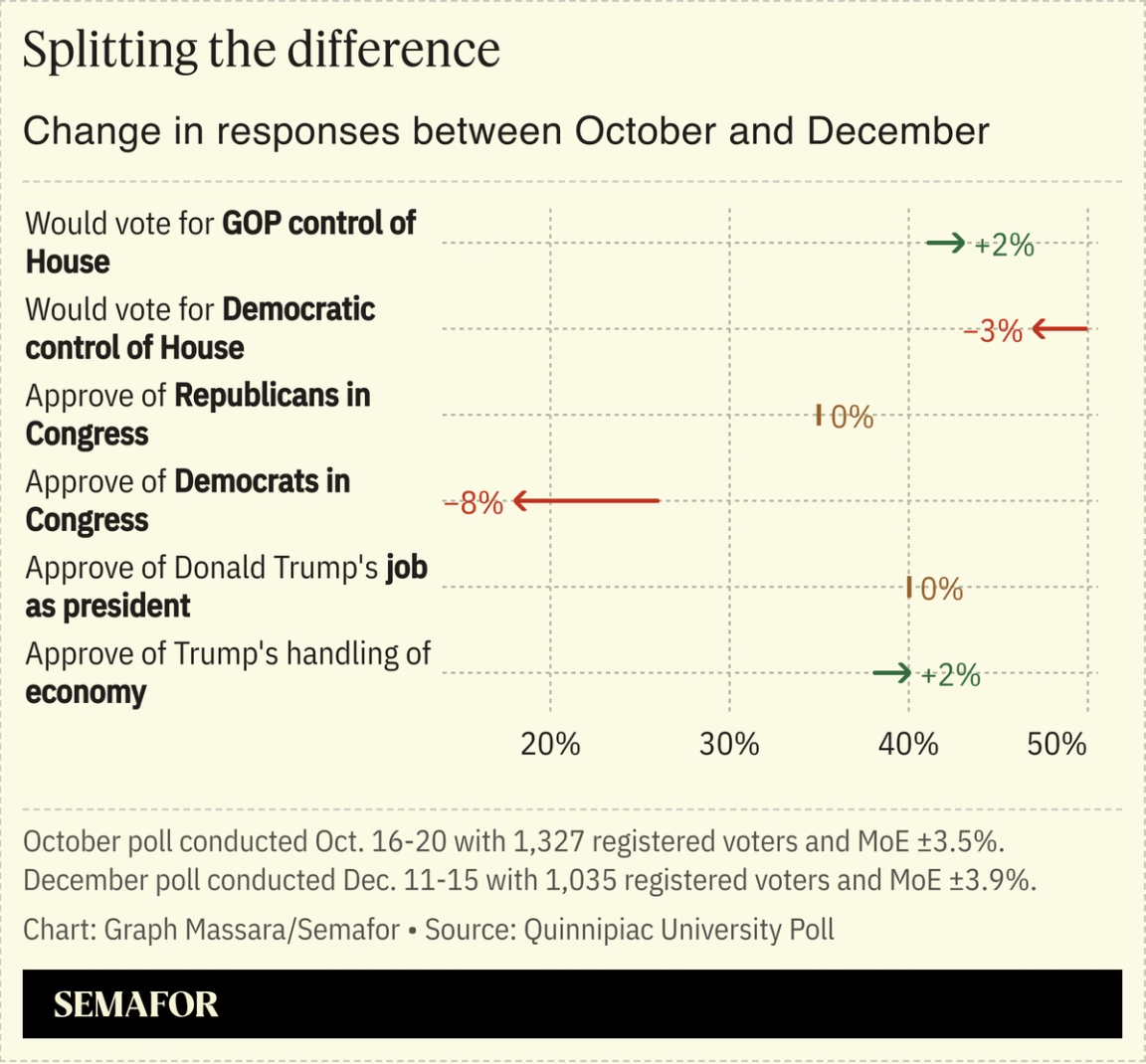 Speaking of Democrats’ challenges ahead of the midterms, they’re illustrated clearly in Quinnipiac University’s latest poll, released today: Even as Trump’s approval rating has stayed low, at 40%, the opposition party’s advantage on the generic congressional ballot has narrowed to 4 points, down from a 9-point advantage for Democrats in late October. One major reason for the slimmer Democratic lead — 47% of respondents favored a generic House Democratic candidate, versus 43% who favored a generic House Republican — may simply be that the government shutdown is over. During Quinnipiac’s last polling window, Democrats were enjoying a bit of a shutdown bump from a base that approved of their battle-eagerness. But no matter why the gap narrowed, it’s still noticeably smaller than Democrats’ generic ballot advantage at a similar point in the 2018 midterms. And there are other bad signs for them in the poll. Just 18% of registered voters approved of the job congressional Democrats are doing, including 15% of independent voters. That’s compared with a 35% approval among registered voters for congressional Republicans, and a 26% approval rating for them among independents. — Elana Schor |
|
Republicans may have found their Senate choice in Minnesota |
 Chuck Cook-USA TODAY Sports Chuck Cook-USA TODAY SportsRepublicans have largely left Minnesota’s open Senate seat alone as the midterms get closer — but that may be about to change. Longtime broadcaster Michele Tafoya is seriously looking at a run on the GOP ticket to succeed retiring Sen. Tina Smith, D-Minn. Tafoya met with National Republican Senatorial Committee officials last week, a person familiar with the conversations told us. Whether or not Tafoya gets in, Republicans may see a chance for inroads thanks to the increasingly tough Democratic primary that’s bubbled up between Lt. Gov. Peggy Flanagan and Rep. Angie Craig, D-Minn. Flanagan is arguing she’s a more pugnacious progressive than Craig, who will lean into an electability argument if Tafoya ends up jumping in on the Republican side. “Whatever candidate the GOP picks will just rubber stamp Donald Trump’s agenda that favors billionaires over working Minnesotans,” a Flanagan spokesperson said. A spokesperson for Craig cited her battleground district wins and said “it’s clear she is in the best position to keep Minnesota’s open US Senate seat blue.” Minnesota is not yet thought of as a truly competitive state for the GOP with Trump in the White House. But Tafoya could pique Republicans’ interest more than the candidate they ran last year, Royce White, who lost by about 15 percentage points. — Burgess Everett |
|
Senate Republican campaign arm runs latest AI-driven ad against Mills |
 Screenshot/NRSC/YouTube Screenshot/NRSC/YouTubeThe National Republican Senatorial Committee continues to experiment with an occasionally odd AI-driven ad strategy this cycle, this time in Maine. Earlier this month, the Senate GOP campaign arm dropped Meet Team Ossoff’s Illegals, an atonal pastiche of an NFL broadcast targeting the Georgia Democratic senator. This 30-second spot, The Janet Mills Collection, singles out Maine’s Democratic governor — who is running to unseat incumbent Republican Sen. Susan Collins — for her stance on transgender rights. In the fuzzy, lo-fi style of a 1980s infomercial, an affectless female voice coos about Mills’ “confusing” suite of gender policies, such as “forc[ing] girls to compete against biological males,” and says she comes with a “no parent-permission required estrogen kit.” Though Mills did sign into law a 2023 bill allowing 16- and 17-year-olds to receive gender-affirming therapy, in certain contexts without parental consent, the child depicted injecting drugs with a comically oversized vintage syringe behind his parents’ backs looks to be much younger than that. Nothing Mills has ever actually said makes it into this all-AI spot, which, in the language of a nostalgic mass-media idyll, depicts Maine’s sitting governor as a creepy drug pusher. — Brendan Ruberry |
|
Mamdani rises as Stefanik stalls out in latest New York polling |
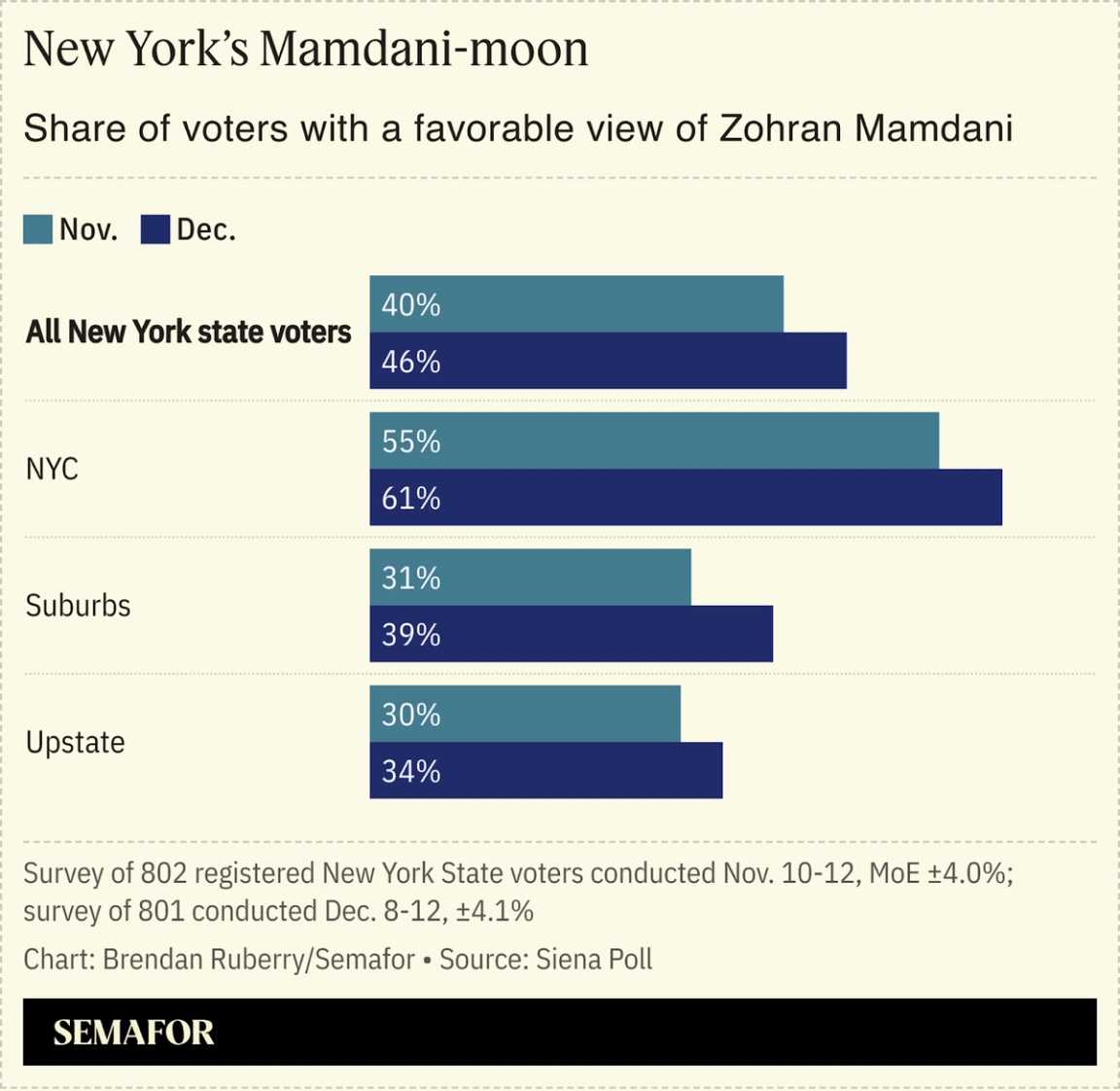 New Yorkers are feeling Zohran Mamdani, as a new Siena poll shows. The city’s mayor-elect now claims the support of two-thirds of New York state’s Democratic voters, per Siena, and has flipped his favorability among independents from -6 to +6. Upstate and suburban voters, who were negative toward Mamdani by double-digit margins one month ago, are now about 50-50. Siena also showed a 20-point shift on the question of whether Trump and Mamdani will be able to work together to improve life in the city, down from 67% who answered in the negative on Election Day to 47% who still said no after the two men’s Oval Office meeting. There’s also bad news here for GOP Rep. Elise Stefanik, whom Siena finds trailing by about 20 points in her campaign to unseat Democratic Gov. Kathy Hochul. That difference hasn’t really budged in six months; worse still, 37% of New York Republicans and 54% of independent respondents claimed either not to know her or to have no opinion, despite her recent clash with House Speaker Mike Johnson. — Brendan Ruberry |
|
 - 45 days until the runoff for Texas’s 18th congressional district
- 76 days until Texas’ Senate primary elections.
- 321 days until the 2026 midterm elections
|
|
|


