| | Donald Trump and Volodymyr Zelenskyy meet to discuss the Ukraine peace plan, China sanctions US firm͏ ͏ ͏ ͏ ͏ ͏ |
| |  | Flagship |  |
| |
|
The World Today | 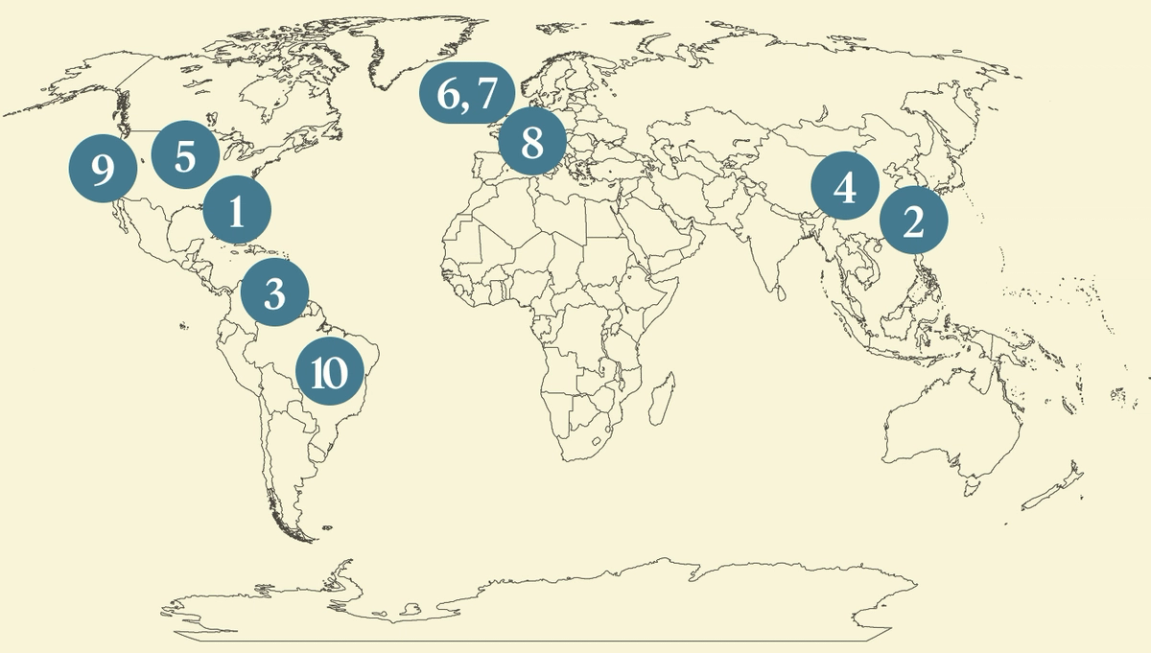 - Zelenskyy-Trump meeting
- China sanctions US firms
- More volatility in 2026
- China’s robotics struggle
- The decline of paperbacks
- Scotch whisky piles up
- Live lobster boiling ban
- Brigitte Bardot dies at 91
- Wikipedia turns 25
- Art heists are back
 A Sotheby’s auction features the “spiritual mother of contemporary Saudi art,” and a Nollywood thriller depicts the very real experiences of people across Nigeria. |
|
Trump, Zelenskyy discuss peace plan |
 Jonathan Ernst/Reuters Jonathan Ernst/ReutersUS President Donald Trump projected both optimism and uncertainty over a Ukraine peace deal before meeting with Ukrainian President Volodymyr Zelenskyy in Florida on Sunday. “We have the makings of a deal,” Trump said, but tempered expectations by suggesting the war with Russia could “go on for a long time.” The two leaders were set to discuss a 20-point proposal that US and Ukrainian negotiators have spent weeks revising, with Zelenskyy hoping to win Trump’s support on two major sticking points: the future of the Donbas region and that of a Russian-controlled nuclear power plant. Zelenskyy said “a lot can be decided before the New Year” but pointed to Russia’s relentless weekend strikes as proof that Moscow “doesn’t want peace.” |
|
China sanctions US firms over Taiwan deal |
 Ann Wang/Reuters Ann Wang/ReutersChina has sanctioned 30 US defense firms and executives after Washington approved its largest-ever weapons deal with Taipei. Northrop Grumman, a Boeing production unit, and the founder of Anduril Industries were among those sanctioned on Friday. But US defense companies seldom do business in China, so the measures mostly signal Beijing’s disapproval and stop “short of a broader escalation,” Bloomberg wrote. The $11.1 billion in arms could “markedly improve Taiwan’s defense capabilities if delivered in a timely manner,” the Institute for the Study of War wrote, though the US has struggled to meet previous timetables. The deal may also reassure US lawmakers concerned by President Donald Trump’s sometimes conciliatory approach toward Beijing, The Wall Street Journal noted. |
|
2026 could be ‘hinge year’ for geopolitics |
 US Navy/Petty Officer 3rd Class Gladjimi Balisage/Handout via Reuters US Navy/Petty Officer 3rd Class Gladjimi Balisage/Handout via ReutersThere are no signs that global volatility will dissipate next year, several analysts projected. Crucial elections defined 2024, and in 2025, US President Donald Trump upended global commerce and intervened in foreign conflicts. 2026 will see a further fraying of norms, a geopolitical risk consultant argued: “The long-term shift to a more anarchic world order is accelerating,” marked by overlapping spheres of influence. 2026 will be “a hinge year” for global power, especially surrounding Venezuela and Ukraine, while Israeli elections could alter Middle East dynamics, a former US envoy wrote. A shipping expert predicted 2026 could be “the year of the tariff consequences,” but a Bloomberg columnist is bullish about the US economy. |
|
China behind in advanced robotics |
 China’s mass production of robots has sparked concerns that it will dominate the global industry, but the country still lags in advanced robotics, The Wire China reported. China has grabbed headlines with its plans to deploy humanoids to help manage crowds at border crossings, and the country’s consumer-grade robot dogs recently hit the domestic market. But when it comes to industrial robots, Japanese and European companies are capturing much of the value, in part because they perform better in premium sectors, while China excels in low-to-medium-end robotics. Beijing may try to prop up the industry, though that risks a price war stemming from overcapacity. Instead, officials might “conclude that such dominance isn’t necessary to accomplish their top-down goals of industrial supremacy.” |
|
Mass-market paperbacks take a hit |
 Photo by Laura Rivera on Unsplash Photo by Laura Rivera on UnsplashThe largest US book distributor will stop trading mass-market paperbacks, with sales down 84% since 2004. The format, invented in the 1930s, was once the most popular in publishing. Printers applied manufacturing techniques used for magazines and newspapers to churn out 4.25-inch-by-6.87-inch books cheaply and quickly. Sales reached 387 million by 1979. Some titles, such as the movie tie-in edition of Jaws, sold millions of copies in months. But numbers have been declining for decades, Publishers Weekly reported, with publishers shifting to larger trade paperbacks, while the pulpy romance and fantasy novels upon which mass-market paperbacks depended have largely moved to ebooks. By 2011, ebook and mass-market sales were roughly equivalent, with ebooks rising fast and paperbacks falling. |
|
Whisky sales keep falling |
 US tariffs, falling demand, and cost-of-living concerns have created a Scotch whisky glut. Global sales fell 2.5% year-on-year in the first half of 2025, a third year of decline after decades of growth. Distilleries have been forced to scale back production or expand warehouses. Alcoholic drinks were not exempted from US tariffs; falling Chinese consumption has hit many luxury industries; and younger people appear to be drinking less than previous generations. The Scotch industry has been through this before, though: In the 1980s, a collapse in demand led to a “whisky loch” of unsold liquor, leading manufacturers to seek new markets such as Japan, Greece, and Spain, the Financial Times reported. |
|
England will ban boiling lobsters alive |
 Chris Helgren/Reuters Chris Helgren/ReutersBoiling lobsters alive will be banned in England under new animal welfare rules. The change follows a report that argued that cephalopod molluscs, such as squid and octopus, and decapod crustaceans like crabs do not simply respond to damage but feel pain as mammals do and should be protected. Other countries, including Norway, Switzerland and New Zealand, have instituted protections for complex invertebrates. England will also make other changes to animal welfare policy, tightening laws on hunting, battery farming, and shock collars. More humane methods of killing lobsters pre-boiling include a sharp knife through the head, electrical stunning, or freezing. |
|
Brigitte Bardot, 91, ‘personified France’ |
 Reuters ReutersBrigitte Bardot, the French actress and international sex symbol who later renounced movies and embraced animal rights activism and far-right views, has died at 91. Bardot’s sultry 1956 breakthrough in And God Created Woman made her one of the world’s most desirable women. Simone de Beauvoir hailed her in 1959 as the face of a changing France. Bardot “personified France in a literal way,” The New York Times wrote: She was the first official face for Marianne, the symbol of the French Republic. But “France’s love affair with Bardot was to curdle,” The Guardian noted; she was fined for incendiary comments about immigration and Islam. In a tribute Sunday, far-right leader Marine Le Pen said Bardot “was incredibly French… free, indomitable, whole.” |
|
 Brendan McDermid/Reuters Brendan McDermid/ReutersWikipedia has become more, not less, trusted in recent decades, one of its founders argued, and should be a model for restoring trust in other institutions. The online encyclopedia turns 25 in January, and has gone from being “a punchline about the unreliability of online information to the factual foundation of the web,” The Verge wrote. During that time, trust in government, media, and business has fallen, surveys have found. Jimmy Wales said Wikipedia’s commitment to transparency — you can see how its decisions are made — and to political neutrality has been key to bucking that trend. The media, he said, often “isn’t representative of broader segments of society and isn’t listening to problems that people are having.” |
|
Art museums are ‘soft targets’ |
 Abdul Saboor/Reuters Abdul Saboor/ReutersA rash of brazen art heists has drawn fascination and prompted the examination of underlying factors. Thieves have recently made off with the Louvre’s imperial jewels, plundered the UK’s Bristol Museum of 600 artifacts, and stolen eight Henri Matisse prints from a Brazilian library. “Hampered by tight budgets and aging infrastructure,” public museums and libraries “have become soft targets,” The Wall Street Journal wrote. An art historian told the BBC that heists “exploded” in the 1970s as more people began to see art “as the equivalent of money.” But regardless of any particular work’s provenance, today’s thieves may be motivated by the soaring value of precious metals. |
|
|


