|



 |
Artificial intelligence adoption is starting to split into two trajectories. Enterprises eager to implement the technology are straining to do so effectively. Their large-scale, ambitious pilots have struggled to get past entrenched organizational habits, new security considerations, and the technology’s limits. Individuals, meanwhile, are gaining access to a new set of powerful tools, like Claude Code, Gemini, OpenAI Codex, and Claude Cowork, and finding results without waiting for permission.
As organizations lag and individuals jump on the technology, an age of individual empowerment, where those who master the tools outpace their peers and employers, seems to be arriving. The divergence will likely create more variability in individual performance than ever before, and push slow-moving enterprises in ways that make them very uncomfortable, fast.
For enterprises, generative AI has the potential to add efficiency to burdensome processes, draw insights from data, and automate some tasks. But as they’ve worked to implement the technology from the top down, they’ve found it hard to break sticky bureaucratic habits, anticipate LLMs’ flaws, and deal with security issues (like what data autonomous AI programs can access). So even for the most AI-interested organizations, the rollout process has often been slow, ineffective, and involved a lot of lawyers.
Individuals, however, are unburdened by many of these same factors. They are in charge of whether to break their own habits, they tend to have access to precise and limited data, they’re adept at spotting and adjusting to LLMs’ flaws in their own domains, and they have fewer legal complications than an enterprise implementing new, still-unpredictable technology.
And now, individuals are gaining access to powerful new tools that should only accelerate this growing trend. Instead of waiting for an organization-wide deployment of a generative AI data analysis tool, for instance, they can now use Anthropic’s Claude Code to analyze a folder of spreadsheets on their desktop and build a dashboard with specialized insights.
Claude Cowork, another tool Anthropic released as a research preview this week, is meant to be used by non-technical knowledge workers for similarly ambitious use cases. The product debuted with a demo of its AI ingesting a series of meeting transcripts and giving advice on how to be more effective in meetings. It also showed the tool searching calendars and preparing custom slide decks. Some reviewers have found it useful for file organization as well.
Increasingly, workplaces will be filled with individuals who use these tools and those who don’t. Those who figure out ways to use them productively are poised to leap out far ahead of their peers. Already in coding, developers run multiple agents at a time and monitor their outputs. The parallels in the rest of knowledge work could lead to a vast gap between the superstars and average performers.
And as enterprises attempt to implement AI effectively, they’ll likely be pushed by high-performing individuals who’ve built prototypes for new products or initiatives that otherwise might not have been possible. This could create some uncomfortable dynamics in the workplace, especially among managers attached to the standard way of operating.
Enterprises may catch up over time, but until they do, the age of individual empowerment is likely to be a defining feature of the AI boom.
Less pain, more gain: Coinbase made investigations 72% faster with AI for prod (Sponsor)
 |
When it comes to production issues, the numbers hurt: 54% of significant outages exceed $100,000 lost. Downtime cost the Global 2000 ~$400 billion annually.
Coinbase, DoorDash, Gametime, and Zscaler use Resolve AI to get to root cause 72% faster, pull in 30% fewer engineers per incident, and optimize costs by analyzing usage, spend, and telemetry volume across Kubernetes, cloud, and observability tools.
Engineering teams like Coinbase started with our AI SRE to provide real-time root cause analysis and prescriptive remediation. From there, teams leverage Resolve AI across production systems to optimize brownfield development, increase release readiness, and fix that new code from Claude before it ever hits prod.
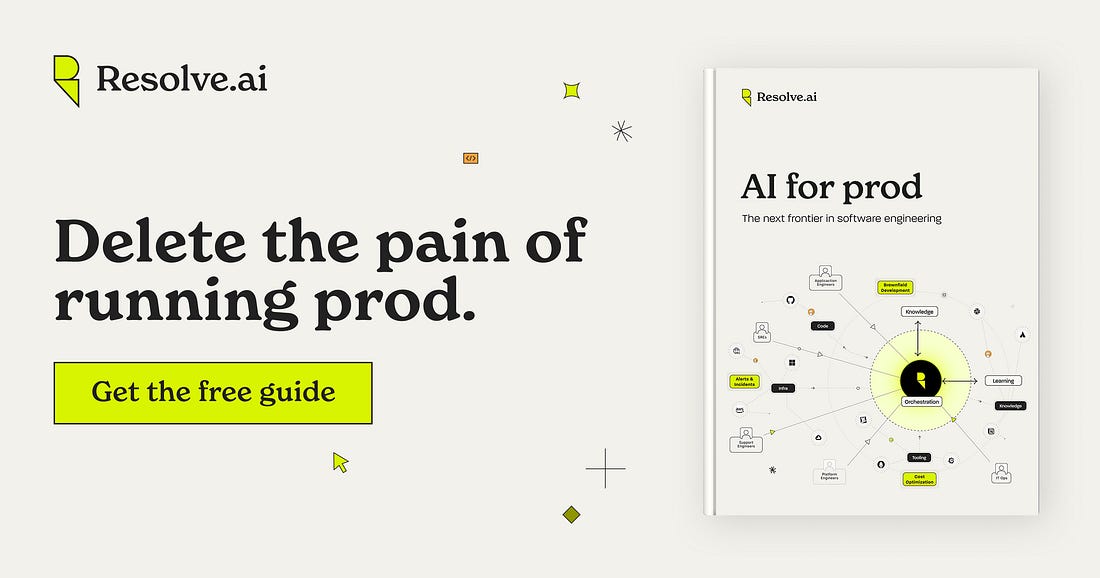
Join our upcoming fireside chat with MSCI and SoFi executives leveraging AI for prod or download the free AI for prod evaluation guide to learn more about how multi-agent systems change engineering workflows.