| Welcome, Weekenders! In this newsletter: |
| • The Big Read: Why “cracked engineers” are hot items in Silicon Valley |
| • The Top 5: The best LinkedIn ghostwriters |
| • Plus, Recommendations—our weekly pop culture picks: “A Whole Other Country,” “The Boys From Brazil” and “Industry” |
| |
| Thanks to AI, Silicon Valley has enjoyed an absolutely wild past couple of years. I’ve written words and phrases like “revolution,” “mania” and “unconscionable amount of money” into countless stories. The explosion in AI produced 50 new billionaires last year, and that’s just counting the easily identifiable ones. Dozens of startups have accumulated, well, unconscionable amounts of money, promising to apply AI to dozens of fields—from healthcare to law to weapons to city zoning permits. |
| As revolutions go, though, this one may have a duller ending than I might’ve once thought or hoped. (Shudder. Journos, by nature, do not like anything remotely boring.) I’m expressing this thought out loud because increasingly it seems like much of the technological advancement—and ultimate revenue—from this great boom time will get consolidated into the hands of the industry’s old guard. |
| There’s no way to look at Google and Apple’s freshly announced second marriage and think otherwise. Google has, of course, been the default search engine for Apple since the early 2000s, and now a new partnership will see Apple using Google’s AI to power its own AI features, including a long-awaited Siri revamp. The deal adds to a very real sense of renewed momentum for Google after its initial slow start in AI and follows the significant release of Gemini 3, a model that seems to have outdistanced everyone else’s AI. |
| As Google has powered ahead, the outlook for OpenAI, the poster child of AI startups, has gotten noticeably cloudier in recent weeks—a real change. A year ago, OpenAI had just announced a deal to let ChatGPT supply answers to Siri and largely owned the conversation around consumer AI, rolling out features that reliably captured the zeitgeist. It was hard to imagine Apple would really go with any other company if it finally cried uncle and sought out outside help with its AI. That was then, though, and just on Tuesday, The New York Times ran an op-ed headlined “This Is What Convinced Me OpenAI Will Run Out of Money.” Eesh! |
| Look, I have no special insight into the state of OpenAI’s balance sheet, and it’s certainly a little facile to write off a company based on the events of a short time frame—especially when it exists within an industry defined by tumult and hairpin turns in sentiment. But it is hard to look at OpenAI’s propensity to attract drama that must be at least a little distracting internally—as it did again on Wednesday with a high-profile poaching from Thinking Machines Lab—and think everything’s rosy. |
| So what happens if Google really does end up running away with AI? John Coogan from “TBPN” posited a fun but somewhat complicated theory this week that agentic shopping will evolve, and rather than Apple paying Google for AI models, Google will end up paying Apple just as it does in its longstanding search deal. Another scenario could bring at least a smidgen of the newsy excitement I crave: a fresh antitrust case against Google’s parent company, Alphabet. Think about it—between Android phones and iPhones, Google might arguably have a real stranglehold on how people access AI. It’s not hard to picture some future version of the Justice Department, operating in an era of populist sentiment against AI, deciding to take another crack at Alphabet. |
| What else from this week… |
| • The word “podcast” really should just be taken out behind the shed and shot: It deserves a far less cruel death than the one it’s suffering at the moment—as companies like YouTube, Spotify and Netflix call everything and anything a podcast. The latest example is Pete Davidson’s TV talk show on Netflix. Or, as Netflix terms it, a “video podcast,” which, you know, isn’t available on any traditional podcast platform. (The Economist calls this unfortunate new era “the age of the vodcast.”) |
| • Revenue from Apple News may quietly be keeping the lights on at more media companies than I might’ve guessed. |
| • I like this thought, even though I don’t have a toddler attached to my hip: Making yourself constantly available to work fries your brain as much as parenting a small child. |
| • Arguably taking us three grownup-size steps closer to “Gattaca,” a fertility startup has used embryo-making robots to produce 18 babies. |
| • Anthropic has scored a ChatGPT-like moment with Cowork, which seems to have pretty effectively distracted everyone from its OpenAI-like leadership shake-up.—Abram Brown |
| |
|
|
 |
|
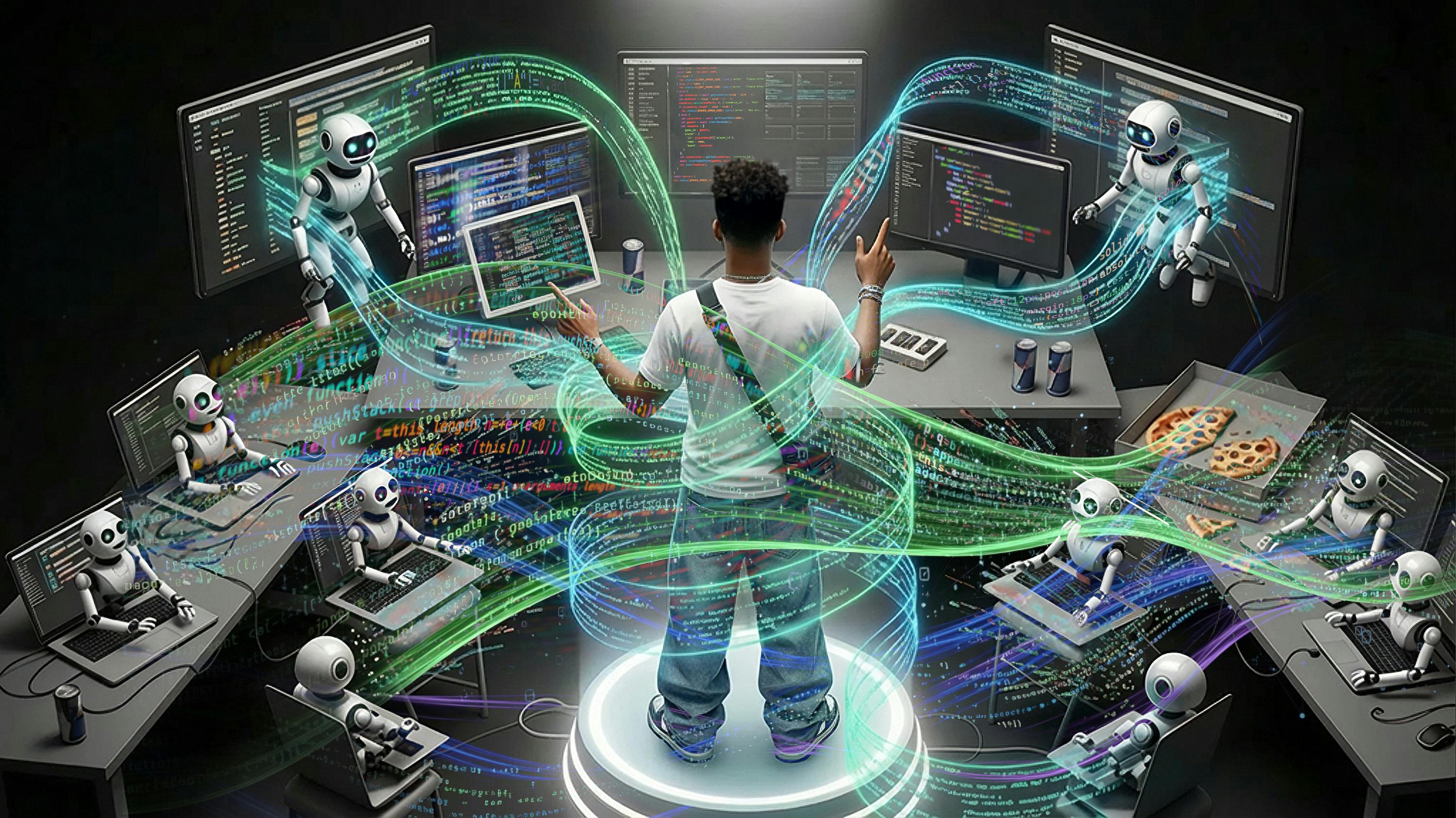
| The AI era has upended Silicon Valley, and among the most significant changes are the alterations to a bedrock profession within tech: software engineering—the coders who help turn ones and zeros into billion-dollar companies. |
| There’s been a proliferation of AI tools that automate many coding tasks, giving rise to the concept of vibe coding, an idea that describes how someone with little technical knowledge can use those programs to code more extensively than ever before. But startup founders eager to jump into the period’s mania have seized on a different archetype: the “cracked engineer,” a young, scrappy, workaholic coder with strong enough technical skills to do a wide range of coding tasks, our Rocket Drew reports in Weekend’s latest Big Read. |
| The buzz phrase has become a social media meme and an obsession among founders and investors, presenting something of a pushback against the enthusiasm for vibe coding, which often produces error-ridden code that still requires human expertise to catch mistakes. From another perspective, the label has come to broadly apply to the latest generation of young people to flock to the Bay Area—the youngest, hungriest part of Generation Z within Silicon Valley. |
|
 |
|
| Once just a humble repository of digital résumés, LinkedIn is today an immensely attractive destination for self-burnishment, and it’s become a key platform for the tech elite eager to bolster their image and reputation. In fact, they’re so eager to achieve LinkedIn stardom that many technorati are paying ghostwriters to craft their posts and personas, and our Jemima McEvoy is here to highlight several of the agencies providing such services for anyone interested in being a Richard Branson-type on LinkedIn. |
| Abram Brown is the editor of The Information's Weekend section. You can reach him at abe@theinformation.com or find him on X. |
| |
 |
| Listening: “A Whole Other Country” |
| Way out in West Texas’s Davis Mountains in the 1990s, an Ohio native, onetime winemaker and amateur homesteader named Rick McLaren stubbornly refused to let his past failures limit his ambitions, so he decided to secede from the U.S. and start his own country: the Republic of Texas. Perhaps unsurprisingly, his plans didn’t work out as he’d hoped: His heavily armed followers split into factions—then the authorities arrived, unhappy about McLaren’s militarized bid for independence. |
| As a latter-day frontier outlaw, McLaren is tumbleweed-scented catnip for journalists like Marfa Public Radio’s Zoe Kurland, host of “A Whole Other Country.” Ostensibly, she sets off to recount McLaren’s insurrection, but as she speaks with the people who knew McLaren and still live in that neck of the woods, she finds that he was only an extreme example of the shoot-first, live-free mindset many of those folks hold. She also stops to ask why so many people end up determined to do what she terms “cowboy cosplay.”—Abram Brown |
| Reading: “The Boys From Brazil” by Ira Levin |
| Over the holidays, I traveled through Brazil and Argentina, and feeling like I’d enjoy a thriller set in that part of the world as I went along, I prompted Gemini for some suggestions and picked up this 1976 novel by Ira Levin, a suspense maestro. |
| Now, look, I’m hardly likely to be here talking up a book that reads like a discarded artifact I pulled off the jungle floor. Rather, I consider “The Boys From Brazil” a real blast-from-the-past treat—an adventure full of Nazis, Nazi hunters, worldwide conspiracies and, uh, advanced biotech, which proceeds at the pace and precision of a V2 rocket. |
| When “The Boys From Brazil” initially came out, it was yet another bestseller for Levin, but it has faded from memory more than his better-known work: “Rosemary’s Baby” and “The Stepford Wives,” both of which, yes, became hit films. (Hollywood also adapted “The Boys From Brazil” but had far less luck with it.) Nonetheless, Levin’s sci-fi–ish potboiler retains a remarkable modern-day relevancy, as its characters grapple with the ethics of genetic engineering and the question of whether we’ve evolved enough since World War II to avoid falling for strongman leaders. Levin was pessimistic on both subjects, and I’m glad he didn’t ever find a way to unnaturally extend his existence, because I doubt he’d find much more reason for optimism today.—A.B. |
| Watching: “Industry” |
| “Industry” has never really trafficked much in subtlety, and as the HBO series enters its fourth season, it seems very determined to do a couple bumps of K and turn up even more. It’s all very enjoyable. This latest season starts a year after the sale of fictional investment bank Pierpoint scattered the series’ characters to the wind, each of them pursuing new endeavors with a good amount of bleary-eyed debauchery in London and New York. (The ensemble cast is terrific and continues to be reliably helmed by the mononymous Myha’la, Marisa Abela and Ken Leung. It also features some big names, including Kit Harington and newcomer Kal Penn.) “Industry” began to branch out into tech land last season, and it now jumps fully into our world, with much of season four’s plot revolving around a political debate over online regulation and a nefarious fintech, Tender, going through an identity crisis. (As one board member describes it, the startup exists in an uncomfortable position as the “PayPal of bukkake.”) As always, the story manages to walk a tightrope between high and low—between boardroom peril and bedroom titillation. In the premiere episode, for instance, a CEO gets ousted, a fund’s short nearly explodes and a main character dons a giant strap-on sex toy. Like I said, it’s not subtle.—A.B. |