|


 |
The biblical story called the Judgement of Solomon isn’t just meant to illustrate what a wise king Solomon was. It’s also supposed to demonstrate a central principle of economics, and of society in general — that the world isn’t a fixed lump of resources waiting to be divided up. In the story, two women are arguing over which one is the real mother of a baby; Solomon proposes to cut the baby in half and give half to each woman, causing the baby’s actual mother to be instantly horrified. The lesson is that a baby is much more than the sum of two halves of a baby.
I feel like modern American leaders and intellectuals often forget this important lesson. There are plenty of thinkers and leaders on both the right and the left who think of society’s main task as slicing up and handing out a lump of “resources”. And yet when they make economic policy based on this idea, it keeps failing.
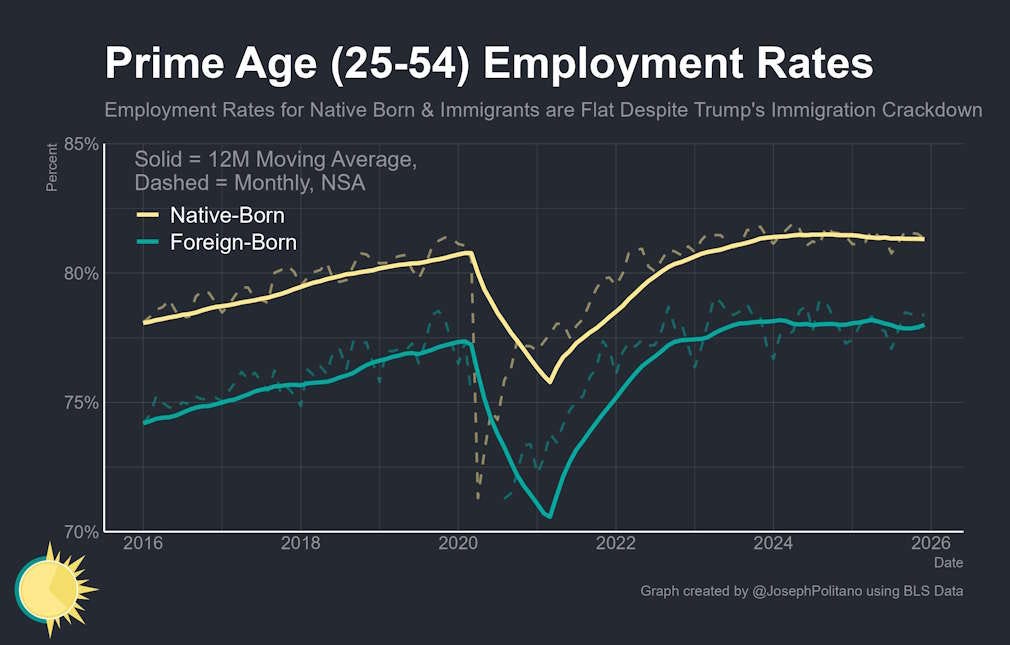
A prime example is Trump’s immigration crackdown. During the 2024 presidential campaign, Trump and his people swore up and down that kicking millions of illegal immigrants out of the country would result in a bonanza of jobs for the native-born. They probably still believe this. But people are now flowing out of the United States on net, and native-born employment rates haven’t risen:
 |
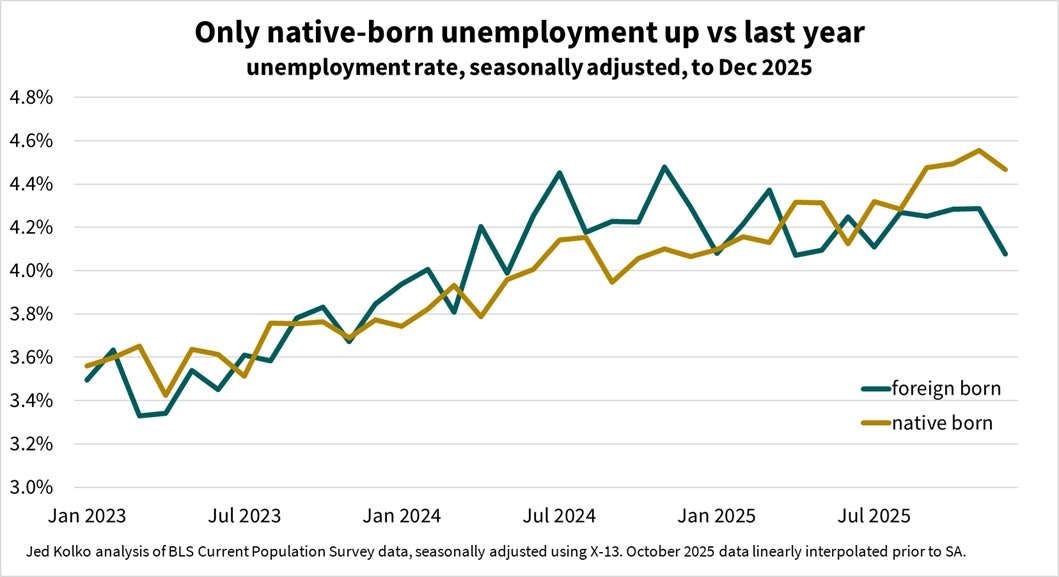
In fact, native-born unemployment has risen, even as immigrant unemployment has fallen slightly:
 |
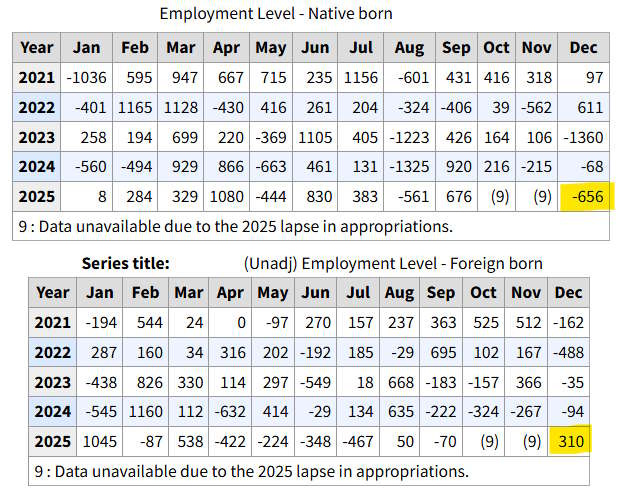
This isn’t just because immigrant laborers are becoming more scarce, either. In fact, despite Trump’s successful crackdown, the number of jobs held by immigrants actually rose in December, while the number of jobs held by native-born Americans fell:
 |
If the Trump administration had bothered to ask economists, they would have replied that the overwhelming majority of the empirical evidence indicates that immigration — even low-skilled immigration — doesn’t take jobs from Americans. Immigrants also produce goods and services, growing the pie and creating labor demand that helps provide work for native-born workers. But the only economist they seem to have bothered to ask was George Borjas, a man who has spent his life unsuccessfully trying to prove that immigration is bad for America. The new jobs numbers illustrate the failures of Borjas’ zero-sum economics.¹
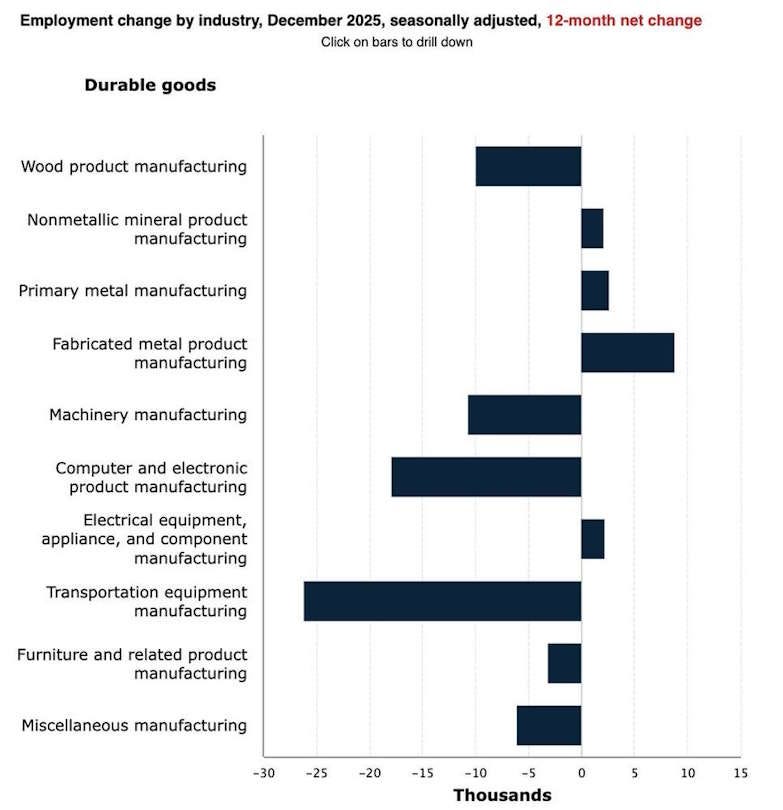
Tariffs are another example. Trump and his people swore that tariffs would bring manufacturing jobs back to America, by reducing foreign competition. But while we do see a few heavily protected industries like steelmaking adding jobs, most manufacturing industries in the U.S. are hemorrhaging workers:
 |
Joe Weisenthal notes how broad the pain in American manufacturing is:
It's not just that total manufacturing employment is shrinking. The number of manufacturing sub-sectors that are adding jobs is rapidly shrinking. Of the 72 different types of manufacturing tracked by the BLS, just 38.2% are still adding jobs. A year ago it was 47.2%.
If the admin