|
|
|
Newsletter continues after sponsor message
|
|
|
When you reach a certain age, you want to nurture someone or something, my friend Mona said, snuggling her fluffy Maltese.
For my 40th birthday I was thinking about getting a dog. But an increasing number of my peers – single women in their 40s – are having human babies.
“Becoming a mother is a marker of adulthood for these women,” says Rosanna Hertz, author of the book Single By Chance, Mothers by Choice. "There is a sense that I'm now ready to do something that is selfless, that involves the care and nurture of another human being and be part of a broader community," she says.
As NPR’s Pallavi Gogoi reports. Births to unmarried women in their 40s have risen by 250% in the last 30 years, many without partners.
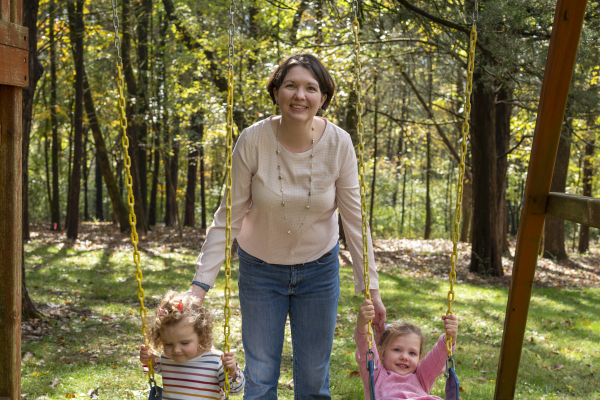
Laura Terry of Nashville, Tenn. dreamed of having kids, but had no interest in marriage or a romantic partner. In her late 30s, Terry read a book where the author described her journey with in vitro fertilization and “a lightbulb went off,” she says. On her 39th birthday, she bought a vial of sperm. Now 44, Terry is the mother of two girls, ages 2 and 4.
Terry says that while being a solo caregiver and decision-maker can be daunting, she treasures the sweet moments she shares with her kids. "I love moments where they say, 'Mama, I need a snuggle.' Just holding them for a minute or two and seeing how that calms them is really, really powerful,” Terry says.
Terry's IVF procedures were covered by her health insurance, but costs can range from $15,000 to over $30,000 for each attempt at a pregnancy. Women who conceive using reproductive technologies tend to be highly educated with higher incomes.
Based on her research, most women who want a family would rather do it with a partner, says author Rosanna Hertz. One of those women was Kate Snyder, who lives in northern New Jersey and has a 2 year-old daughter. For her, becoming a single mom by choice came with a reframe: "Once I came to terms with the fact that the father of my child doesn't have to be the person I end up with, and you separate the two, it's very freeing," she says. "And it just took the pressure off."
Learn more about what it’s like to be a single mother by choice, after 40.
Also: The cost of IVF: How far did you go to pay for your fertility treatment?
IVF has reshaped who gets to be a parent today. But the process is complex and expensive, often involving multiple attempts. It’s why IVF is out of reach for many. To pay for it, some go into debt, dip into retirement or take a second job.
If you've used IVF, we'd like to hear the story of how you paid for it — and possibly feature it on NPR. Share your story here, and a reporter may reach out to you. And thanks.
And: South Korea has the world’s lowest fertility rate, as young adults struggle with affordability |
|
The Facts are PowerfulIn an age of fake news and disinformation, NPR strives to amplify the truth. Your financial support ensures our journalists can stay on the ground, uncovering the facts and reporting on the truth. Can you donate today? |
|
|
|
Purely for research purposes I asked Chat GPT if I'm a good writer. As a sample, I fed it a story I wrote for NPR last spring about seasonal allergies.
It offered a few helpful points of critique, couched in gentle language. But mostly it was gushing. The AI concluded with “That’s not just ‘good writing.’ That’s professional, mature, trusted writing—the kind editors rely on and readers come back for.” Wow, guess I deserve a raise 😝.
Chat GPT and other AI chatbots are programmed to be sycophantic, meaning they tell you more or less what you want to hear, with the goal of keeping you on the platform.
But now imagine a middle school student asking a chatbot for feedback on a paper and getting a fawning response. They might not take it with the heaping tablespoon of salt it deserves.
This echo-chamber effect is one of a number of concerns cited in a study by the Brookings Institution about the use of AI in K-12 education, as NPR’s Cory Turner reports. If children are building social-emotional skills largely through interactions with chatbots that were designed to agree with them, "it becomes very uncomfortable to then be in an environment when somebody doesn't agree with you,” says Rebecca Winthrop, one of the report’s authors. The report warns that interactions with chatbots could stunt children’s emotional growth.
AI can negatively affect cognitive development too – providing instant answers that allow students to bypass the brain work of getting through a problem, according to the Brookings report. There’s evidence that students who use generative AI are already seeing declines in content knowledge, critical thinking and creativity.
Still, the report found some significant upsides to using AI in schools. Teachers told researchers that AI helps students with language acquisition. For instance, it can adjust the complexity of a passage depending on a reader’s skill. AI can help students draft their writing and organize an essay, as long as they don’t use it to write the essay for them. Teachers also report that AI is helping them be more efficient outside of class time, making it easier to email parents, create worksheets and more.
The report also suggests a series of recommendations for parents, teachers, lawmakers and tech companies. They include passing regulation to protect students’ mental health and privacy, training teachers and students in AI literacy, and designing chatbots to challenge kids more instead of agreeing with them.
Here’s more on how researchers are thinking about the impact of AI on school kids, and the guardrails they want put in place.
Plus: 1 in 5 high schoolers has had a romantic AI relationship or knows someone who has |
|
Brian van der Brug/Los Angeles Times |
|
Exercise is as effective as medication in treating depression, study finds
Workers who cut countertops are getting sick with lung disease. Some lawmakers want to ban their lawsuits
Marrying for health insurance? The ACA cost crisis forces some drastic choices
Listen: When is your brain actually all grown up? (It’s later than you think!) |
|
We hope you enjoyed these stories. Find more of NPR's health journalism online.
All our best,
Andrea Muraskin and your NPR Health editors |
|
Listen to your local NPR station. |
|
Visit NPR.org to find your local station stream. |
|
|
| |
|
|
|
|
|
|
|
|
You received this message because you're subscribed to Health emails. This email was sent by National Public Radio, Inc., 1111 North Capitol Street NE, Washington, DC 20002
Unsubscribe | Privacy Policy |
 |
|
|
|
|
|
|
|