|
 |



The Justice Department remains wildly out of compliance with the Jeffrey Epstein transparency law Congress passed last year—but don’t expect the House Republicans who voted for the bill to make too much of a stink about it. “I don’t give a rip about Epstein,” Rep. Lauren Boebert (R-Colo.) told Politico last week. “I’ve done what I had to do for Epstein. Talk to somebody else about that. It’s no longer in my hands.”
Way too much weekend news for us to go dark for the holiday—but we hope you enjoy a pleasant Martin Luther King Jr. Day today. Happy Monday.
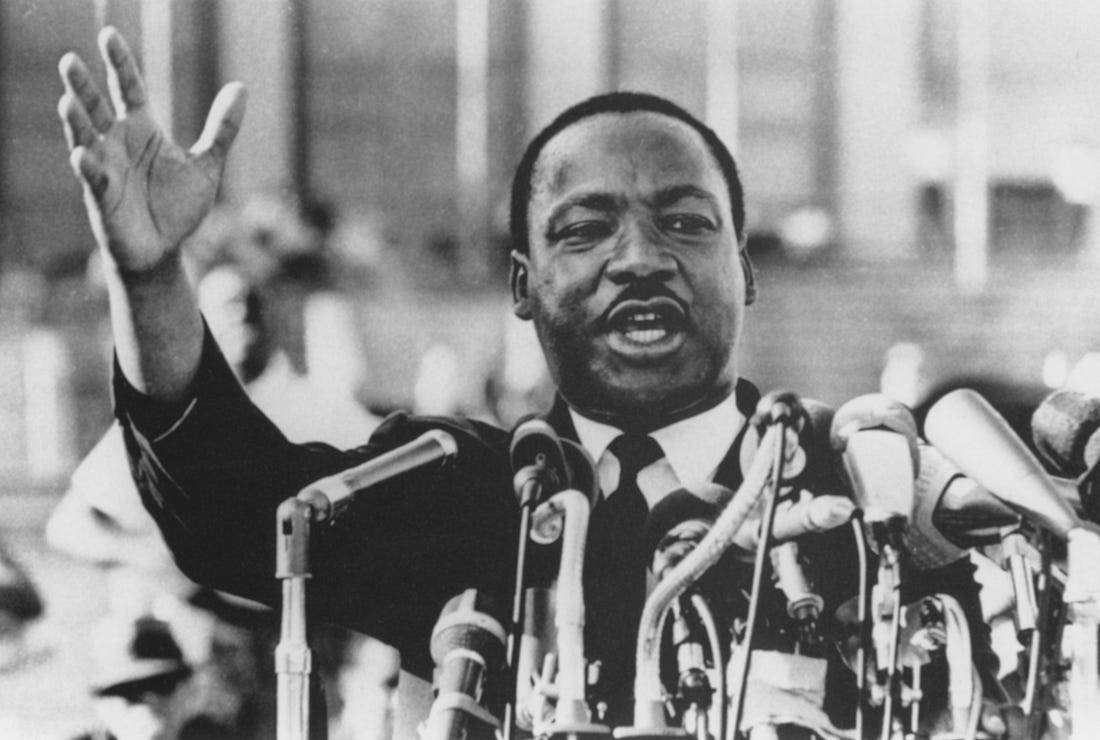 |
Honoring MLK Today
by William Kristol
On November 2, 1983, President Reagan signed legislation officially proclaiming the third Monday in January a federal holiday in honor of Martin Luther King Jr.’s life and legacy.
So far as I can tell, our current president has issued no statement this year in recognition of Martin Luther King Jr. Day. Indeed, this administration’s only notice of the day seems to have come in late November of last year, when it announced that it had eliminated this holiday from the list of days with free entry to America’s national parks.
So if you go to a national park today, you’ll have to pay. But not if you go on June 14th, 2026. For Donald Trump’s Interior Department has announced that the schedule of “resident-only patriotic fee-free” days will include for the first time that date billed as “Flag Day/President Trump’s birthday.”
So petty. So pathetic.
Still, Martin Luther King Jr. Day remains a federal holiday. There is no federal holiday honoring the current occupant of the Oval Office. I trust there never will be. And it is heartening that the United States is still a country that, by law and consensus, honors King and not Trump.
If you want to reflect on real American patriotism and greatness, you might take a few moments today to read about the life and achievements of King and the civil rights movement he led. You might particularly find it worthwhile to read some of King’s own writings, and to listen to or watch some of his own words.
You might focus on the year 1963. In April of that year, he wrote his great “Letter from a Birmingham Jail” defending nonviolent civic action and expressing grave disappointment with the self-proclaimed “moderates” who in recent years had been reluctant to join wholeheartedly in the fight against injustice.
Of course, you ought to watch the magnificent “I Have a Dream” speech at the Lincoln Memorial in August 1963, one of the great speeches in American history. The “I have a dream” peroration is justly famous, but the whole speech—it lasts less than 20 minutes—is very much worth watching.
Just three weeks after that, King delivered a beautiful eulogy for the four young girls killed in the bombing of Birmingham’s Sixteenth Street Baptist Church—“unoffending, innocent, and beautiful . . . victims” of violence, the “martyred heroines of a holy crusade for freedom and human dignity.”
For what he had accomplished in his still short life, King was awarded the 1964 Nobel Peace Prize. In his acceptance speech, he emphasized that “I accept this award today with an abiding faith in America and an audacious faith in the future of mankind. I refuse to accept despair as the final response to the ambiguities of history.”
He added that,
Today I come to Oslo as a trustee, inspired and with renewed dedication to humanity. I accept this prize on behalf of all men who love peace and brotherhood. I say I come as a trustee, for in the depths of my heart I am aware that this prize is much more than an honor to me personally.
. . .
I accept this award in the spirit of a curator of some precious heirloom which he holds in trust for its true owners—all those to whom beauty is truth and truth beauty—and in whose eyes the beauty of genuine brotherhood and peace is more precious than diamonds or silver or gold.
The contrast in human spirit between the 1964 Nobel Prize recipient and the current wannabe winner in the Oval Office speaks for itself.
This year will mark our 250th birthday as a nation. The current administration will do everything it can to vulgarize and personalize the celebration. There will be much talk of American greatness and little evidence of it. But all the shouting and strutting won’t be able to conceal the fact that the malevolent charlatans who now dominate our national stage will sooner or later—and I trust sooner—be left behind, unlamented discards on the ash heap of history. Whereas the memory of the life and legacy of Martin Luther King Jr. will live on.