Kazakhstan oil woes weigh on market

Global news you can trust.

Download the Reuters App.


Power Up

Power Up


A Reuters Open Interest newsletter

By Ron Bousso, ROI Energy Columnist


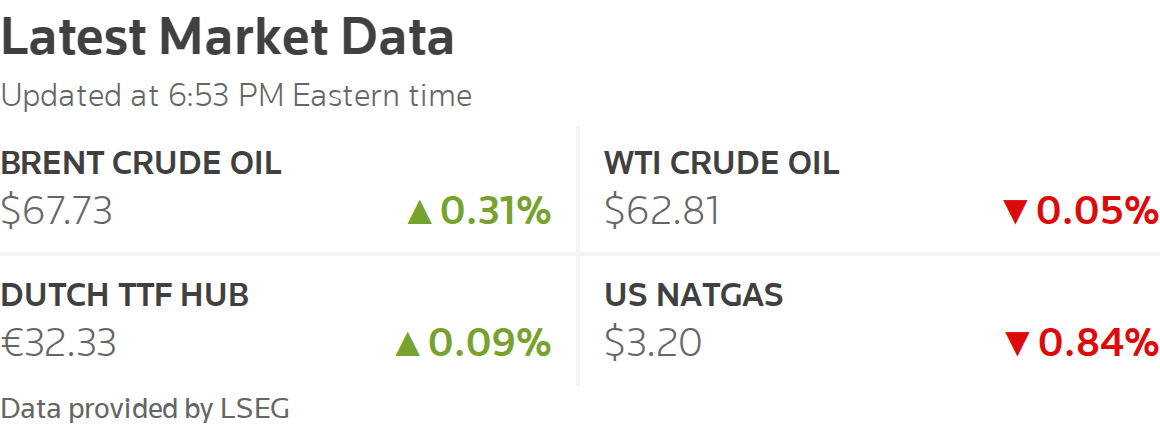
Data refreshes every time you open this email. For more energy news, click here. Please send any feedback to powerup@thomsonreuters.com.

Hello dear Power Up readers,

While I couldn’t reuse last week’s headline – ‘another week, another country’ – the sentiment still holds. Iran may have been the world’s focus last week, as expectations of U.S. intervention sent crude prices above $66 a barrel, but prices are back down near $62, and investor attention has shifted westward.

Move over Venezuela and Iran, it’s Greenland’s week.

President Donald Trump’s threat to impose a 10% tariff from February 1 on several European countries over their opposition to the U.S. buying Greenland risks sparking a painful trade war between the two major trade zones.

Indeed, European Union ambassadors agreed on Sunday to prepare retaliatory measures against Washington. While Greenland, unlike Venezuela and Iran, isn’t an oil and gas province, a standoff regarding it could have significant impact on economic activity and, subsequently, on energy demand and trade.

What’s more, Europe remains the biggest buyer of U.S. liquefied natural gas (LNG), creating vulnerabilities for both powers.

President Trump will be speaking at the World Economic Forum in Davos, Switzerland on Wednesday, where he will also hold a number of talks with European leaders. Stay tuned.

Here are a few more headlines:

  • Oil major Shell is exploring potential options to sell its 40% stake in the $29 billion LNG Canada project, Reuters reported on Friday. The LNG project on Canada’s Pacific coast is a flagship project for Shell, the world’s largest trader of the chilled fuel.
  • China's mostly coal-based thermal power generation fell in 2025 for the first time in 10 years, government data showed on Monday, as growing renewable generation supported rising electricity demand even as overall power usage hit a record.
  • Staying with China, LNG imports in 2025 are forecast to decline for the first time in three years on weak industrial demand and strong domestic and piped gas supply, according to revised forecasts from five research firms.

As always, don’t hesitate to contact me at ron.bousso@thomsonreuters.com or follow me on LinkedIn with any questions or thoughts.


Top energy headlines

  • Peru state oil firm workers kick off three-day strike over privatization plan
  • Oil steadies as Iran supply fears ease and Greenland moves into spotlight
  • Bolivia pledges to honor energy, lithium deals to reassure investors
  • Russia's oil and gas budget revenue set to sink 46% in January, Reuters calculations show
  • Renewables push China's fossil‑fuelled power into first annual drop in 10 years

Black Sea tensions

Away from icy Greenland, things are heating up in the Black Sea, which is once again a focal point in the war in Ukraine, nearly four years after Russia’s full-scale invasion of its western neighbour.

On Monday, Kazakh oil producer Tengizchevroil, a consortium led by U.S. oil giant Chevron, temporarily halted production at the giant Tengiz and Korolev oilfields after a fire at a turbine transformer affected power distribution systems. The cause of the fire is still unknown.

Oil production at Tengiz averaged about 860,000 barrels per day in 2025, according to Reuters calculations, which alone represents 0.8% of global production. This suspension of oil production at Kazakhstan's largest fields further complicates matters for the OPEC+ producer, which has already faced export bottlenecks and drone attacks on energy infrastructure and vessels. Drones struck two oil tankers in the Black Sea last Tuesday, including one chartered by Chevron, as they sailed towards the port of Novorossiysk. Russian terminals on the Black Sea handle more than 2% of global crude. Its waters, which are shared by Bulgaria, Georgia, Romania and Turkey, as well as Russia and Ukraine, are also crucial for the shipment of grain.

The drone attacks came days after U.S. forces seized a Russian-flagged vessel in the Atlantic.

There is no indication that Monday’s fire is linked to the escalating tensions between Russia, Ukraine and the United States. But the supply disruption and heightened risk are certainly increasing jitters in a markets that’s already on edge.


Get full access to Reuters.com for just $1/week. Subscribe now.


Sponsors are not involved in the creation of newsletters or other Reuters news content. Advertise in this newsletter or on Reuters' website

LiveIntent Logo
AdChoices Logo
 

Power Up is sent twice weekly. Think your friend or colleague should know about us? Forward this newsletter to them. They can also sign up here.

Want to stop receiving this email? Unsubscribe here. To manage which newsletters you're signed up for, click here.

This email includes limited tracking for Reuters to understand whether you’ve engaged with its contents. For more information on how we process your personal information and your rights, please see our Privacy Statement.

Terms & Conditions


© 2026 Thomson Reuters. All rights reserved.

3 Times Square, New York, NY 10036

FacebookInstagramX