|
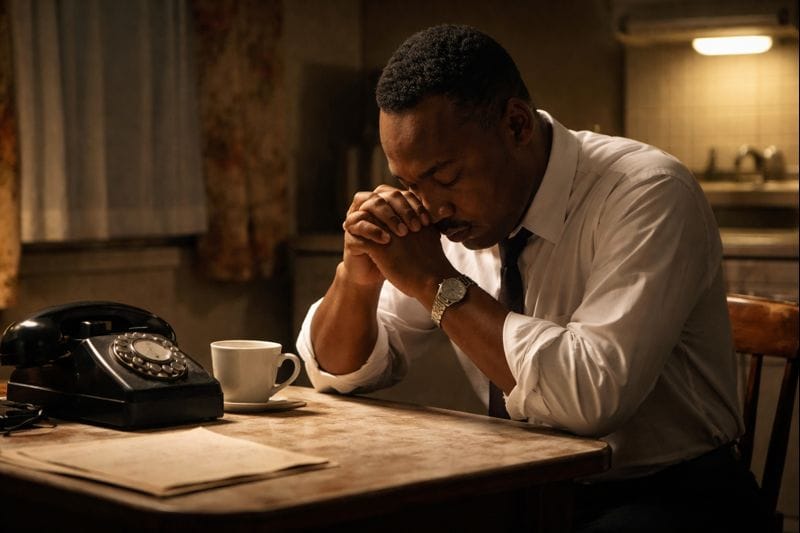
Today we celebrate the life of Martin Luther King Jr. — one of the greatest Americans who ever lived. It is a national holiday, and rightly so. I must admit that I didn’t always agree with making the third day in January a national holiday. I had read and been moved by King’s powerful “Letter From Birmingham Jail” — one of the great documents in American history. But I also had read about his moral transgressions — his adultery and plagiarism. We all have feet of clay. But, before reading about his life, I didn’t fully understand how his Christian faith and worldview and his strategy of non-violent civil disobedience had so profoundly changed the soul of America, shaming the nation to change from its legacy of racism and injustice. Perhaps most importantly, I didn’t know about the extraordinary courage that King exemplified in his life, in the face of almost weekly threats of assassination. The following is a prime example of his courage. King arrived as a pastor in Montgomery, Alabama shortly before the famous bus boycott launched by Rosa Parks in December 1955. Not long after the boycott began, King gave a powerful, prophetic speech to thousands of blacks who had assembled in and around the Holt Street Baptist Church. It catapulted him into the leadership of the protest. King was elected president of the Montgomery Improvement Association, which led the boycott, which lasted more than a year before a federal court order ended race segregation on the buses. King went to jail during the boycott — the first of 29 times during his brief life. Three or four months into the bus boycott, the telephone rang one night at midnight. At the time, King was young — only 26 — and he was married and had one child. The caller said: “We are tired of you and your mess now. If you aren’t out of this town in three days, we’re going to blow your brains out and blow up your house.” As King told the story later, he said he was scared. He wanted out — to leave town, to go back to Atlanta, where he was from. He wanted safety. What did he do? He fell to his knees and prayed: “Lord, I’m here trying to do what is right. I think that I’m right; I’m weak now; I’m faltering; I’m losing my courage. And I can’t let the people see me like this because if they see me weak and losing my courage, they will begin to get weak.” Then he said that the Holy Spirit spoke to his soul: “Martin Luther, stand up for righteousness, stand up for justice, stand up for truth. And lo, I will be with you, even until the end of the world.” King repeated this story many times and always said that these words were the strength that sustained him over the next 12 years. Sometime later, King’s home was, in fact, dynamited; he was at his church, but his wife and small baby were in the house. By the grace of God, they were not harmed. His father pleaded with him to give up the leadership of the bus boycott, and he even got the president of Morehouse College, King's alma mater, to ask him to stop and come back to Atlanta. But King refused. In Montgomery, he later said, “If someone has to die, let it be me.” He stayed in Montgomery throughout the bus boycott, not leaving until 1960, when he became co-pastor of his father’s church in Atlanta. In November 1963, when King learned that President John Kennedy had been shot, he was with his wife, Coretta, at their home. They prayed for Kennedy. When King learned that Kennedy had died, he was silent for a long time, and then said, “This is what’s going to happen to me.” When King was at Selma for a voting-rights campaign in early 1965, the U.S. Attorney General, Nicholas Katzenbach, called him to tell him that the Justice Department had just learned about a failed attempt on his life. King was by now accustomed to death threats, but he said that he had been getting a large number of them recently. By late 1967, in Miami, there were death threats that were so credible that the FBI stood guard constantly at his hotel room for days, and he went out of his room only with security guards. Months later, he was gone, killed by an assassin in Memphis. Perhaps the best book written about Martin Luther King Jr. is Jonathan Eig’s superb 2023 biography King: A Life. It describes not only his vision and moral and physical courage, but also what a heroic Christian leader King was. Like Washington and Lincoln, King changed the face of America for the better. Like them, he is quoted often by “the better angels of our nature.” One of his greatest lines was in the speech he gave in Montgomery at the conclusion of the March from Selma in 1965: “The arc of the moral universe is long, but it bends towards justice.” Indeed, over 400 years, the arc has bent towards justice in America — sometimes slowly and sometimes quickly. May it continue. Today we thank God for the life of Martin Luther King Jr., one of the greatest men that this country has ever produced. He changed the face of America to live up to its promise, encouraging us all “to judge people not by the color of their skin but by the content of their character.” May we always do so. Robert H. Bradley is Chairman of Bradley, Foster & Sargent Inc., a $9.1 billion wealth management firm with offices in Hartford, Connecticut; Wellesley, Massachusetts; and four other locations. He is the founding chairman of the Massachusetts Family Institute and currently serves as its vice chairman. Read other articles by him here.
|