LNG market catches a cold

Global news you can trust.

Download the Reuters App.


Power Up

Power Up


A Reuters Open Interest newsletter

By Ron Bousso, ROI Energy Columnist


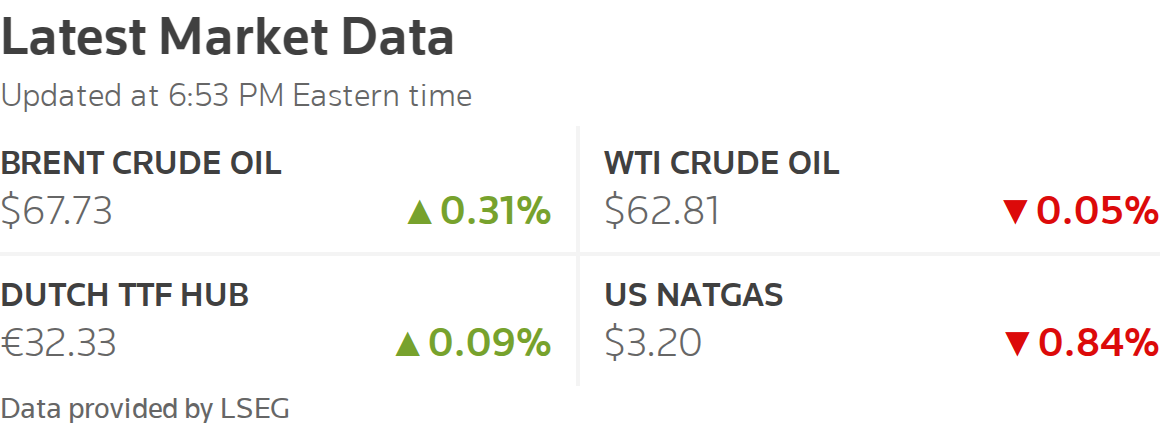
Data refreshes every time you open this email. For more energy news, click here. Please send any feedback to powerup@thomsonreuters.com.

Hello Power Up readers,

The massive winter storm sweeping across the eastern U.S. has left tens of millions of Americans hunkered down amid fierce blizzards and bitter cold. Power plant outages surged along the East Coast and Mid-Atlantic as constricted natural gas supplies and frigid temperatures cut the electricity output from the country’s largest regional grid.

The PJM Interconnection, which serves 67 million people, reported nearly 21 gigawatts of generation outages yesterday, representing about 16% of its Sunday afternoon demand.

Over the past two weeks, concerns that the freezing conditions would restrict gas output caused benchmark U.S. natural gas prices to nearly double to $6.20 per million British thermal units (mmBtu), the highest since December 2022.

The concerns were warranted. U.S. dry gas production plummeted in recent days below 100 billion cubic feet per day for the first time since May 2024, hitting the lowest level since late 2022 on Monday, according to LSEG data.

Importantly, this spike in U.S. gas prices has reverberated overseas as well, leading to sharp increases in European and Asian markets, underlining the growing globalization of the U.S.-dominated liquefied natural gas trade.

More on this below

Here are a few more energy-related headlines:

  • China's electricity output and clean energy technology exports reached record highs in 2025, while crude oil imports inched higher as LNG and coal imports contracted in another dynamic year for the world's largest power producer and energy consumer, wrote ROI Energy Transition Columnist Gavin Maguire.
  • Britain, Germany, Denmark and other European countries will sign a clean energy pact at a summit in Hamburg on Monday, pledging to deliver 100 gigawatts (GW) of offshore wind power through large-scale joint projects, the British government said.
  • European Union countries on Monday also gave their final approval to ban Russian gas imports by late 2027 – meaning their vow to cut ties with their former top energy supplier is now legally binding, nearly four years after Moscow's full-scale invasion of Ukraine.

As always, don’t hesitate to contact me at ron.bousso@thomsonreuters.com or follow me on LinkedIn with any questions or thoughts.


Top energy headlines

  • Oil prices steady as end of European outages counters US disruption
  • OPEC+ likely to maintain oil production pause for March as prices climb, sources say
  • Winter storm grips much of US in snow, ice, Arctic cold
  • Russian Urals oil trades at close to widest discounts since 2022 in India, sources say
  • US oil capital Houston buzzes as industry limbers up for Venezuela oil rush


The U.S. freeze

As discussed above, the Arctic blast sweeping across the U.S has led to a sharp drop in natural gas output as icy conditions force drillers in regions such as the Permian shale basin in Texas and New Mexico to curb output due to “freeze‑offs,” when water and other liquids in the gas stream freeze.

Such declines in production have happened several times in recent years, and production tends to return to its pre-storm levels within a month or two.

What has changed in recent years is that cold weather conditions in the U.S. can now lead to higher gas prices in Asia and especially Europe, which is heavily dependent on U.S. LNG after Russia slashed pipeline flows following its invasion of Ukraine in 2022.

The U.S. has since 2023 dominated the LNG market, becoming the first country to export over 100 million metric tons per year in 2025. Around two-thirds of that was delivered to Europe, according to data analytics firm Kpler.

The U.S. has since 2023 dominated the LNG market, becoming the first country to export over 100 million metric tons per year in 2025. Around two-thirds of that was delivered to Europe, according to data analytics firm Kpler.

The increasingly interconnected LNG market means that when sudden shifts in supply or demand do occur in major producing areas, whether due to outages or extreme weather, the global impact will be more pronounced than in the past.

Read the full column
 

Get full access to Reuters.com for just $1/week. Subscribe now.


Sponsors are not involved in the creation of newsletters or other Reuters news content. Advertise in this newsletter or on Reuters' website

LiveIntent Logo
AdChoices Logo
 

Power Up is sent twice weekly. Think your friend or colleague should know about us? Forward this newsletter to them. They can also sign up here.

Want to stop receiving this email? Unsubscribe here. To manage which newsletters you're signed up for, click here.

This email includes limited tracking for Reuters to understand whether you’ve engaged with its contents. For more information on how we process your personal information and your rights, please see our Privacy Statement.