|
 |
Hey fam: I’m trying to keep as much content open and free as possible in this moment, so today’s Triad is unlocked, too. There are more important things for you to spend your resources on than The Bulwark—and I trust you’re doing your part to support the people in Minneapolis.
For instance, you can donate to COPAL here. (Adrian Carrasquillo wrote about them last week.) And here is a list of local charities compiled by a Minneapolis resident.
But if you also want to support what we’re doing here, I’d be grateful. We believe in our bones that you can’t save democracy from behind a paywall. But we’re only able to do that because of the Bulwark+ members who make it possible.



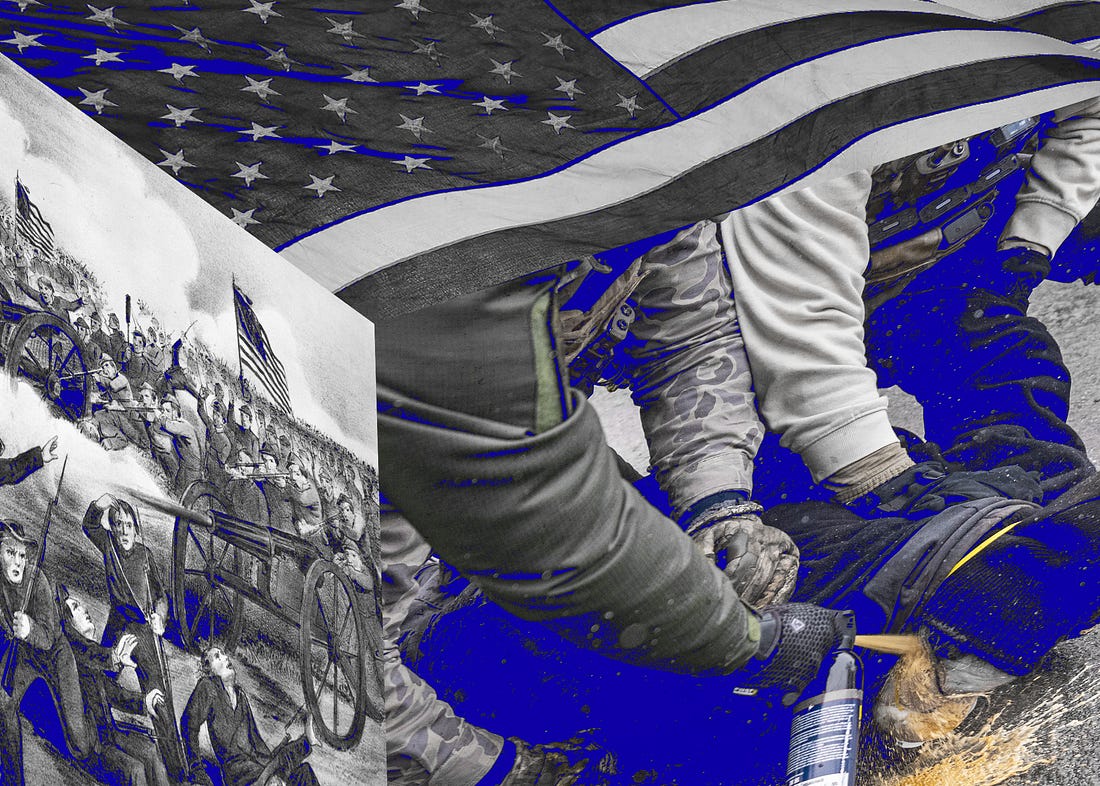 |
1. Gettysburg
Neither the Union nor the Confederate army planned to engage at Gettysburg.
In June 1863 the Confederate army had moved north toward Pennsylvania. General Robert E. Lee’s plan was to lure the Union forces north and west, and then swing south and east to strike Washington, D.C. The Union army, commanded by General George Meade, was shadowing the Confederate forces at a distance. The armies were spread out, but in the same vicinity on June 30.
The difference was that Meade knew precisely where Lee’s army was, while Lee did not know details about the disposition of the Union forces.
In the early morning hours of July 1, two brigades of Confederate soldiers made their way into the town of Gettysburg to probe, expecting to find a local militia. Instead, they encountered Union cavalry and exchanged fire. At that moment, neither side had any idea what was about to happen.
Caught by surprise, the Confederates pushed more troops forward, moving down the Chambersburg Pike. The Union rushed infantry in to harry the Confederate advance while they awaited reinforcements.
The story of the first day of Gettysburg was two armies, meeting by chance, then pouring forces into the battle until they were both pot-committed to a major engagement.
It’s important to understand that no one understood the stakes at Gettysburg.
Neither army intended to have a major showdown at that time or in that place.
Once begun, the conflict escalated by its own logic until neither side had any choice but to go all-in.
Even after the battle was finished, neither side understood that it had just fought the defining engagement of the war.
This last bit is crucial. The Union understood it had won a victory, but saw the escape of Lee’s army as failure. The Confederates believed they had suffered a setback, but did not understand the strategic implications of what had just happened.
The point is that the people in the battle could not understand its significance. It would take time for everyone to grasp exactly what the events of Gettysburg meant.
Which brings us to Minneapolis.
It’s not clear why the Trump regime chose to invade Minneapolis. Maybe it was animus toward the city’s Somali population. Maybe it was because Gov. Tim Walz had run against Trump and Vance. Maybe it was because they believed the state’s welfare fraud investigations made Minneapolis favorable terrain on which to fight.
But when the regime’s forces occupied the city they were surprised by the resistance they encountered. Not from Democratic politicians, or institutions, or the legal establishment. From ordinary people. The people of Minneapolis organized to protect their neighbors and provide oversight of the regime’s forces that the local government either could not, or would not, perform.
Think about this: State and local law enforcement could do nothing to document the crimes being carried out against the residents of Minneapolis by federal forces. But the people were able to do it themselves. This grassroots army used cell phones and whistles to show the world what was happening.
In return they were menaced, beaten, and arrested. And Renee Good was murdered by the regime’s masked secret police.
Upon encountering this unexpected resistance, the Confederates Trump command poured more forces into the city and adopted even more brutal tactics. At which point the people of Minneapolis organized a general strike. After which the regime’s police executed Alex Pretti on the street, in broad daylight.
Once begun, these engagements have a logic of their own. Maybe Minneapolis will prove to be a hinge point in the battle against American fascism. You can never tell from inside the crucible.
But here is what I want you to understand: The Trump regime, even as it tries to figure out what to do next, continues to pour resources into this fight. The people of Minneapolis have given all they have to give. They need reinforcements from other parts of the resistance.
So where is the opposition party?
In Washington this week, Democrats in the Senate can join the fight by shutting off funding for the regime’s forces in Minneapolis. T