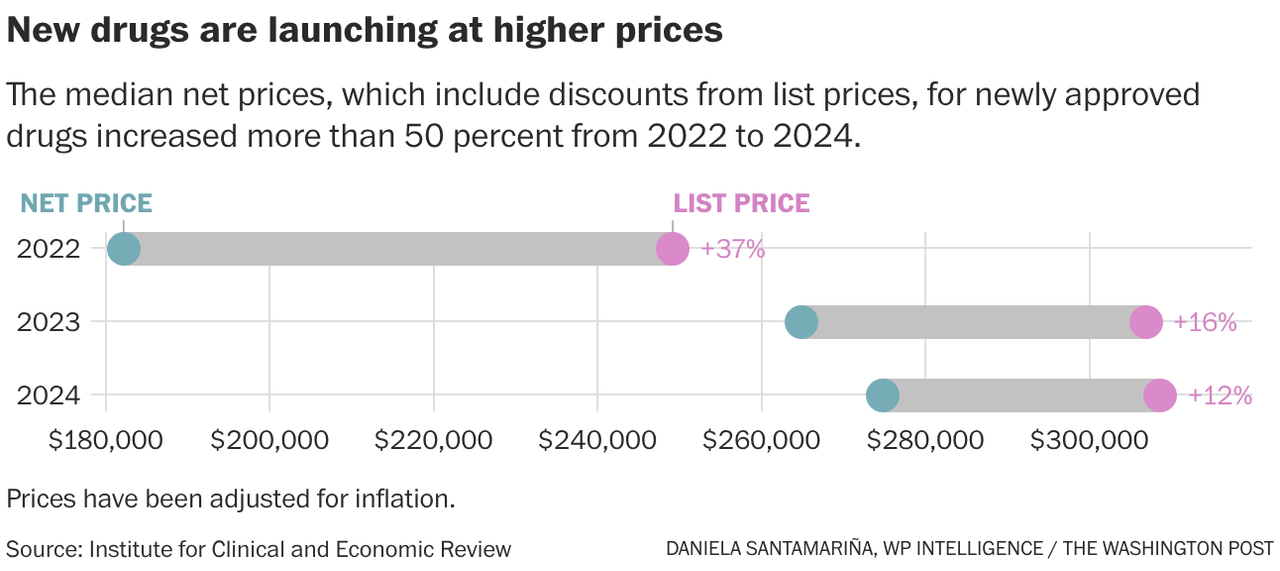
| Launch prices of new medications began increasing exponentially in 2023 — the year after the Inflation Reduction Act, the Democrats’ sweeping law that directs Medicare to negotiate drug prices, was enacted. “A lot of that has to do with public policy constraints that have been overly focused on list price growth, but not necessarily controlling for the intrinsic ability to set whatever price you want out of the gate,” Antonio Ciaccia, the CEO of nonprofit group 46brooklyn Research, told Rebecca. The median annual net price of newly launched drugs increased by 51 percent between 2022 and 2024, according to the Institute for Clinical and Economic Review (ICER), the Boston-based nonprofit that studies the value of prescription drugs. The net price includes the discounts that drugmakers offer to intermediaries called pharmacy benefit managers, or PBMs. Drug manufacturers argue that the pricing system is complex and say PBMs are to blame for driving up costs because they can sometimes favor higher-priced medications in order to exact larger discounts. A significant share “of every dollar is going to someone other than the manufacturer making the drug that’s saving your life,” said Alex Schriver, a spokesman for the Pharmaceutical Research and Manufacturers of America, or PhRMA, which represents brand-name drugmakers. Drugmakers defend the costs for their products by noting that, unlike hospitals, they ultimately face lower prices when patent protections expire and generic drugmakers offer lower-cost competition to the companies that developed the brand-name drugs. What’s next: A growing number of drugmakers have been asking the Supreme Court to hear their legal challenges to Medicare’s drug price negotiation program, but the high court hasn’t signaled whether it will get involved. Meanwhile, the White House is pushing Congress to codify the Trump administration’s action to impose most-favored nation (MFN) pricing on medications, aligning U.S. drug prices with other wealthy nations. It remains to be seen whether consumers will see benefit from the MFN pricing deals the administration cut with more than a dozen drugmakers, but initial analysis suggests it may be limited. It’s also unclear whether Republican lawmakers are eager to turn the pricing directives into legislative text. | 

_tstmp_1756933376-1920-1080.png)