|
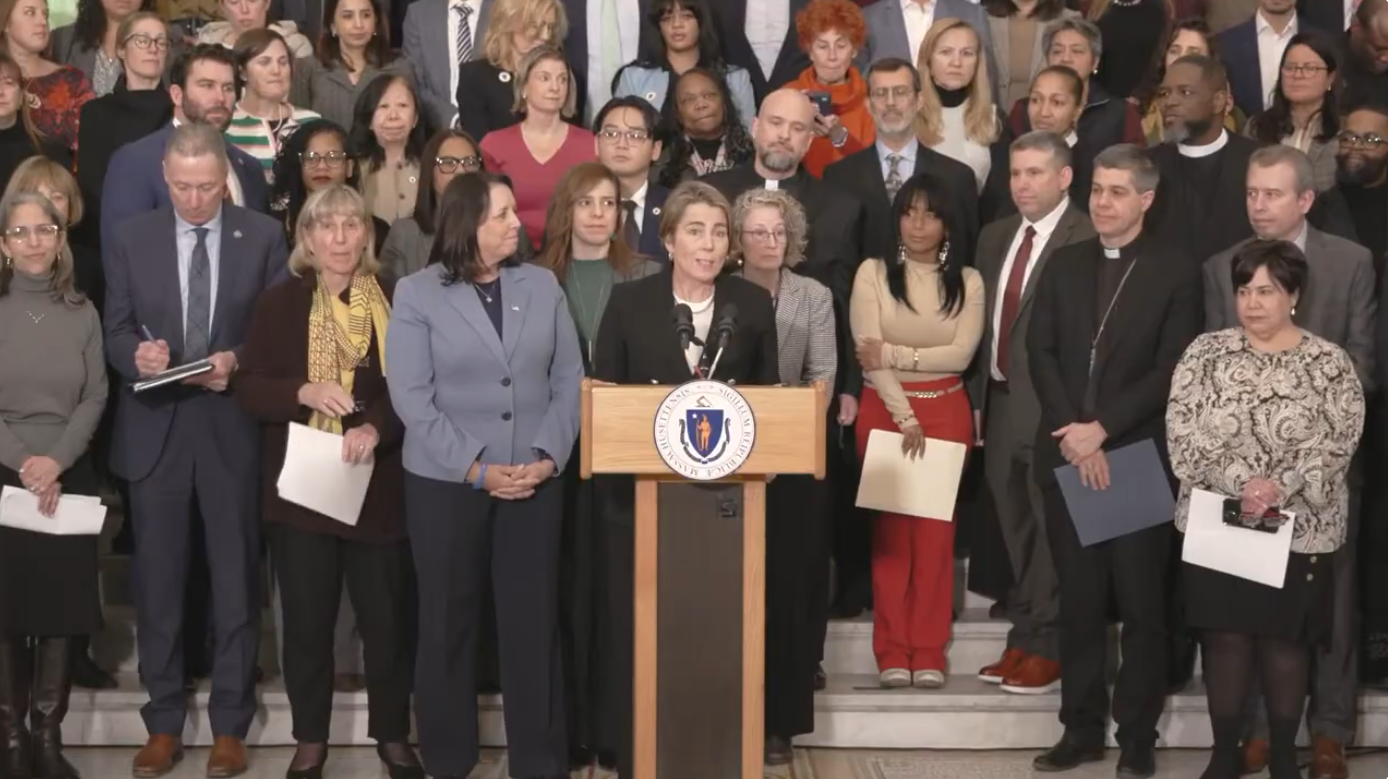
Governor Maura Healey signed an executive order Thursday that limits how Massachusetts state agencies may cooperate with U.S. Immigration and Customs Enforcement, drawing criticism from Republican candidates for governor who said the move undermines public safety and coordination with federal law enforcement. The executive order restricts the use of 287(g) agreements, which allow state and local law enforcement agencies to partner with ICE to help identify and transfer custody of immigrants in the country without legal status who are arrested for crimes. Under Healey’s order, no executive-branch office or agency may enter into a new 287(g) agreement unless the secretary of the Executive Office of Public Safety and Security certifies in writing that the agreement is based on a specific and articulable public safety risk or need. Any such agreement must automatically expire within 12 months. The order also bars ICE from carrying out civil immigration arrests in nonpublic areas of state facilities unless agents have a judicial warrant. It further prohibits state-owned property from being used to support federal civil immigration enforcement, including use as a staging area, processing location, or operations base. Healey also announced she will file legislation that would codify additional restrictions. The bill would prohibit warrantless civil immigration arrests by ICE inside courthouses, schools, licensed child care programs, hospitals, and churches. It would also allow parents to pre-arrange temporary guardianship for their children in the event they are detained or deported, without terminating parental rights, according to a press release from her office. Another provision would make it unlawful for a National Guard unit controlled by another state’s governor to enter Massachusetts without the governor’s permission. The governor’s office described the actions as the most comprehensive effort in the country to limit immigration enforcement in what it calls sensitive locations. Healey said the measures respond to federal enforcement practices under the Trump administration. “In Massachusetts and across the country, we continue to see unlawful and unconstitutional actions by ICE that are meant to intimidate and instill fear in our communities, including against United States citizens who are exercising their constitutional rights,” Healey said in the press release. “This puts people at risk and in harm’s way, and I find it necessary in the interest of public safety to take this action today.” The executive order states that Massachusetts is home to more than 1.2 million immigrants and asserts that the state constitution guarantees equal treatment regardless of national origin or immigration status. Republican candidates for governor criticized Healey's executive order and her proposed legislation, arguing the restrictions would force ICE to make arrests in neighborhoods rather than in controlled settings such as courthouses. Mike Kennealy, who served as housing and economic development secretary under former Governor Charlie Baker, argued that barring ICE from courthouses makes enforcement less safe. “If a criminal illegal immigrant is in a courthouse, in handcuffs, in state or local law enforcement custody, Healey would rather that they be released onto the street so that the Feds have to apprehend them in the community,” Kennealy said in a press release emailed to NewBostonPost. Mike Minogue, a businessman and Republican gubernatorial candidate, accused the Healey administration of prioritizing politics over safety. “State and local officials need to work together with the federal government to get criminal illegal immigrants out of our communities,” Minogue said. “This is about public safety and the law, not party politics.” Brian Shortsleeve, a former Massachusetts Bay Transportation Authority administrator and GOP candidate, said Healey sent conflicting messages on cooperation with federal authorities. “She admitted cooperation with federal law enforcement is necessary and proper,” Shortsleeve told State House News Service. “Then she banned it.” As Shortsleeve points out, Healey publicly rejected the premise that Massachusetts is a sanctuary state on Tuesday, January 27, two days before signing this executive order on Thursday, January 29. “Massachusetts is not a sanctuary state," Healey told reporters at the time, "I’ve said this time and time again. People can buy in and continue with the absolute bull[expletive] rhetoric out of the Trump administration on this. You know they have no respect for cities and states. They don’t respect law enforcement." Massachusetts Republican Party chairman Amy Carnevale criticized the governor’s actions, arguing they would make immigration enforcement more chaotic rather than safer. "These apprehensions are best done in spaces like courthouses," Carnevale said in a press release emailed to NewBostonPost. "By signing an executive order and advancing legislation to make it more difficult for the federal government to precisely and safely target enforcement toward criminal illegal aliens, our communities have now been put at greater risk for chaotic law enforcement." The governor's executive order took effect immediately, while the proposed legislation now moves to the Massachusetts Legislature for consideration. Healey's office could not be reached for comment on Thursday.
|