|



You.com Founders Predict an AI Winter Is Coming in 2026
 |
Richard Socher and Bryan McCann are among the most-cited AI researchers in the world. They just released 35 predictions for 2026. Three that stand out:
The LLM revolution has been “mined out” and capital floods back to fundamental research
“Reward engineering” becomes a job; prompts can’t handle what’s coming next
Traditional coding will be gone by December; AI writes the code and humans manage it
This week’s system design refresher:
HTTP/2 over TCP vs HTTP/3 over QUIC
How Cursor Agent Works
How Git Really Stores Your Data
How NAT Works
Building a Computer Vision App on Ring APIs
We’re hiring at ByteByteGo
HTTP/2 over TCP vs HTTP/3 over QUIC
HTTP/2 vs HTTP/3 looks like an HTTP upgrade. It’s actually a transport-layer rethink.
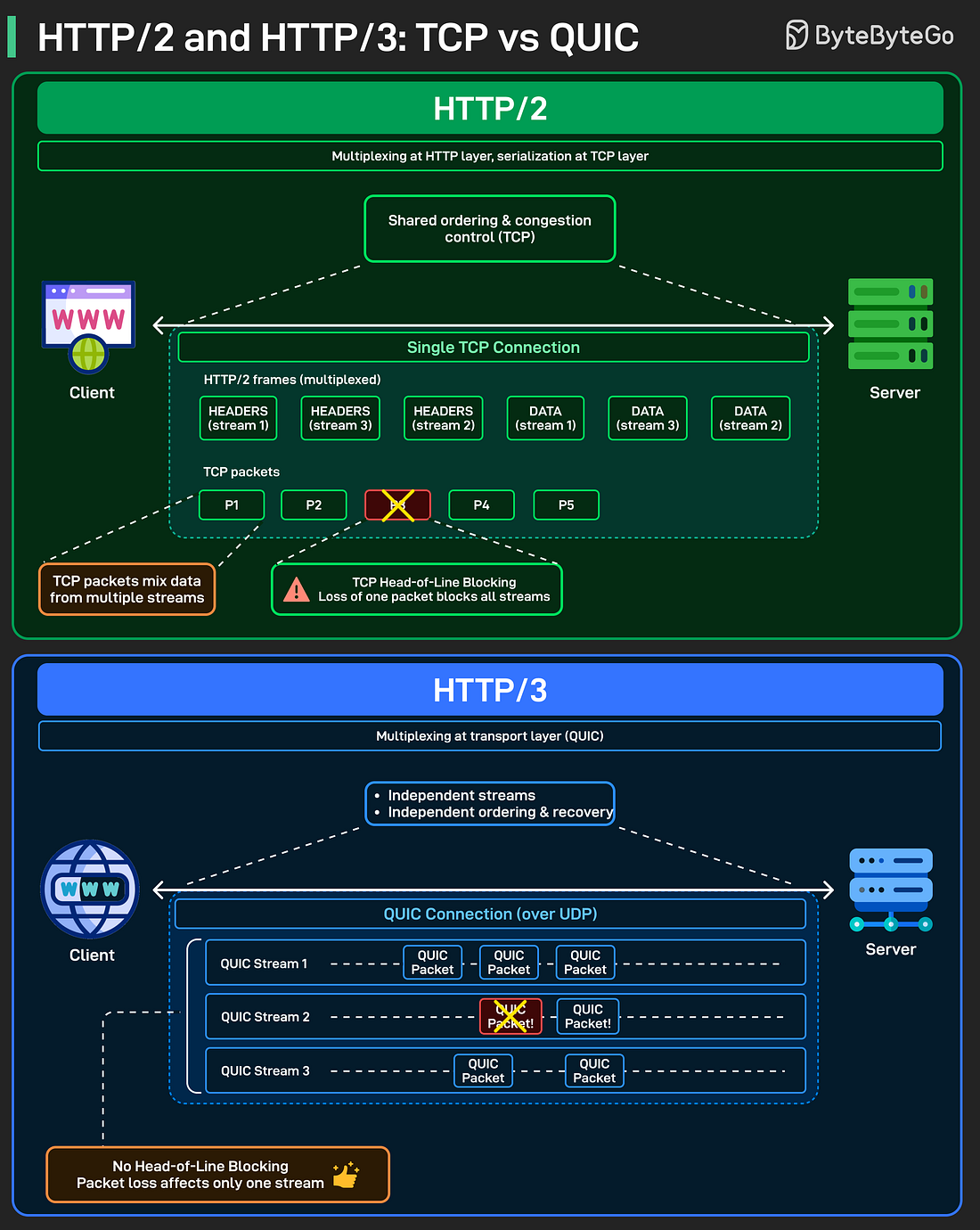 |
HTTP/2 fixed a big problem in HTTP/1.1: too many connections. It introduced multiplexing, allowing multiple requests and responses to share a single connection. On paper, that sounds ideal.
But under the hood, HTTP/2 still runs on TCP. All streams share the same TCP connection, the same ordering, and the same congestion control. When a single TCP packet is lost, TCP pauses delivery until it’s retransmitted.
Since packets can carry data from multiple streams, one loss ends up blocking all streams. That’s TCP head-of-line blocking. Multiplexed at the HTTP layer, serialized at the transport layer.
HTTP/3 takes a different approach. Instead of TCP, it runs over QUIC, which is built on UDP. QUIC moves multiplexing down into the transport layer itself.
Each stream is independent, with its own ordering and recovery. If a packet is lost, only the affected stream waits. The others keep flowing. Same idea at the HTTP layer. Very different behavior on the wire.
HTTP/2: multiplexing above TCP
HTTP/3: multiplexing inside the transport
Over to you: Have you actually seen TCP head-of-line blocking show up in real systems, or is it mostly theoretical in your experience?
How Cursor Agent Works
Cursor recently shipped Composer, its agentic coding model, and shared that the agent can be ~4× faster!
 |
We worked with the Cursor team, particularly Lee Robinson, to understand how the system is put together, and what drives the speed.
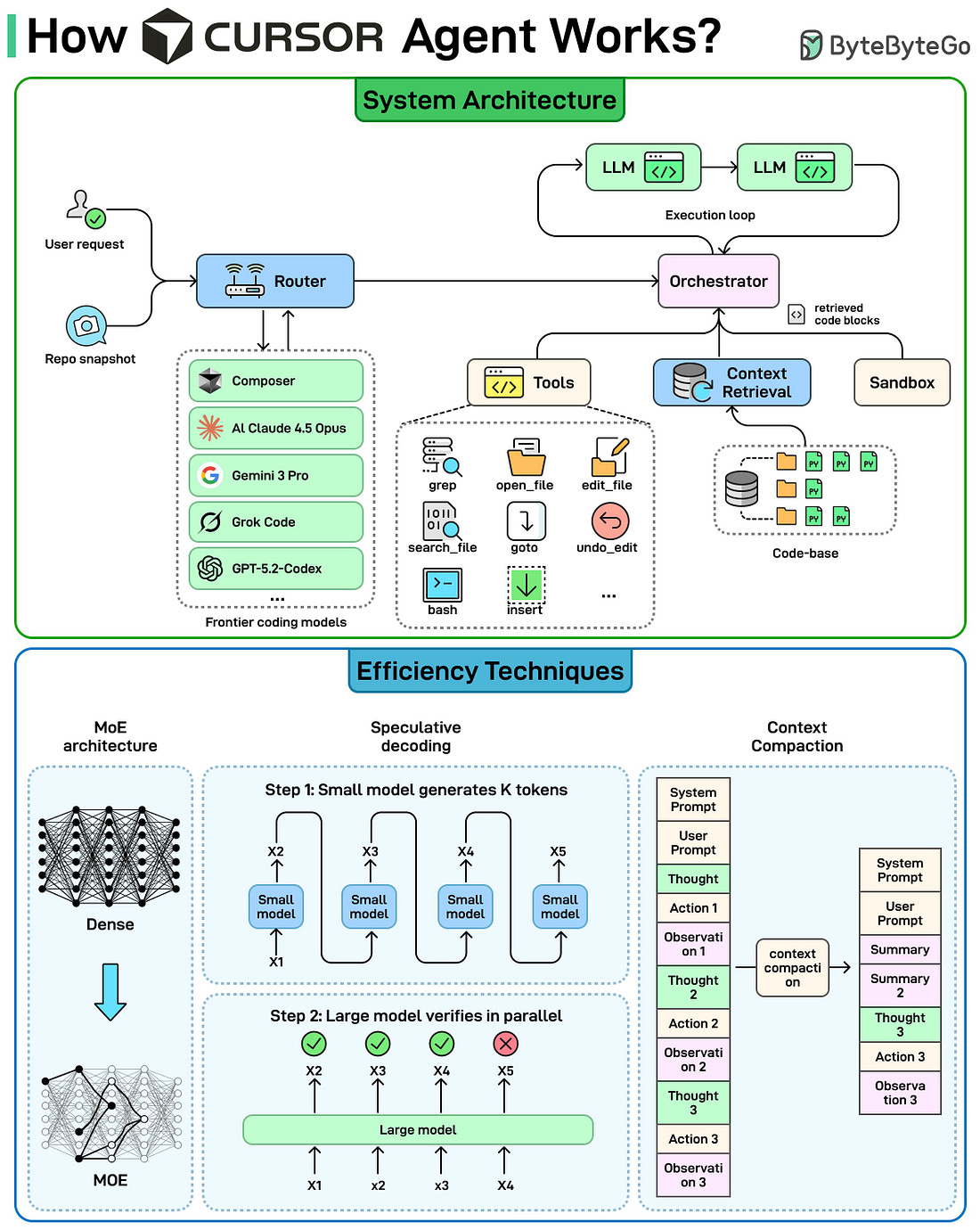
A coding agent is a system that can take a task, explore a repo, edit multiple files, and iterate until the build and tests pass.
Inside Cursor, a router first picks a suitable coding model (including Composer) to handle the request.
The system then starts a loop: retrieve the most relevant code (context retrieval), use tools to open and edit files, and run commands in a sandbox. Once the tests pass, the task is complete.
Cursor uses three key techniques to keep this loop fast:
Mixture-of-Expert (MoE): A sparse MoE architecture activates only a subset of model weights per token.
Speculative decoding: a smaller model drafts multiple tokens at once, then a larger model verifies them in parallel to reduce latency.
Context compaction: summarize older steps and keep only the active working set so the prompt stays relevant and short as iterations continue.