What matters in U.S. and global markets today

Global news you can trust.

Download the Reuters App.


Morning Bid U.S.

Morning Bid U.S.

A Reuters Open Interest newsletter

What matters in U.S. and global markets today


By Mike Dolan, Editor-at-Large for Finance and Markets

Amid the dramatic twists and turns of the year so far, U.S. manufacturing seems to have rebounded sharply - with ISM survey showing factory activity expanding in January for the first time in a year.

That’s sure to throw another curve ball into the macro and interest rate picture, keeping a lid on Fed easing expectations.

I'll get into all that and more below.

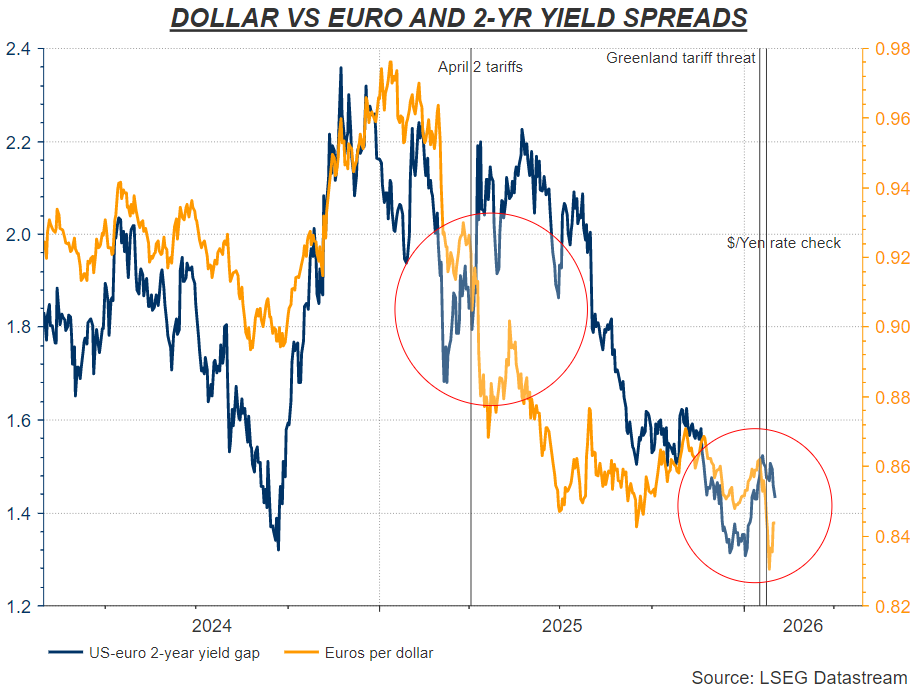
But first, check out my latest column on why we should all be focusing on the dollar risk premium.

And listen to the latest episode of the Morning Bid daily podcast. Subscribe to hear Reuters journalists discuss the biggest news in markets and finance seven days a week.


Data refreshes every time you open this email. For more U.S. market news, click here. Please send any feedback to morningbid@thomsonreuters.com.


Today's Market Minute

  • U.S. President Donald Trump on Monday announced a trade deal with India that slashes U.S. tariffs on Indian goods to 18% from 50% in exchange for India halting Russian oil purchases and lowering trade barriers.
  • Bitcoin investors liquidated $2.56 billion in recent days as cryptocurrencies slumped following a sell-off in other risk assets, including equities and precious metals.
  • Elon Musk said on Monday that SpaceX has acquired his AI startup xAI in a record-setting deal that unifies his AI and space ambitions.
  • President Trump’s push to channel U.S. and Venezuelan crude oil into India will run up against global oil economics, with price signals, not political directives, determining where barrels end up, writes ROI Energy Columnist Ron Bousso.
  • Warsh’s nomination has eased dollar fears and sparked a historic precious metals unwind, but the debasement trade may yet live on, argues ROI Markets Columnist Jamie McGeever.
 

Deals and delays

Equities were unfazed on Monday by the recent commodities selloff as the already upbeat earnings season continued, with all major Wall Street indexes in the green. The S&P 500 closed higher, led by tech and AI companies, with Alphabet up 1.9% and Amazon up 1.5%. Both companies are set to report later this week, on Wednesday and Thursday, respectively.

European equities followed suit, with the pan-European STOXX 600 closing 1% higher, notching a new record high, thanks to strong gains in financial and healthcare stocks.

In tech news, Elon Musk announced Monday that SpaceX has acquired his AI startup xAI. The ambitious tie-up consolidates Musk’s space and AI ambitions and could boost SpaceX’s planned expansion into the data center business as it seeks to compete with AI heavyweights.

Investors will get a further taste of how the AI economy is faring when AMD and Supermicro Computer report today, alongside updates from consumer and pharma names including PepsiCo and Pfizer.

But they will have to wait longer for the JOLTS data originally slated for today, thanks to the partial government shutdown that began last Friday. January’s employment report, originally due Friday, will also be delayed until government funding resumes. Happily, the shutdown is likely to be brief, with lawmakers expected to vote today on legislation to end it.

In commodities, volatile precious metals seemed to find their level on Tuesday after the withering shakeout of recent days, with gold surging more than 5%, putting it on track for its biggest one-day gain since 2008. Despite the recent selloff, analysts say the precious metals bull run still has plenty of space to continue.

Oil continued to edge down on Tuesday as the geopolitical risk premium dissipated, due to the possibility of de-escalation in U.S.-Iran tensions. The two sides are gearing up for nuclear talks in Turkey on Friday. Oil fell more than 4% on Monday.

Meantime, President Trump on Monday announced a trade deal with India that would see New Delhi cease Russian oil purchases in return for a reduction in tariffs on Indian goods to 18% from 50%. Trump said India will instead buy oil from the U.S. and possibly Venezuela - alongside American arms and aircraft.

The dollar weakened a touch, but China's yuan reached its highest level in almost three years ahead of the Lunar New Year holidays.

Australia's dollar and bond yields all climbed after its central bank hiked rates for the first time in two years, with the Reserve Bank warning that inflation was likely to stay above target for some time.


Dollar risk premium is rebuilding

The year is already so jarring that many in markets barely have time to digest one seismic news event from Washington before another one hits. But a dollar risk premium appears to be rebuilding regardless - most clearly in last week's sudden swoon.

Like all attempts by Wall Street to model measures of risk, there are many different ways to slice and dice what a dollar risk premium might look like and even what it might represent. A weakening exchange rate, by itself, may be perfectly reasonable and warranted. But sometimes pricing throws up obvious anomalies that raise red flags.

Risk premia typically capture uncertainty or doubt in the market beyond what can be explained simply by fundamentals and relative economic performance, even if precise measurement often just hinges on the inputs you use - or the analyst you read.

For currencies, that uncertainty shows up in two common places: how far an exchange rate moves from "fair value" models, and how much it deviates from what relative interest-rate gaps would normally suggest.


Graphics are produced by Reuters.

Read the full column