|
 |
Good afternoon, Press Pass readers. The 2026 election cycle is upon us. Important, contentious primary races are starting to fill the calendar. Back in Washington, the House majority is hanging by a thread. If you want to stay politically apprised without losing your mind, consider upgrading your membership to Bulwark+. You’ll get access to everything we produce, a chance to pitch us on story ideas, and a connection to the other paying subscribers in our community.
Today’s edition explores a gravy train-like situation for a key Senator from the northeast—what we’re calling the Lobster Roll-back. It’s a pattern that has emerged over the first year of Trump’s second term as president: when he implements horribly unpopular policies across the nation, the state of Maine somehow always gets to have an exemption. Mainers can thank Sen. Susan Collins for that. Her status as the state’s lone Republican, one who is up for election this cycle, gives her enough capital to take the edge off Trump’s policies for her constituents. It’s done with the hopes of keeping her electable as a purported “moderate” in a purple state.
In addition, the House moved forward with the government funding package that will end a government shutdown so partial you may have barely noticed it. Lawmakers now have ten days of breathing room to negotiate conditions for Homeland Security’s appropriations. Lastly, you might view show dogs as pageant queens, but they’re actually hard workers. Today’s palate cleanser is a bit of a greenie. All that and more, below.
The Lobster Roll-back: How Susan Collins Gets Trump Carveouts
Her endangered status means the MAGA agenda doesn't hit as hard in Maine
|

| |||||||||||||||


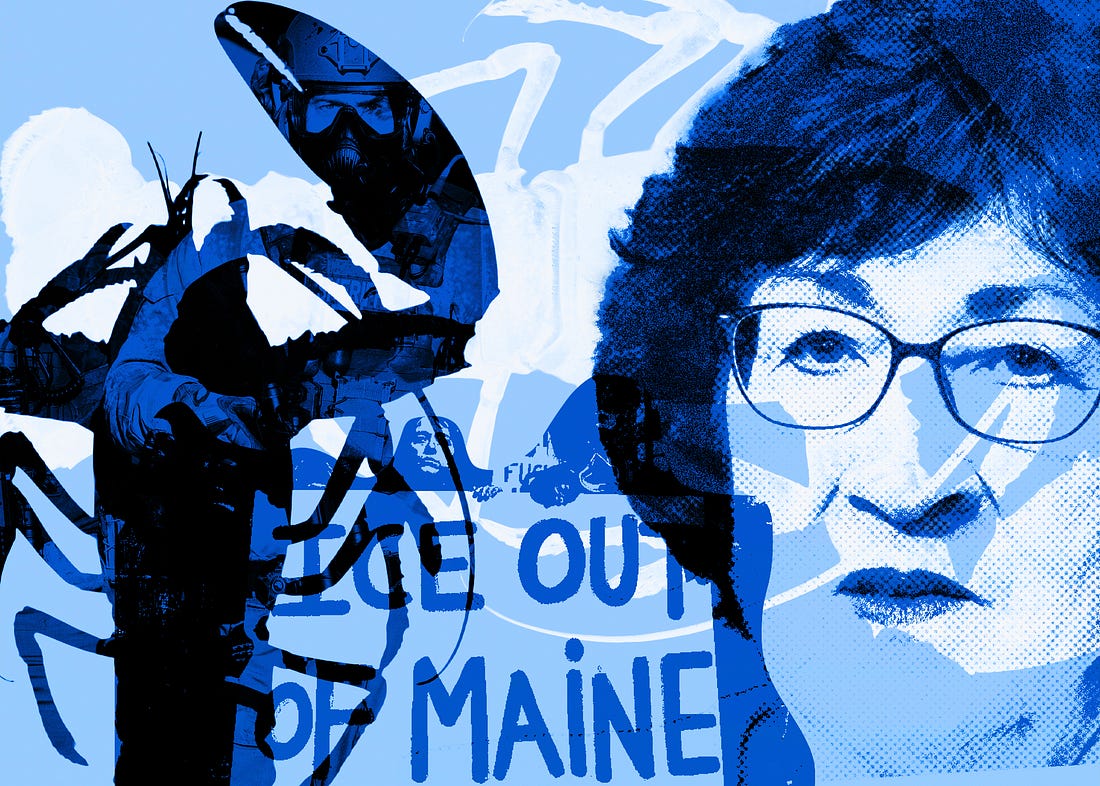 |
The Lobster Roll-back
Sen. Susan Collins (R-Maine) proudly announced on Thursday that ICE was ceasing special operations in Maine. The Pine Tree State, with its relatively large Somali population, had been targeted by the agency as part of President Donald Trump’s mass deportation effort, which in other states has resulted in harassment of U.S. citizens, family separations, and death. Before Collins intervened, Maine had come in for its share of anxiety and state violence: During the operation, many students stayed home from school out of fear, and in one particularly egregious episode, agents shattered the window of a car with a month-old baby in it. But just days after it began, the operation was over.
ICE’s short Maine stay illustrates a pattern that has emerged since Trump began his second stint in the White House: The administration will implement its signature policies in the state, but only temporarily or provisionally. That seems due to Collins.
The Senator appears to consistently win exemptions for Maine—those Lobster Roll-backs—because the administration appears to be intent on preserving her political career.
To wit: Immediately upon entering office last year, Trump initiated a hiring freeze across federal agencies. The Russell Vought–led Office of Personnel Management, DOGE, and others in the administration would soon after begin their work of cutting whatever they could out of the federal workforce, including by offering deferred resignations. A few weeks later, however, Collins joined Sen. Jeanne Shaheen (D-N.H.) in sending a letter to the acting secretary of the Navy requesting that the Portsmouth Naval Shipyard be made exempt from these workforce reduction policies. In March, Collins secured the exemption.
She wasn’t done there. Panic about DOGE’s activities began setting in across Republican circles in the House and Senate within weeks of Trump’s swearing-in. Last March, as Trump started ramping up his campaign of belligerence against prominent universities, the United States Department of Agriculture suspended $30 million in federal funding for the University of Maine. The administration claimed the hold was related to a review to ensure compliance with Title IX policies (in modern GOP parlance, that means keeping MEN out of WOMEN’s sports). A couple of days after the news broke, however, Collins announced the funding had been restored:
This USDA funding is critically important not only to the University of Maine, but to our farmers and loggers, as well as to the many people who work in Maine’s agriculture, aquaculture, and forestry industries. Now that funding has been restored, the work that the University does in partnership with the many people and communities who depend on these programs can continue.
This was a short-lived victory. In April, Agriculture Secretary Brooke Rollins made good on the promise to freeze the USDA fundin