|
 |
When Vice President J.D. Vance appeared on screen during the opening ceremonies of the 2026 Winter Olympic Games, the crowd in Milan greeted him with a chorus of boos. NBC viewers, however, were unaware that Vance was jeered because the network did not include the crowd’s reaction.
In other words, a major U.S. media organization is sanitizing reality to make it more palatable to the Trump administration.
That is why Popular Information exists. We can no longer trust outlets owned by corporations and billionaires to accurately report on the powerful.
As others kowtow, Popular Information has ambitious plans for more aggressive reporting. But we need your help to do it. Upgrade to paid for $6 per month or $50 per year.


 |
During a December 2 cabinet meeting, President Trump unleashed a torrent of bigoted invective against Somali migrants. “We’re going to go the wrong way if we keep taking in garbage into our country,” Trump said. “They come from hell, and they complain and do nothing but bitch.”
At the same meeting, Trump made clear that he wanted all Somalis to be kicked out of the United States. “I don’t want them in our country,” Trump announced. “Their country is no good for a reason. Their country stinks, and we don’t want them in our country.”
At a December 10 event in Pennsylvania, Trump reprised his dehumanizing tirade, calling Somalia a “shithole” nation. “The Somalians should be out of here,” Trump said, describing their homeland as “filthy, dirty, disgusting, [and] ridden with crime.”
It is clear what Trump wants, but all migrants in the United States have due process rights under federal law. Specifically, Somali migrants have the right to appear before an immigration judge and seek asylum based on a well-founded fear of persecution based on race, religion, political views, or another protected category. This is a particular risk in Somalia, where al-Shabaab, an Islamist militant group, is responsible for hundreds of thousands of civilian casualties.
The Trump administration, however, appears to be manipulating the judicial process to dramatically reduce the chance that Somali immigrants are granted asylum.
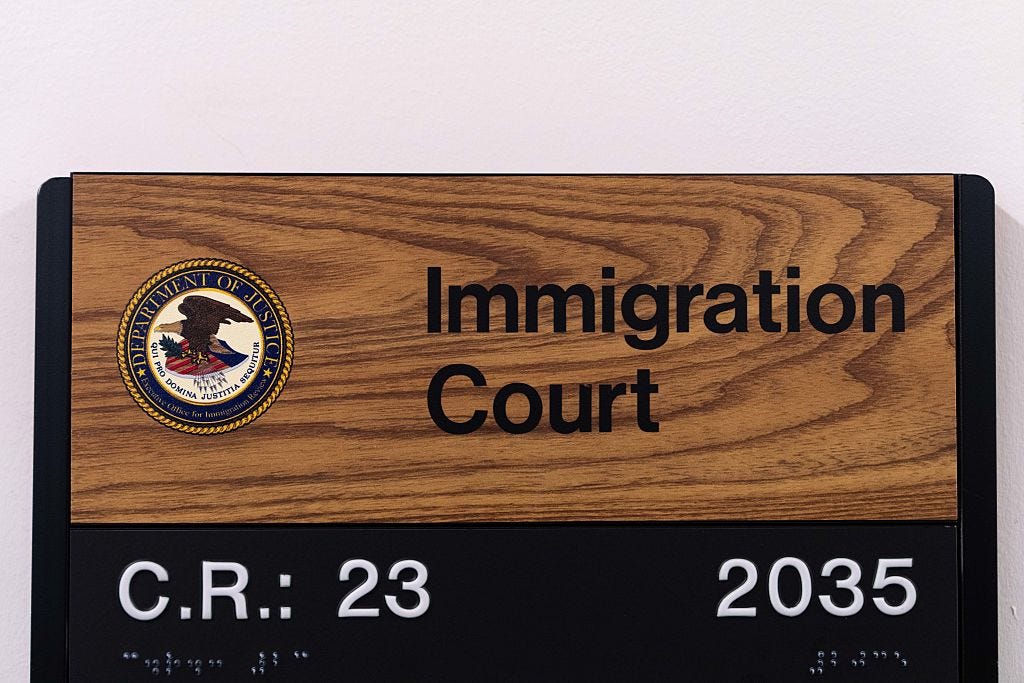
Matthew Happock is an immigration lawyer based in Kansas City. He currently represents eight Somali migrants in immigration court. On February 4, Happock said that all his cases had been reassigned to a new immigration judge. While the cases will still be heard in Kansas City, this new judge will preside via video conference from Louisiana. According to Happock, other immigration lawyers representing Somalis have had their cases reassigned to the same judge on the same day.
The judge who will now be hearing these cases involving Somali migrants is Sherron Ashworth, Popular Information has learned. Ashworth is a former ICE prosecutor with a track record of quickly rejecting most asylum claims and accepting the Trump administration’s most specious legal arguments.
Unlike other court systems, immigration courts are run by the Department of Justice (DOJ) under the Executive Office of Immigration Review (EOIR). Although it is normally handled as a bureaucratic matter, the DOJ and Attorney General Pam Bondi can reassign immigration cases.
Who is Sherron Ashworth?
Ashworth was first appointed as an immigration judge in July 2020. She was named to the post as part of a cohort of 46 immigration judges by former Trump Attorney General William Barr. She was hired as part of a push by the first Trump administration to install immigration judges more skeptical of asylum claims. From 2009 to 2020, Ashworth worked as a prosecutor for ICE.
Ashworth has delivered. Between 2020 and 2025, Ashworth has rejected 85.3% of asylum claims. Nationally, the average rejection rate was 58.9%. In 2025, Ashworth denied asylum in more than 95% of cases.
Her work has not gone unnoticed. In January 2026, the DOJ promoted Ashworth to Acting Assistant Chief Immigration Judge, overseeing the cases for several Louisiana immigration courts. This is a critical position because there is a high concentration of immigration detention centers in the Louisiana area, making these courts a major hub of activity.
Ashworth and the case of Rümeysa Öztürk
Rümeysa Öztürk, a 30-year-old Turkish national and Fulbright scholar, was a student at Tufts University when, on March 25, 2025, she was apprehended by six plainclothes ICE agents and handcuffed. Over the next 24 hours, she was transported over 1,300 miles to the South Louisiana ICE Processing Center in Basile. That facility is overseen by the Oakdale Immigration Court, meaning Öztürk’s detention proceedings would be considered by Ashworth.
Secretary of State Marco Rubio said that he had summarily revoked Öztürk’s visa because she was a “lunatic.” Öztürk’s lawyers say she was never notified that her visa was revoked.
Lawyers representing Öztürk sought her release on bond. But Ashworth rejected that request, finding that Öztürk was “both a flight risk and a danger to the community.” Ashworth’s decision was based entirely on a Department of State memorandum, which only cited Öztürk’s co-authorship of a 2024 student op-ed critical of Tufts’ stance on Israel and Palestine.
A March State Department memo, later reported in the Washington Post, “determined that the Trump administration had not produced any evidence showing that she engaged in antisemitic activities or made public statements supporting a terrorist organization.” Further, according to the memo, “Rubio did not have sufficient grounds for revoking Öztürk’s visa.”
In May, after being detained for six weeks, Ashworth’s decision was effectively overturned by a federal district court judge. District Judge William Sessions said there were “very substantial” and “very significant” claims that Öztürk’s First Amendment rights were violated. “Her continued detention cannot stand,” Sessions said. “There has been no evidence that has been introduced by the government other than the op-ed. I mean, that literally is the case.”
More Somalis may end up in immigration court after March
On January 13, the Trump administration announced that it was ending Temporary Protected Status (TPS) for Somali nationals. TPS is a humanitarian measure used to protect migrants who would not be safe if they returned to their home country. It has been afforded to Somali nationals since 1991, but will expire on March 17.