Hi! Whether you’re a triumphant Seahawks supporter or a commiserating Patriots fan, one thing you might have in common is how you’re feeling this Super Bowl Monday — with research firm UKG projecting that 26 million people will be missing work today. Today we’re exploring:
|
- Glutide turned: Novo Nordisk has lost almost all its market cap gains since its Wegovy launch.
- Fresh tracks: This year’s Winter Olympics will feature a new sport for the first time since 2002.
-
Apple of my AI: Apple is the only Big Tech company whose capital spending dropped last quarter.
|
Novo Nordisk has lost most of its post-Wegovy market cap gains |
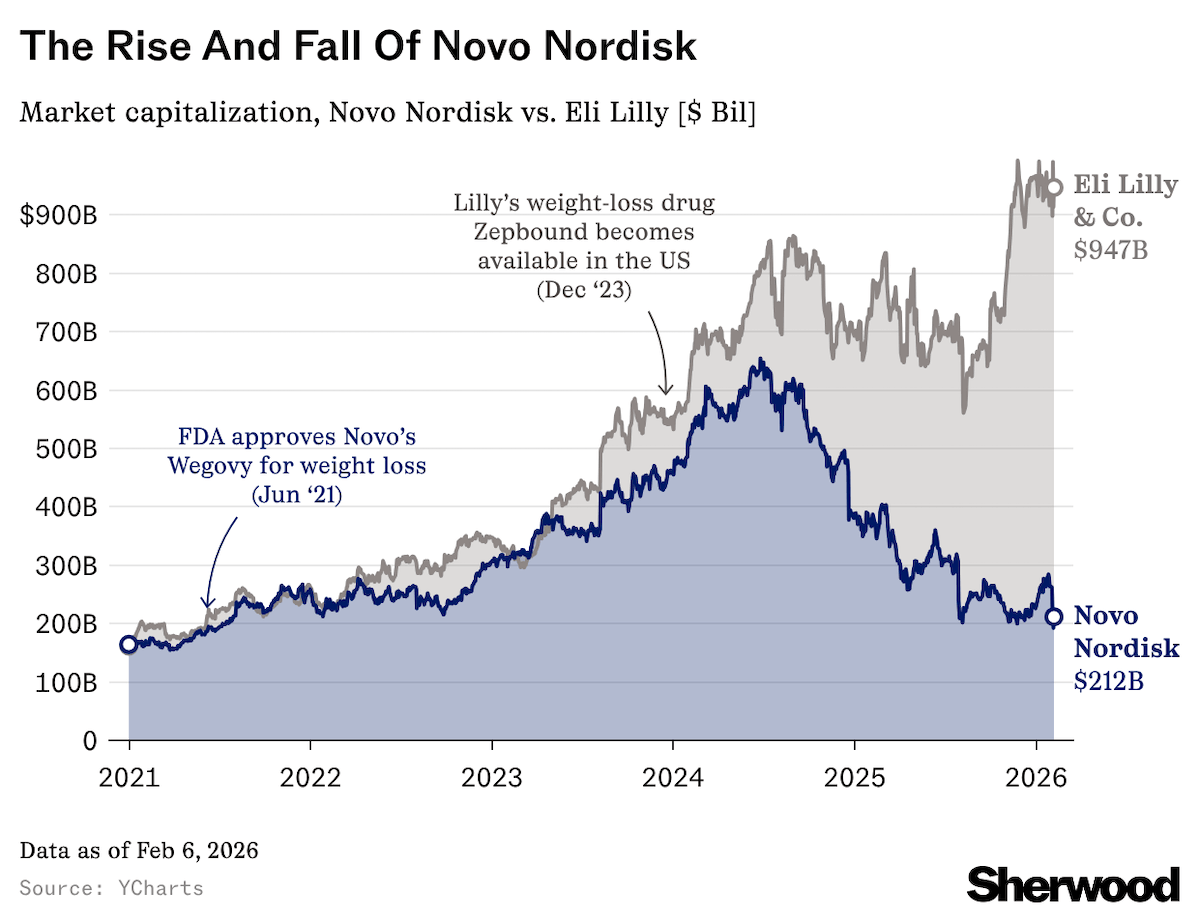
Danish pharma giant Novo Nordisk has now erased nearly all of the market cap gains it racked up after winning FDA approval for its weight-loss drug Wegovy in 2021.
The company’s shares slid ~20% last week amid two major setbacks. On Tuesday, Novo warned that 2026 sales could fall by as much as 13%, citing “unprecedented pricing pressure” in the US, intensifying competition, and a looming patent expiry for semaglutide, the active ingredient in its GLP-1 drugs.
Then, telehealth company Hims & Hers launched a copycat version of Novo’s newly approved Wegovy pill on Thursday at an initial price of just $49 a month... though later that day, the FDA warned of a crackdown on “illegal copycat drugs.” Hims pulled the pill on Saturday, sending Novo’s shares higher this morning, as the company announced that it’s suing Hims.
Even so, the hits wiped out Novo’s January rebound, fueled by excitement around its oral pill launch. Zoom out further, and the picture is even more stark: almost all of Novo’s gains since Wegovy burst onto the scene are now gone. |
Since its FDA approval in June 2021, Wegovy, alongside its diabetes-treating counterpart Ozempic, helped propel Novo to become Europe’s most valuable company, with its market cap peaking at ~$650 billion in mid-2024.
But that dominance didn’t last. Chronic shortages of semaglutide left room for cheaper compounded alternatives, while competitor Eli Lilly surged ahead after launching its weight-loss drug Zepbound in late 2023 — momentum that briefly pushed Lilly’s valuation above $1 trillion last November. By contrast with Novo, Lilly posted stronger-than-expected 2026 guidance last week, as its GLP-1s have been more effective than Novo's offerings, while also being cost-competitive.
After the weight-loss saga’s dramatic turn this weekend, however, Novo might still have some breathing room. |
The Winter Olympics will feature a new sport for the first time in decades |
Strap on your snow boots and get practicing your curling stance: the Winter Olympic Games are officially here.
Marking the third time that Italy has hosted the Winter Games, Milano Cortina 2026 will see some 2,900 athletes (and Snoop Dogg, for some reason) representing more than 90 countries compete from February 6 through 22.
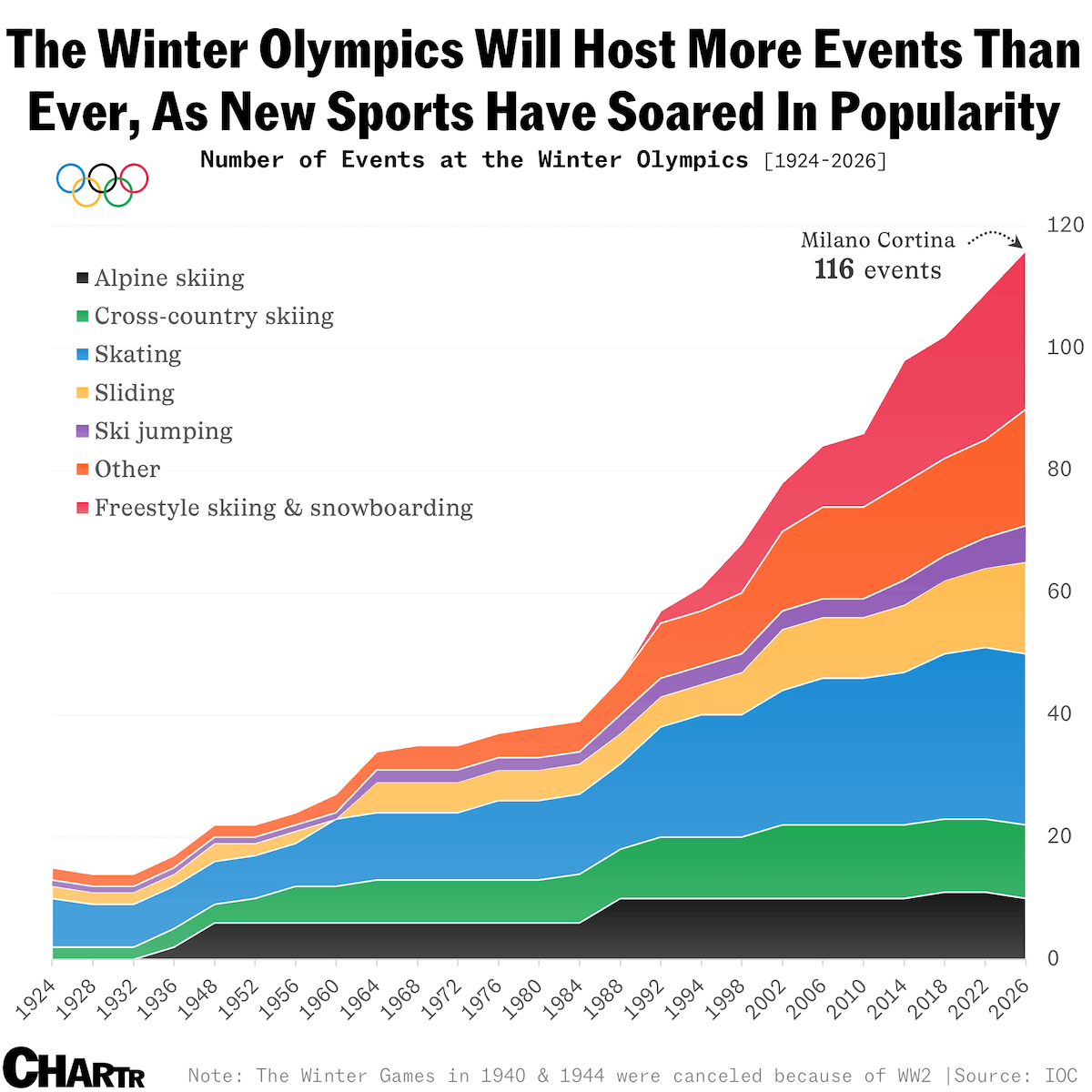
For anyone who plans on catching the action, there’s more skiing, skating, and sliding to see than ever before, with a record 116 medal events taking place in 2026 — seven more than took place in Beijing in 2022. |
Among those events is one entirely new sport, the first that’s been introduced at the Winter Olympics since the return of skeleton in 2002.
On February 19, two ski mountaineering, or “skimo” — a sport based on the traditional pre-chairlift practice of climbing up a mountain, hiking, and then skiing back down — Olympic contests will take place. But, as noted by The Economist more than a decade ago, the Games have been leaning into hosting new events for some time now, particularly for “cool” sports that appeal to younger viewers.
For example, the number of freestyle skiing and snowboarding events has more than tripled since 2002 to a total of 26, while alpine and cross-country skiing have stayed steady at 10 and 12 events, respectively. That’s snow business, baby
Organizers might be hoping that novel events will raise this year’s viewing figures above the 713 billion combined minutes watched at the 2022 Beijing Games. But while 56% of Americans said they’ll watch at least a few events at this year’s Games, per a recent YouGov poll, their favorite sport overall was century-old Olympic mainstay figure skating.
|
|
|
Unlock more leverage in your favorite markets |
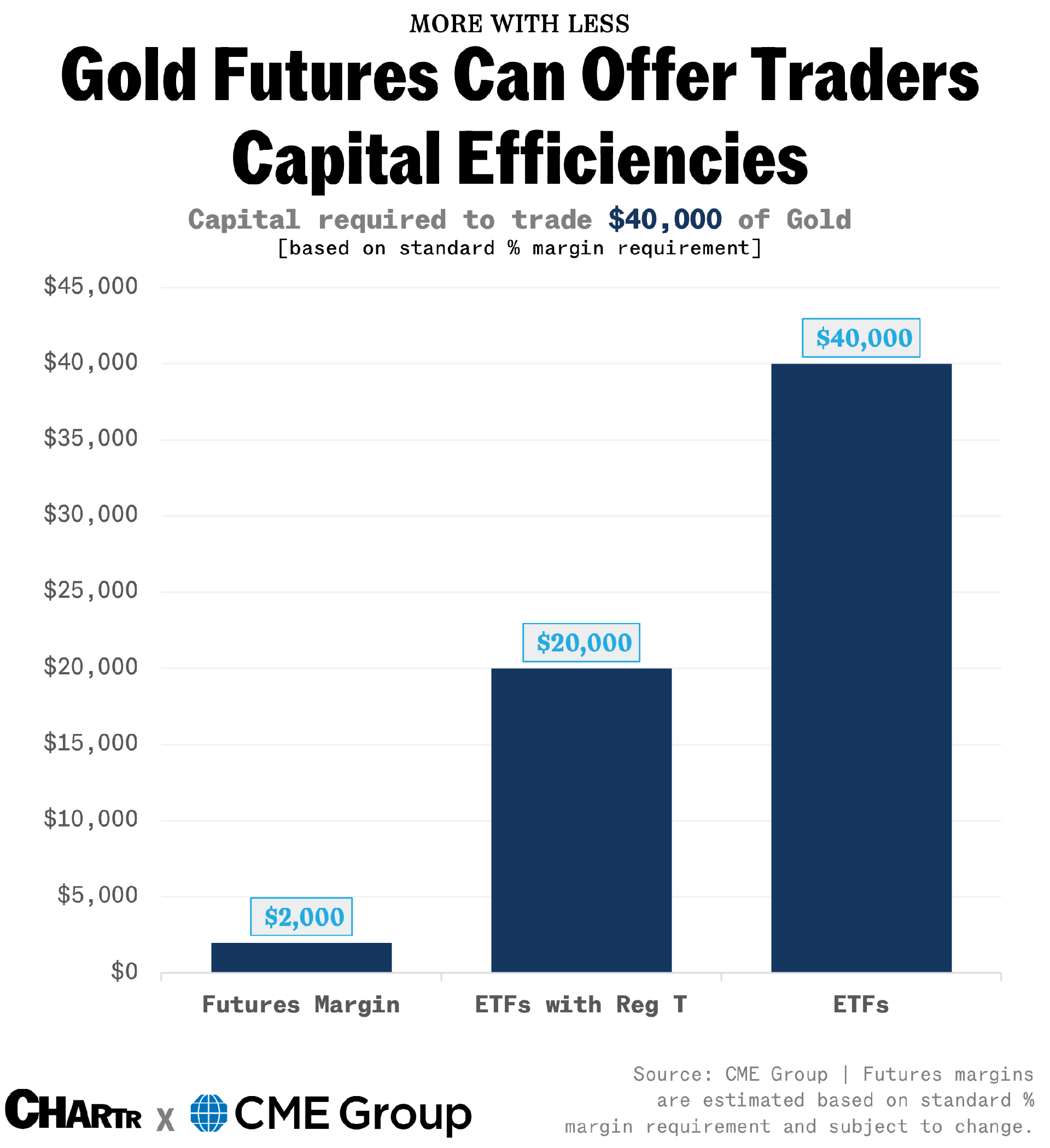
Actively trading the gold market? Micro gold futures can offer unique capital efficiencies that are giving traders the opportunity to enter positions with 5-10% of the position size.1 |
Unlike ETFs, futures give you the opportunity to go short as easily as you go long,2 without the restrictions of locate requirements and borrow costs.
For traders looking to learn about futures and practice in a risk-free environment, CME Group’s simulator lets you test strategies across standard, E-mini and Micro products. Trade with real market data and build confidence in a customizable workspace that fits you and your trading style. |
|
|
1 Margin comes with increased risks. Losses as well as gains will be magnified with the greater amount borrowed. 2 Shorting introduces a different dynamic to your portfolio's risk profile. Because there is no inherent limit to an instrument's upside or downside, managing these positions closely is essential to protecting your capital. |
Apple is the only Big Tech company whose capex declined last quarter |
If you’ve been following Big Tech earnings, you know that they’re pouring more than ever into capital expenditure to pursue their AI futures.
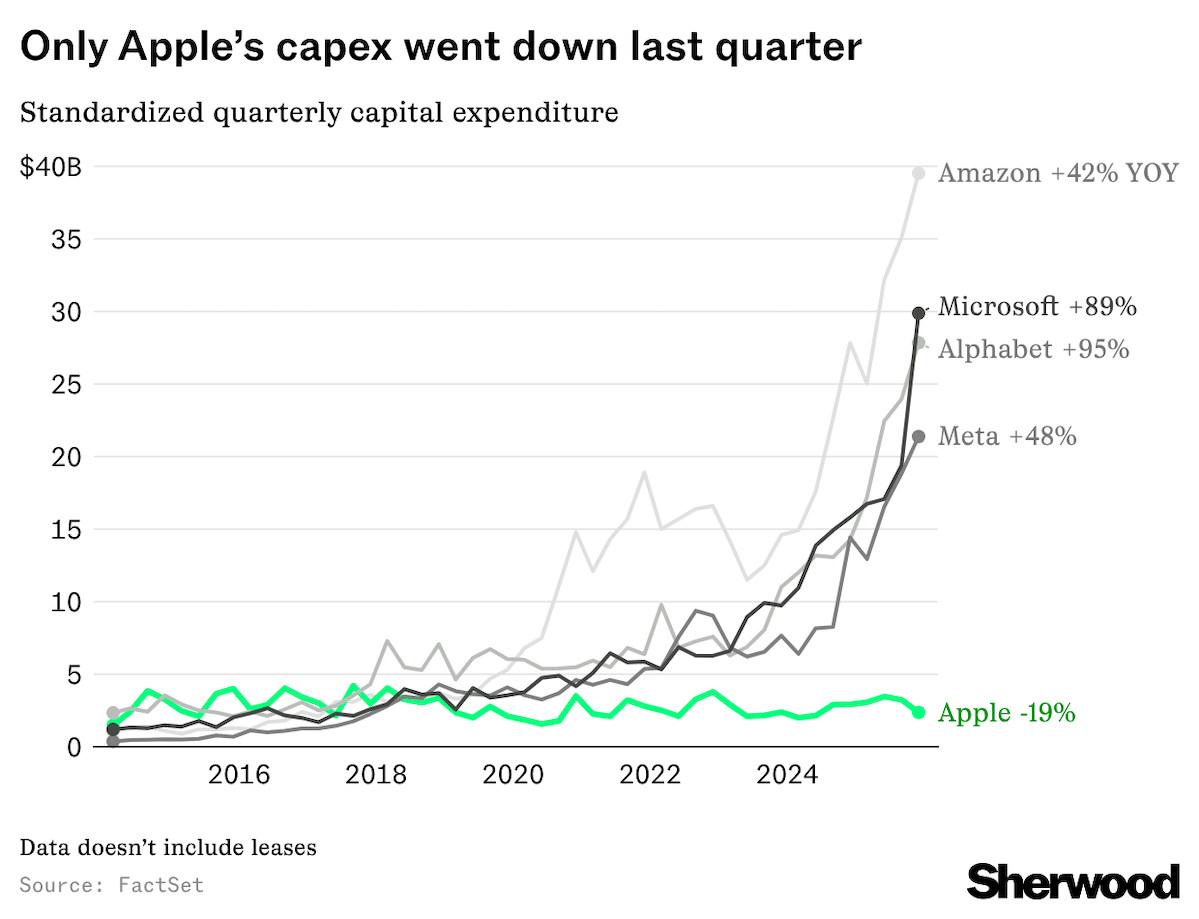
Amazon, Alphabet, Meta, and Microsoft all spent record sums last quarter on AI-related purchases of property and equipment, largely tied to AI chips and data centers. Their future plans are even more ambitious, with estimates for the year blowing analysts’ already generous estimates out of the water — Amazon expects its 2026 capex to surge to $200 billion; Google aims for $175 billion to $185 billion; Meta estimates somewhere between $115 billion and $135 billion.
But, of the Big Tech companies, only one stands apart this earnings season: Apple, whose capital expenditure, already just a fraction of its peers, actually declined in the December quarter from a year earlier. |
For better or worse, Apple has struck its own path with AI. Unlike its peers, the company has chosen a hybrid model, relying on both first- and third-party data centers — a move that keeps a significant amount of infrastructure spending off its balance sheet. And while Apple expects capex to increase as it invests more heavily in AI, those outlays remain minimal compared with its peers.
Indeed, Apple is using Google’s Gemini, rather than an in-house model, for its next-gen Siri and Apple Intelligence, giving the company access to a top-tier AI model for pennies on the dollar compared to what other Big Tech companies are spending to build their own. While that means that the company won’t fully
won't fully own a technologythat some see as powering the next industrial revolution, if that revolution fails to materialize, at least Apple won’t be left holding the most expensive bag in Silicon Valley history. |
|
|
-
Japan’s Prime Minister Sanae Takaichi just won an election victory with a landmark two-thirds supermajority, seeing the Nikkei 225 briefly cross 57,000 on Monday.
-
Meanwhile, the Dow industrials surpassed 50,000 points for the first time ever on Friday — though the index slipped back Monday morning.
-
Starbakes: Coffee giant Starbucks is rolling out one of its biggest menu updates in years today, including 6 new bakery items and 2 new permanent matcha drinks.
-
Nearly one in four (23%) of the ads in this year’s Super Bowl featured AI, according to iSpot.tv, including spots from consumer brands as well as AI giants OpenAI and Anthropic.
-
Downslicing: Pizza Hut is planning to close 250 restaurants in the US in the first half of this year, as its parent company considers a sale.
|
|
|
Trading the gold market and ready to learn futures? Turn curiosity into trading confidence with the simulator from CME Group.
|
|
|
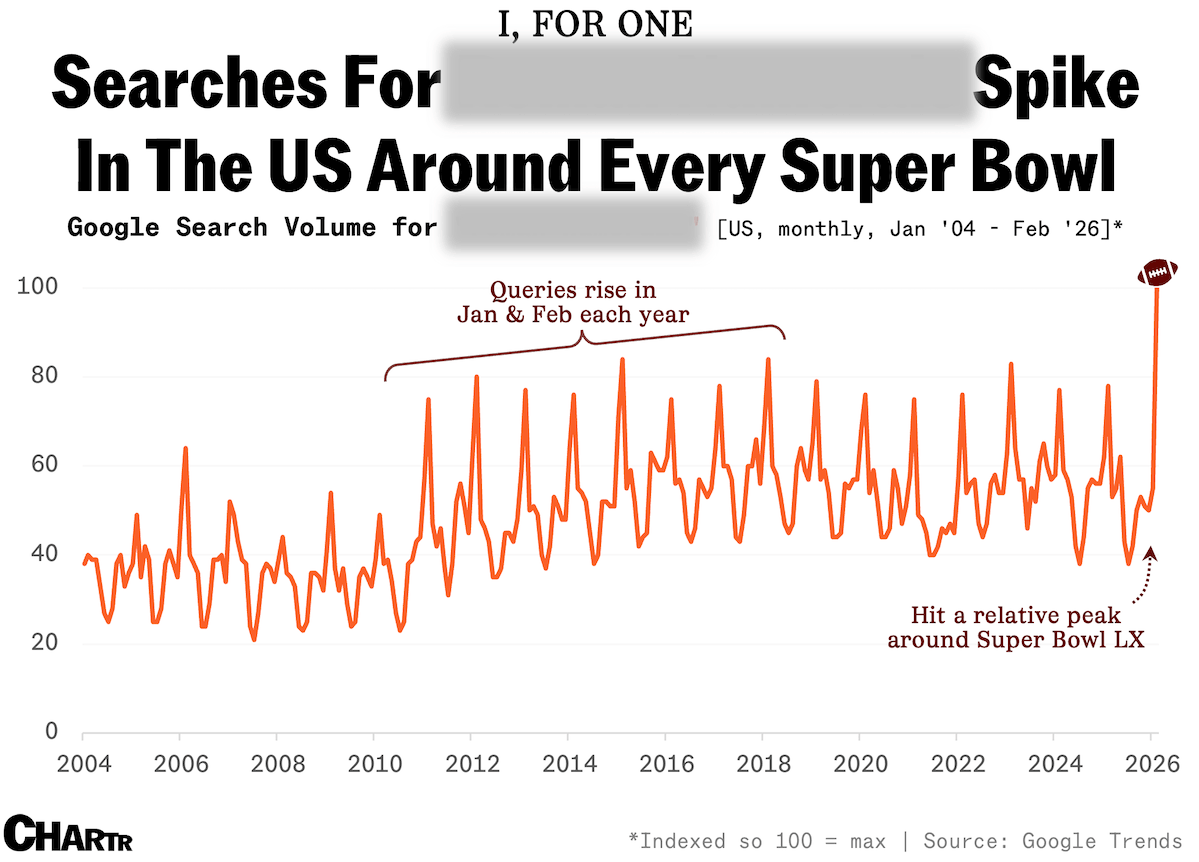
Off the charts: Google searches related to which numbering system tend to rise in January and February, around Super Bowl season? [Answer below].
|
Not a subscriber? Sign up for free below. |
| |
|