What matters in U.S. and global markets today

Global news you can trust.

Download the Reuters App.


Morning Bid U.S.

Morning Bid U.S.

A Reuters Open Interest newsletter

What matters in U.S. and global markets today


By Mike Dolan, Editor-at-Large for Finance and Markets

Wall Street returned from its three-day weekend on Tuesday to another day of AI-related angst and market churn that briefly saw the VIX volatility gauge stalk some of its highest levels of the year.

Even though the S&P 500 ended little changed on the surface, that masked another big downdraft in the software sector, ongoing jitters about hyperscalers' spending on AI, and even a big drop in high-flying Walmart stock ahead of its results this week.

I’ll get into that and more below.

But first, check out my latest column on why AI‑linked productivity bets might be moving Treasuries.

And listen to the latest episode of the Morning Bid daily podcast. Subscribe to hear Reuters journalists discuss the biggest news in markets and finance seven days a week.


Data refreshes every time you open this email. For more U.S. market news, click here. Please send any feedback to morningbid@thomsonreuters.com.


Today's Market Minute

  • ECB President Christine Lagarde plans to leave her job early to give outgoing French leader Emmanuel Macron an input into picking her successor, the FT said on Wednesday.
  • Iran and the U.S. reached an understanding on Tuesday on main "guiding principles" in nuclear talks, but that does not mean a deal is imminent, Iranian Foreign Minister Abbas Araqchi said.
  • The IMF urged Japan to keep raising interest rates and avoid loosening fiscal policy further, warning that trimming the consumption tax would erode its capacity to respond to future economic shocks.
  • Chinese firms continue to purchase U.S. LNG under long-term contracts, demonstrating how intertwined U.S. and Chinese energy systems remain, writes ROI Energy Columnist Ron Bousso.
  • Asia's crude imports are on track to hit a record high in February as the recent strong run continues, but the supplier mix is shifting in response to geopolitics, writes ROI Asia Commodities and Energy Columnist Clyde Russell.
 

Changing of Lagarde

Six weeks in, it's worth noting that the S&P 500 is still in the red for the year to date, the Nasdaq is down over 2%, and funds tracking the 'Magnificent Seven' mega-cap tech stocks are down almost 8% for 2026 so far. U.S. stock index futures were firmer ahead of Wednesday's bell, however.

In Europe, all the chatter centred on fresh reports that European Central Bank President Christine Lagarde plans to step down before her term ends in October 2027. The ECB said no decision had yet been made, but the original FT report said Lagarde was mulling the move to allow Emmanuel Macron and Friedrich Merz to influence the selection of her successor.

European markets were calm on the news as these reports have been doing the rounds for some time. In any case, steady ECB policy looks baked-in for the foreseeable.

But there will inevitably be focus on the political decision over Lagarde's successor - whether Germany may break with convention and claim its right to have a Bundesbanker head the ECB for the first time, or whether a compromise candidate like BIS boss and former Bank of Spain chief Pablo Hernández de Cos is more likely.

If a German ECB president emerged, markets may, at the margin, bet on a more hawkish trajectory over the horizon.

Elsewhere, UK inflation fell to 3%, as expected, keeping speculation about another Bank of England rate cut next month on the boil. Sterling was unmoved.

The main focus of the macro world later will be the FOMC's release of minutes for its January meeting - usually a relatively anodyne readout, but one that could take on more significance amid debates around AI's impacts on productivity and inflation going forward.

In geopolitics, Iranian Foreign Minister Abbas Araqchi said on Tuesday the U.S. and Iran had reached an understanding on "guiding principles" in nuclear talks. The prospects of a final deal remain uncertain, however. Oil prices trimmed some losses after falling around 2% on Tuesday.


Bonds swept up in leap of faith on AI productivity

Treasuries now appear to be riding the artificial intelligence frenzy, as speculation about the speed and scale of AI development spreads across companies and sectors — beating a drum for interest rate cuts if an outsize labor‑productivity boom follows.

That's at least one rationale for the past week's eye-catching slide in U.S. government bond yields. It makes more sense than hanging the move solely on January employment or inflation reports — neither of which offered the Federal Reserve a green light to resume easing.

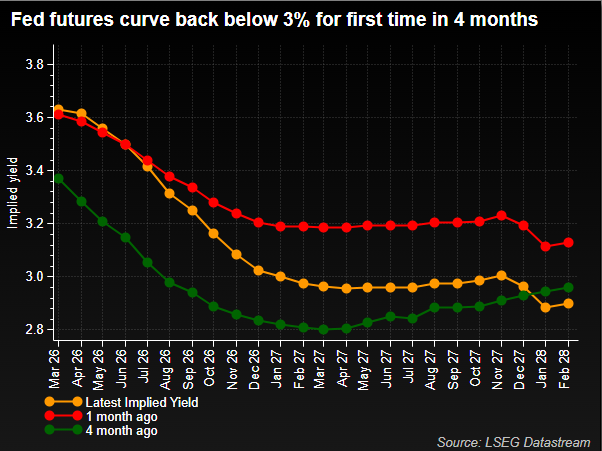
Yet, as bond yields tumbled across the curve to their lowest levels of the year, Fed rate futures through next year dipped below 3% for the first time in four months. That pricing now implies a third additional Fed rate cut is back in the mix and has invigorated the whole bond universe, which is starting to bet there may be even more in store.


Graphics are produced by Reuters.

Read the full column
 

Today's key chart