|
 |
Thank you for subscribing to Off Message. This is a public post, available to all so please share it widely. If you enjoy this newsletter, I hope you’ll consider upgrading to a paid subscription, for access to everything we do.
Alternatively, if you don’t want a Substack account, you can keep Off Message going with a donation. All support is appreciated, but donations of $75 or larger come with a comped annual subscription—all content unlocked and emailed to the address provided.
You make Off Message possible. Thanks again.
What AOC Wants For The World
The overwhelming majority of her critics are vapid; but there is one potential vulnerability in her vision of a better future.
|

| |||||||||||||||


 |
If you’ve been on the fence about breaking up with mainstream political news to support independent journalism, do me a quick favor and Google AOC + Munich. Open a new tab and do it right now. No leading words, just enter AOC + Munich and scroll the headlines.
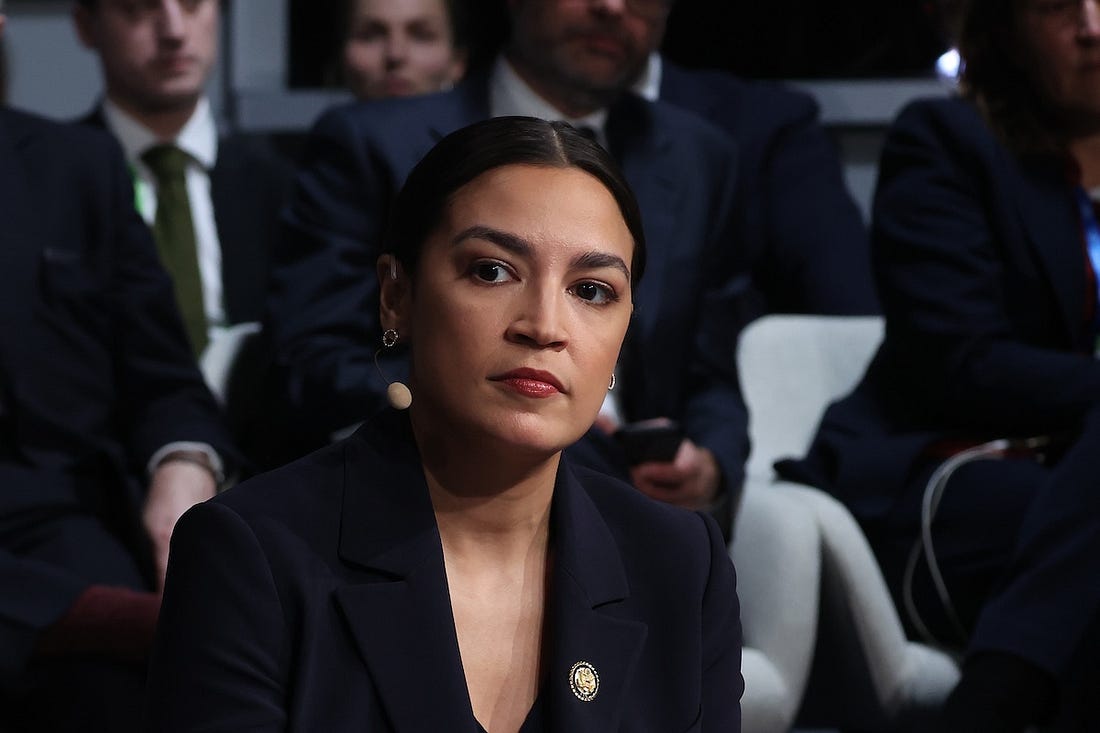
You’ll likely notice a slight bias. We live in the Trump era, yet for some reason Democrats must meet a very high standard of gaffe-avoidance. You’ll see that establishment media (Google included) still enjoys the power to define politicians, and is simply selective about who’s subject to this kind of treatment. Alexandria Ocasio-Cortez fell short of an arbitrary bar, freeing political journalists to depict a topsy-turvy world in which one of the Democratic Party’s most articulate leaders is an incoherent amateur. Their imputation that clarity and polish are essential political skills is left unstated, because that might raise some questions about double standards.
Essentially all substantive criticism of AOC has come from the left. Her progressive critics detected a dissonance between her appeals to economic egalitarianism and her participation in a security conference of, by, and, for the global elite—with all of its assumptions about the international trading system, and the defense alliances that undergird it.
“[F]or a politician that has built a progressive platform on criticism of US military interventionism and domestic policies aimed at benefitting the working class,” tut-tutted The Nation, “her presence at [the Munich security conference], widely considered to be the biggest international annual security event in the West and a major hub for hawkish military elites, seemed at first glance out of line with her values.”
In AOC’s defense, I believe these critics misapprehend the ambitious vision she drew in her remarks. But it’s important to probe the limits of that vision.
What AOC wants to see in the world, apparently, is U.S. moral leadership stripped of hypocrisies, and sustained by global, pro-democratic class solidarity. When we fail to live up to enlightened values, we breed contempt; when democracy doesn’t deliver people a decent standard of living, they will be tempted by the false promises of strongmen. Those vulnerabilities imperil both freedom and prosperity.
It’s a highly ambitious, idealistic vision of a better future. And there’s nothing in it for most progressives to dislike. To be a little flip, it’s a two step process of, first, global class war.
“We are moving in this direction of increased recognition that we have to have a working class centered politics if we are going to succeed, and also if we are going to stave off the scourges of authoritarianism,” which she defined as “political siren calls to allure people into finding scapegoats to blame for rising economic inequality, both domestically and globally.”
…and, second, benevolent U.S. participation in the new class-conscious community of democracies.
[W]e are in a new day and in a new time. But that does not mean that the majority of Americans are ready to walk away from a rules based order, and that we're ready to walk away from our commitment to democracy. I think what we identify is that in a rules based order, hypocrisy is vulnerability, and so I think what we are seeking is a return to a rules based order that eliminates the hypocrisies around when, too often in the West, we look the other way for inconvenient populations to act out these paradoxes, whether it is kidnapping a foreign head of state, whether it is threatening our allies to colonize Greenland, whether it is looking the other way in a genocide. Hypocrisies are vulnerabilities, and they threaten democracies globally. And so I think many of us are here to say, we are here and we are ready for the next chapter, not to have the world turn to isolation, but to deepen our partnership on greater and increased commitment to integrity to our values….
When you have a rules based order where you carve out exceptions to our values, exceptions to our rules, eventually the exceptions become the rules. And I think that to your original point, over the last five years, we've seen such a breaking and such a fraying of these alleged western values that people wonder if it ever existed in the first place. So I don't know if it's necessarily that we are in a post-rules based order, I think it's possible that we were in a pre-rules based order, and we have an opportunity to explore what a world would look like if we upheld democracy, human rights, trade that actually centers working class people, instead of accruing overwhelmingly the benefits of trade to the wealthiest. But if we reoriented a new era that could actually help people and show how foreign policy and healthy foreign policy can show up and help them in their lives.
There is no tension, in this view, between an international liberal order and social democracy. She has not aligned with dread globalists at the expense of workers. She wants to forge an international popular alliance of workers and their progressive allies, to counter the bourgeoning alliance of nationalists and kleptocrats—and for the resulting governments to helm more honorable, humane alliances.
You may think this is all pie in the sky. Moving the world in this direction is the undertaking of lifetimes. But it is a good vision, and perfectly defensible.
My main question is to what extent she presents this idea in this manner because she thinks it can be fashioned into a strong domestic and international political appeal, and to what extent she actually believes the underlying analysis—that fascism is an outgrowth of working class economic disaffection, and thus that economic policy is our best weapon in the fight against authoritarianism.
To my mind, it’s a strong, high-brow appeal, and a good guide star for the people who will build the future. It does not, however, strike me as an accurate assessment of the social underpinnings of authoritarianism, and would thus be a poor guide star for the more immediate challenge of defeating fascism.