In partnership with |  |
|
|
| Happy Thursday, N2K reader! | This week’s world-famous news haiku competition™ is about all the high-profile business, tech, and finance people who’ve shown up in the Epstein Files. Send me your entry — to our spiffy email address, haiku at cheddar dot com — by noon ET Thursday (today!) for consideration by your Cheddar peers! | And now for something completely different. | Matt Davis — Need2Know Chedditor | | News You Need2Know | | | What’s the stock market up to, eh? | $SPX ( ▲ 0.56% ) $DJI ( ▲ 0.26% ) $NDX ( ▲ 0.78% ) | | Companies mentioned in today’s newsletter | $KALSHI ( 0.0% ) $POLYMARKET ( 0.0% ) $AAPL ( ▲ 0.18% ) $NYT ( ▲ 1.99% ) $BRK.A ( ▼ 0.92% ) $TJX ( ▲ 0.17% ) | | Feds back prediction markets as states try to ban them |  | Polymarket’s politics predictions page yesterday…there’s also a 4% chance of Jesus Christ’s second coming by 2027, if you believe the prediction markets on the site’s homepage. |
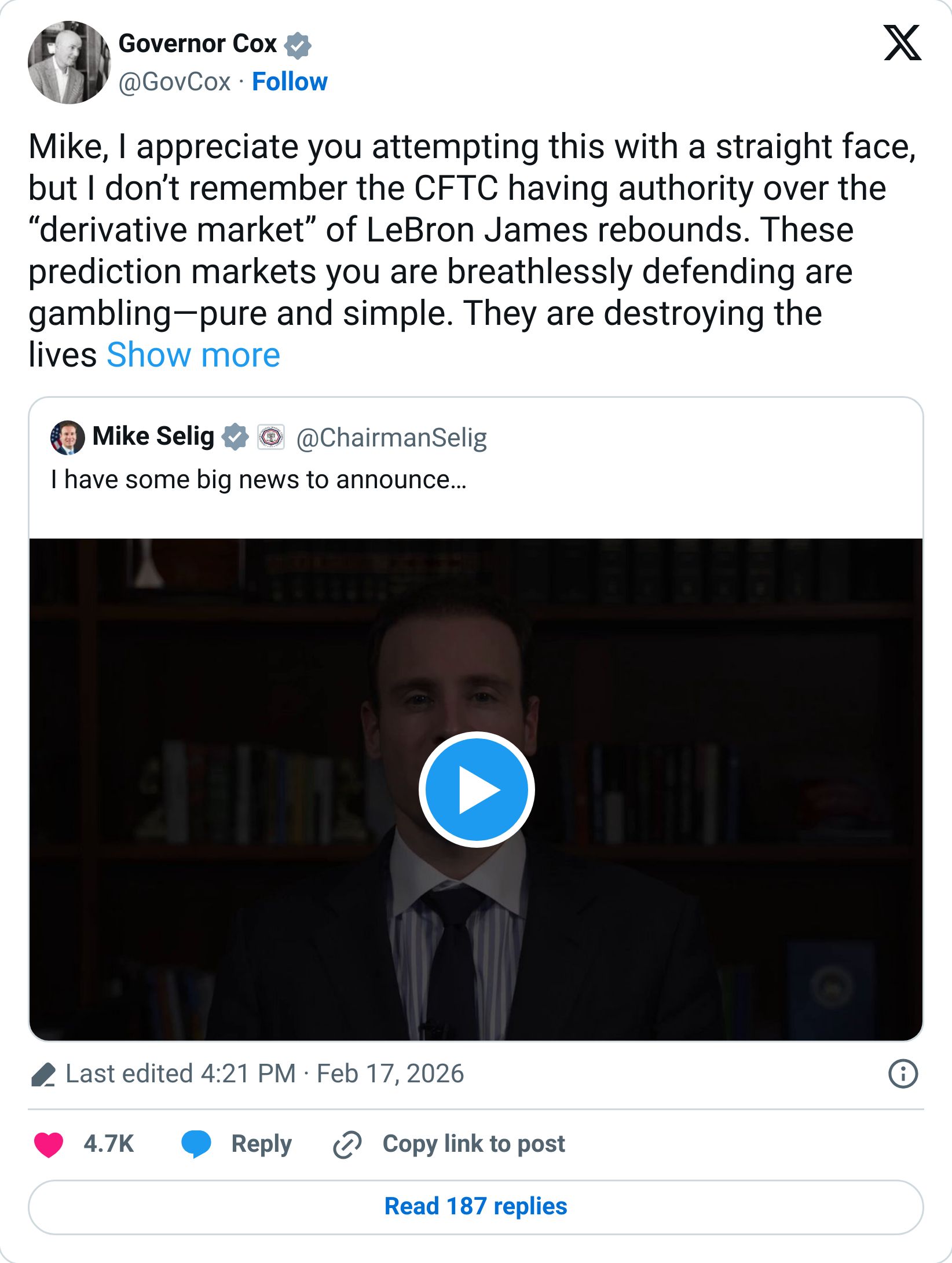
| The growing “prediction market” industry, powered by platforms like Kalshi $KALSHI ( 0.0% ) and Polymarket $POLYMARKET ( 0.0% ) , has become the center of a heated legal battle after the Commodity Futures Trading Commission (CFTC) expressed its support for the sector. Chairman Michael Selig put a video up on Twitter all about it, threatening to sue states who try to ban the platforms. | | Mr. Selig also wrote in a (checks notes) op-ed in the Wall Street Journal, “The CFTC will no longer sit idly by while overzealous state governments undermine the agency’s exclusive jurisdiction over these markets.” | His stance could revolutionize how prediction markets operate nationwide, potentially encroaching on states' ability to regulate gambling. | Prediction markets allow users to buy and sell contracts based on the likelihood of events, ranging from sports to geopolitical outcomes. However, states like Nevada, home to stringent gaming laws, argue these platforms function as unlicensed sports betting operations. | "These prediction markets you are breathlessly defending are gambling — pure and simple," said Utah Governor Spencer Cox, pushing back on Selig’s assertion that prediction markets mirror traditional futures contracts. “They’re destroying the lives of families and countless Americans, especially young men. They have no place in Utah.” | | Selig, whom we should take seriously because his shirt collar is a different color than the rest of his shirt, remains resolute: "To those who seek to challenge our authority in this space, let me be clear, we will see you in court,” he said. Yikes! | | | Let’s have a laugh at the tech bros’ expense |  | A group of people who might possibly take themselves too seriously |
| Austin Nasso and Jesse Warren, the co-founders of the Tech Roast Show, have turned the absurdities of tech culture into a global comedy tour. What started as a reaction to the homogenous culture in places like Seattle — where "every single person had the same exact job" — has evolved into a unique form of "punching up" at the industry's elite.
As the tech landscape has changed (with more job insecurity for the average worker), their target has shifted. Warren notes, "it really moved towards the regular person to more of like the startup founder, the arrogant CEO...taking advantage of all the funding going around." Nasso adds that the definition of a "founder" has shifted from "real businesses with, like, strong financials" to "children who have, like, just a prompt that they rode."
The show itself has moved "from an almost entirely scripted production to an entirely unscripted production," catering each performance to the individuals present. Thankfully, their audience of tech workers is mostly self-aware and supportive. With only a handful of negative reactions in almost a decade, they seem to have found the sweet spot for roasting the most privileged sector of the professional world. | | | Quote of the Day | | | Is there a recession coming, or what? | | The start of 2026 has seen significant market rotation, with energy and materials outpacing big tech. According to Bill Mann, Chief Investment Strategist at Motley Fool Asset Management, a major factor is "valuation fatigue" in the former market leaders. While recognizing that "the Mag 7 are some of the best companies that have ever been devised," he cautions, "that doesn't mean that you buy them at any valuation."
Mann sees the market "finally a little bit concerned about how AI is going to impact the software companies." He notes that AI is putting "a lot of pressure on certain business models that have worked in the past, the SaaS models," which are "definitely at risk." However, he looks forward to an end to the current "indiscriminate selling," when the market "will become more discriminating."
For the second quarter, Mann favors sectors "completely AI-resistant, completely resistant to tariffs," such as consumer staples. He cites TJ Maxx $TJX ( ▲ 0.17% ) as a favorite, emphasizing, "you're not going to AI-out, close-out retailers." He is also closely watching the shift in the AI build-out, which is increasingly using debt rather than equity, interested "to see if that changes some of the risk dynamics." Motley Fool Asset Management has also found "a lot of value out there" in international markets like Japan, Mann said. | | | Song of the Day: Charlie XCX, ‘Always Everywhere’ | |
|