|
Contact: Jessica Ryan, arspress@usda.gov
Finding More Effective Treatments in the Fight Against Varroa Mites
Researchers from USDA’s Agricultural Research Service (ARS) are helping bee keepers protect their colonies by studying the effectiveness of combining a widely used mite-killing pesticide with an agent that inhibits the ability of the destructive Varroa mite to tolerate the pesticide.
Honey bees play a crucial role in U.S. agriculture, with the value of crops that require pollination estimated at more than $20 billion annually in the U.S. Varroa mites, also known as Varroa destructor, are a force to be reckoned with in the honey bee world. The dangerous and parasitic mite of bee colonies causes bodily harm and spreads deadly viruses that have led to major colony losses across the country.
A preferred method to control Varroa mite populations is amitraz, a pesticide that is highly toxic to Varroa mites but safe for honey bees, when used as instructed. However, a recent ARS study found that Varroa mites are becoming increasingly resistant to amitraz due to a genetic mutation. Thus, bee keepers are now seeking more effective methods for controlling Varroa mite populations.
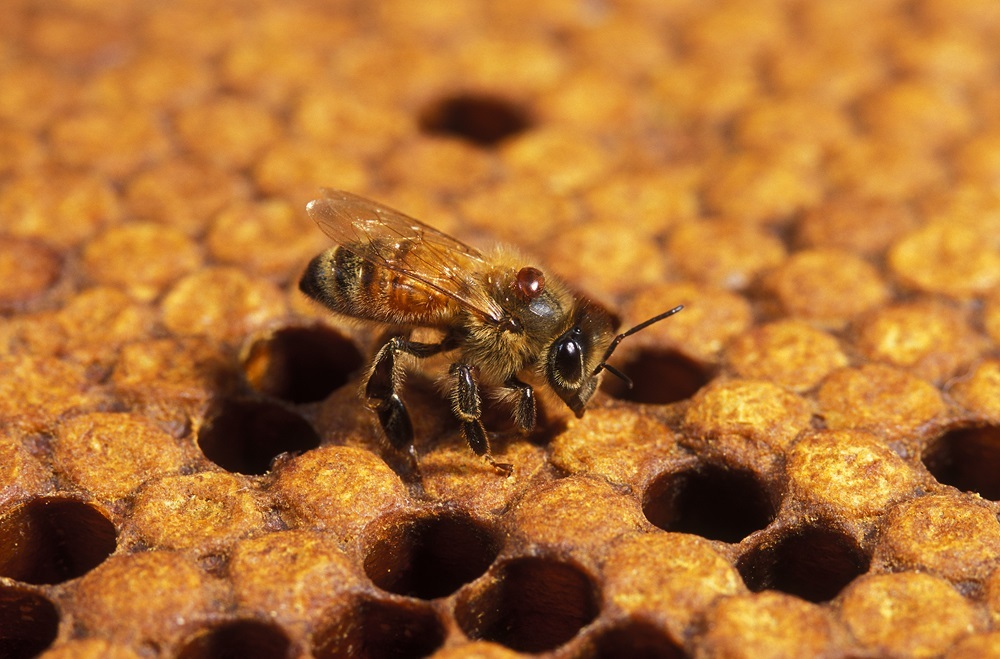
Adult honey bee with a Varroa mite on its back. (Photo by Stephen Ausmus, ARS)
In a new study, ARS and University of California, Davis (UC Davis) researchers explored a new way to increase the efficacy of amitraz, even in amitraz-resistant mites. The researchers conducted a proof-of-concept study in a laboratory setting by combining amitraz with a compound used in research to understand how certain pesticides are tolerated in organisms, like the Varroa mite.
“This compound inhibits a naturally occurring process that prevents certain chemicals, like pesticides, from accumulating inside cells,” said Julia Fine, a Research Entomologist at the Pollinator Health Research Laboratory in Davis, CA. “If a chemical toxicant can’t reach a high enough concentration in a cell, it won’t have a toxic effect in the organism. Previously, we didn’t know if this process was part of how Varroa tolerate amitraz exposure.”
Through a collaboration with UC Davis, Fine found that using the inhibiting compound in combination with amitraz increases amitraz toxicity and was even effective against amitraz-resistant mites. These findings open a promising new line of research that may lead to the development of novel synergists that can be used to control Varroa mites in combination with amitraz or other miticides. Increasing the efficacy of amitraz treatments, especially the initial application, may help bee keepers save time and money.
“Better amitraz formulations can decrease the need for additional treatments, lower the selection pressure on the mite population, and decrease the economic burden on bee keepers as they protect their colonies,” said Fine.
Fine noted that the inhibitor used in the research is not specific to Varroa. It can also negatively affect the ability of honey bees to tolerate pesticide exposures.
“Now that we know this process is important to amitraz tolerance in Varroa, the next step is to develop synergists that specifically inhibit this process in Varroa without affecting honey bees.”
The research was conducted in collaboration with the ARS Bee Research Laboratory in Beltsville, MD, and ARS Honey Bee Breeding, Genetics, and Physiology Research Laboratory in Baton Rouge, LA. This research was supported by a Honey Bee Health Grant through the North American Pollinator Protection Campaign (NAPPC) and the Pollinator Partnership (P2) to Professor Sascha Nicklisch of UC Davis.
The Agricultural Research Service is the U.S. Department of Agriculture's chief scientific in-house research agency. Daily, ARS focuses on solutions to agricultural problems affecting America. Each dollar invested in agricultural research results in $20 of economic impact.
|