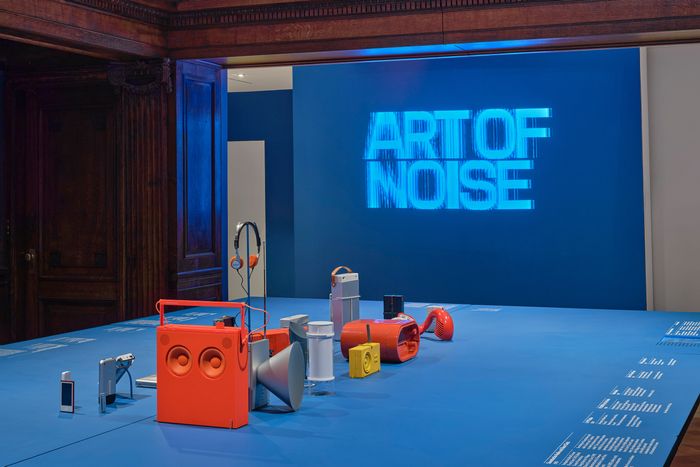
For those of us who grew up analog, a visit to the Cooper Hewitt’s survey Art of Noise turns into a nostalgic romp through the technologies of yesterday. My Proustian trigger was a portable gramophone designed by Mario Bellini for the Italian company Minerva. As a child, I spent hours in the backseat of the family station wagon entertaining myself with a similar gizmo, shaped like a bright plastic club sandwich. The mangiadischi, or “record-eater,” would swallow a 45; spin it for four minutes of crackly, tinny song; and then spit it out again with a click and a whimper. It must have driven my parents crazy.
The exhibition covers more than a century’s worth of music and design — or rather, design for music — and along the way it prompts a whole series of such full-body memories. I can recall a roll call of music machines, each with its own hazards and revelations, each tied to a moment in my evolving taste. It’s no accident that my mind goes back to a pocket music maker, because the story that the Cooper Hewitt tells is largely a chronicle of portability.