|
English | Español | አማርኛ | 中文 | 한국어 | Tiếng Việt | العربية | فارسی | اردو
Note: This newsletter contains links to translated versions of the content for your convenience. These translations are generated by Google Translate and are not intended to be a substitute for professional translation services.
Dear Fairfax County Community,
I hope everyone is enjoy the first glimmers of spring weather, and that snow days are behind us. It has been a busy few weeks for the School Board as we navigate our upcoming budget and finalize some important decisions for the next school year. Below are several important updates on our work and my recent visits throughout the community.
Budget Update
Last night, the School Board officially adopted the FY 2027 Advertised Budget. This is the first step toward passing the final budget later this spring, and it kicks off a community conversation around budget priorities. The $4.1 billion plan represents a 5% increase and is focused on sustaining our current programs while supporting our hard-working students and staff. The top priority of this budget is a compensation increase for our educators and employees, as they are our greatest asset. Of the $198m in increased spending, $178m is compensation. The Superintendent has also prioritized a reduction in class sizes, maintaining special education staffing, and funding advanced academic resource teachers. On my priority list is the Middle School After School programming that traditionally has been funded by the Board of Supervisors but has now shifted to the FCPS budget. I am working with other School Board Members and the Superintendent to identify funding and program reforms to ensure this critical, and very popular, program is maintained for tens of thousands of middle school students.
However, there is a $43 million gap due to significant challenges with state funding. During our deliberations, we discussed the difficult balance between "needs" and "nice-to-haves". This budget cycle is a long process that continues through May. We will continue advocating for the state to adopt JLARC recommendations, which could bring over half a billion dollars in additional funding to our schools annually and help reduce pressure on our local government.
More information on the budget can be found here, and information on budget town hall meetings can be found here.
Boundary Phasing and Transportation
Also last night, the School Board approved transportation services for high school students (grades 10-12) who are authorized to remain at their old base school as a result of recently adopted boundary changes. You may recall that this decision came before the School Board earlier this year; however, a 5-0-5 vote resulted in it being brought back last night.
Following an extensive outreach effort to families impacted by boundary changes, the Superintendent recommended transportation services only for 12th graders. I was unwilling to support that for several reasons, mostly because a bus carrying a 12th grader can also carry 10th and 11th graders.
After weeks of this decision being on the agenda, an 11th-hour amendment was brought forward to vastly expand bussing services from 12th graders to 5th, 6th, 7th, 8th, 10th, 11th, and 12th graders. This ballooned the annual budget impact from $800,000 to over $3,000,000. The timing of this proposal was a bit ironic because the next day the School Board and Board of Supervisors held its annual joint budget meeting, and the message was clear: this is not the time to unnecessarily increase spending on nice-to-have items.
There is another key piece of information that helped inform my decision last night: survey results indicated that 44% of students would need transportation to remain at their old base school; this represented 154 students, which extrapolates to 300 students based on the response rate. The other respondents were moving to the new school or were legally required to be provided transportation anyway (ie students with IEPs and 504s). This is to say that the decision last night was around whether to spend $3,000,000 per year to bus 300 kids above and beyond what is already done. That is not even close to reasonable.
Throughout this process, the biggest concern I heard from constituents was regarding changes for high school students, and the unique period in their lives (academically and socially) that these years represent, and the academic and extracurricular records that feed into college applications. I wanted to find a way to target transportation supports to those students, but only if it could be done within existing budget constraints. I worked with the Superintendent to explore options, and it was concluded that a hub transportation model could be established for high school students within existing funding for the most part. The hub system is very similar to how students are transported to Thomas Jefferson. Out of an abundance of caution, I also placed language in my substitute motion that in the event of cost increases, end-of-year funding could be used to cover those.
I am happy that my proposal was adopted by the School Board last night, and that high school students will be given transportation should they choose. I recognize that some families at the middle and elementary levels will be disappointed, and I share that disappointment. I am disappointed that there is a $43 million budget gap that is threatening other critical initiatives too (Middle School After School programming, advanced academic resource teachers, reducing class sizes, maintaining special education staffing support, and more).
When I made the motion to adopt this plan, I stated that this strikes the best balance between addressing the equity concerns that have been raised and recognizing the fiscal reality of the day. While we could not get there for all 7 grade levels, I am happy that we were able to get there for 3 of them.
School Spotlight: Herndon MS
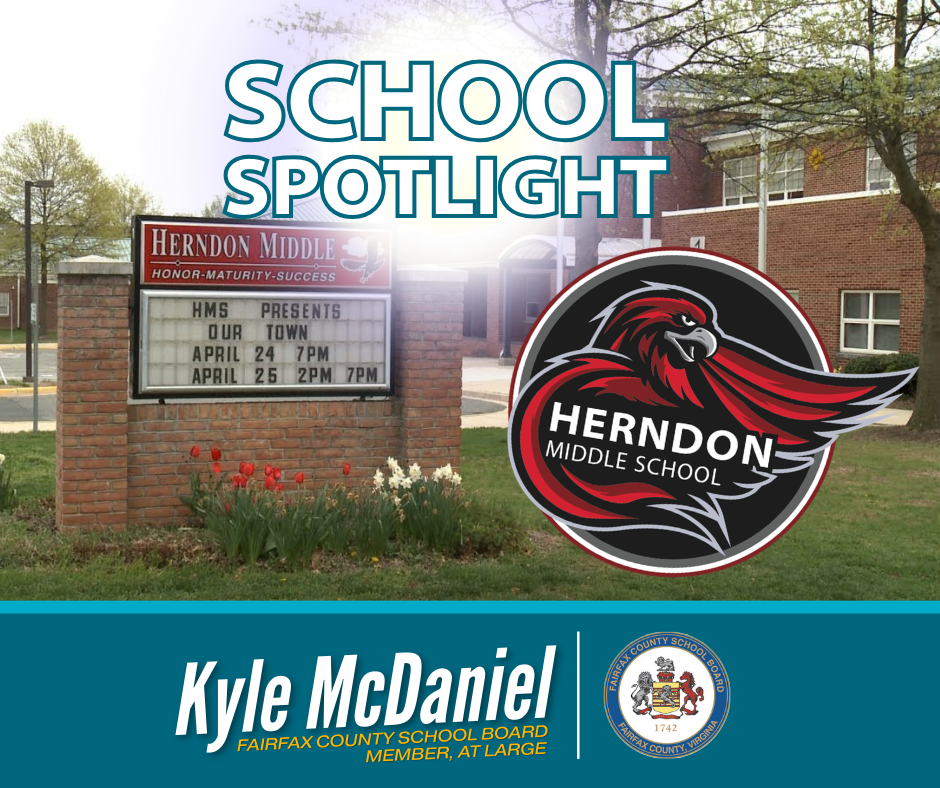
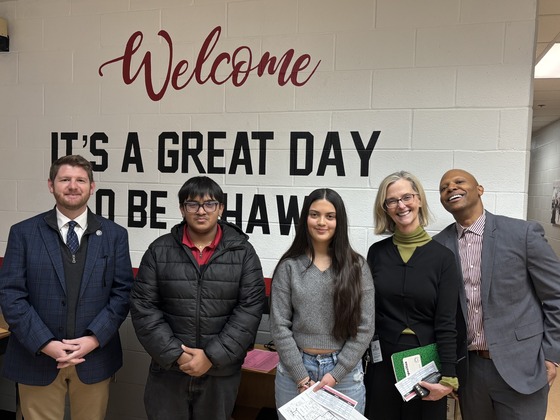
This week, I had the pleasure of visiting Herndon Middle School, home of the Hawks, which is proudly celebrating its 65th anniversary. Opened in 1961 and originally the site of Herndon High School in 1912, this campus has been an educational cornerstone in Herndon’s community. Today, it serves one of the most culturally and economically diverse student populations in the county and continues to build on its storied history.
Herndon stands out for its strong academic programs, including AVID and Advanced Academics (AAP), as well as new opportunities like Google Robotics, Capital One Coders, and an annual STEAM Night that connects students with real-world learning. The school is also recognized as part of the ISTE Lighthouse Schools network, highlighting its innovative teaching and learning. Go Hawks!
In the Community
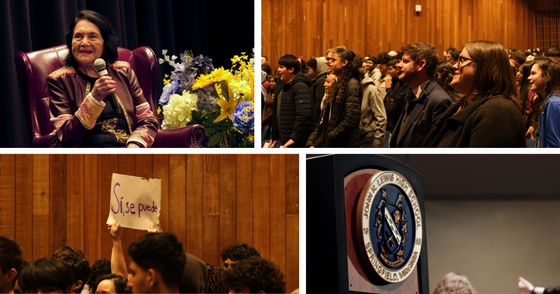
I have had a busy week around the county. Last Tuesday, it was an honor to attend a special event at Lewis High School where the legendary civil rights activist Dolores Huerta spoke to our students. Her message of advocacy and community strength was truly inspiring.
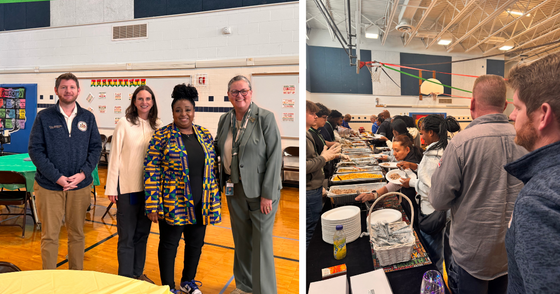
In celebration of Black History Month, I joined Superintendent Dr. Reid at West Potomac High School for Mr. Cooper’s 15th Annual Soul Food Lunch. The food was delicious and it was a wonderful opportunity to reflect on the history and contributions of the Black community in Fairfax County.
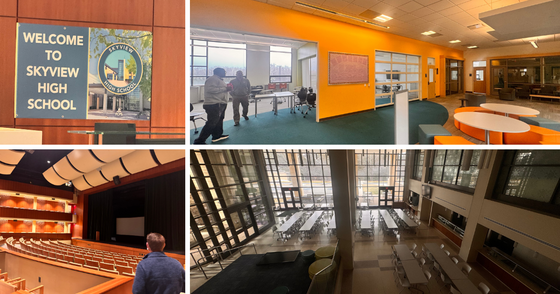
Finally, I toured the new Skyview HS with staff to get an update on getting ready for opening and new community partnerships. I am happy to report that progress toward our fall opening is looking great! I am so excited to see our newest school open this fall.
Thank you for your continued engagement and partnership.
Sincerely,
Kyle McDaniel
Fairfax County School Board
Member, At-Large
Other Updates
|