|
 |
The information landscape in the United States is busted. Billionaires are using the powerful social media platforms and media outlets they control to curry favor with Trump.
Google paid Trump $25 million to settle a bogus lawsuit.
Jeff Bezos purged Trump critics from the Washington Post opinion page.
Meta CEO Mark Zuckerberg canceled fact-checking on Facebook.
A pro-Trump billionaire bought CBS News — and is now buying CNN.
The only way to fight back is to build up independent media that is free from the influence of billionaires and corporate America.
Popular Information will never bow down to the powerful.
Although Popular Information has 535,000 readers, only a small percentage support our work as paid subscribers. We could put up a paywall to encourage more people to pay, but we don’t think access to crucial information should be limited by income.
If you believe in independent accountability journalism and can afford $50 per year or $6 per month, please consider becoming a paid subscriber.


 |
On February 28, the United States and Israel launched major combat operations in Iran. Iran has retaliated by striking multiple U.S. military facilities and embassies across the Middle East, including in Iraq, Kuwait, and the United Arab Emirates (UAE). As of Wednesday, the war had claimed the lives of six U.S. service members, 10 people in Israel, and over 1,000 civilians in Iran, according to the Human Rights Activists News Agency.
Due to the intensity of combat in the Middle East, other countries not directly involved in the conflict quickly began evacuating their citizens from the region. The Italian government has facilitated the evacuation of 2,500 Italians on commercial flights. The Czech Republic sent multiple flights to evacuate people stranded in the area. Several other countries, including the United Kingdom, France, and Greece, had organized flights scheduled for Wednesday, Reuters reported.
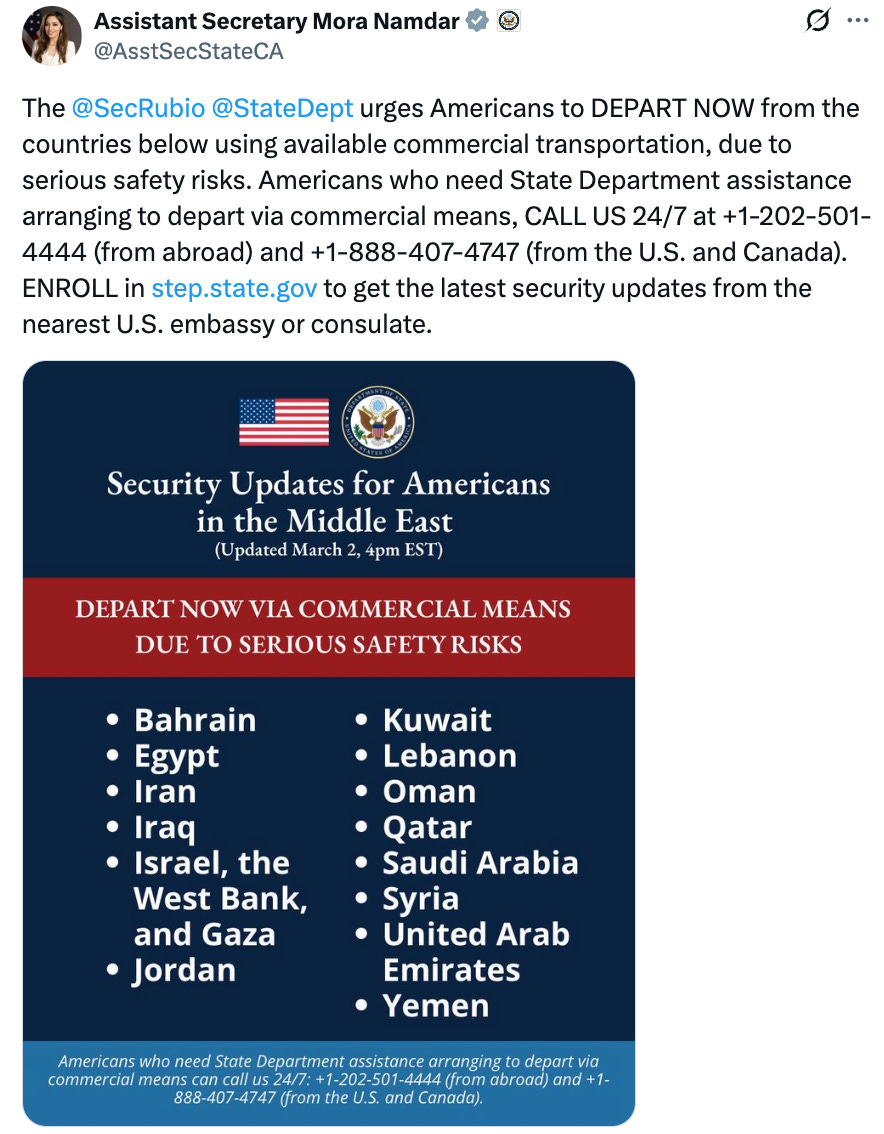
Americans in the area are in danger of being targeted, but the State Department did not advise citizens to leave the region before the strikes began. Before the 2003 Iraq War, in contrast, the State Department advised citizens to prepare to evacuate weeks in advance and ordered a final evacuation days before fighting began.
This year, Americans in 14 countries were not advised to evacuate until three days after the Trump administration began major combat operations in Iran. By that time, much of the region’s airspace and most airports had closed.
 |
According to the BBC, between “500,000 and one million US nationals are estimated to be living in the Middle East.”
The State Department told Americans to use “available commercial transportation“ to evacuate. On Tuesday, when Americans called a phone number publicized by the State Department, they received an automated message: “Please do not rely on the U.S. government for assisted departure or evacuation. At this time, there are currently no United States evacuation points.” (When Popular Information called the hotline on Wednesday afternoon, the recorded message said that the U.S. is “committed to helping U.S. citizens who want to leave the region to do so.”)
An American businessman who has been stranded in the UAE told NOTUS that when he reached a live operator, he was told to sign up online for State Department security alerts but was not offered any other help. Several news outlets spoke to stranded Americans who described feeling “trapped” and “helpless.”
“I’m just very shocked and upset that I see other nations getting their citizens out and we’re just stranded here,” one U.S. citizen stuck in Abu Dhabi told NPR.
Meanwhile, U.S. embassies throughout the Middle East announced that they were shutting down or unable to help stranded Americans. On Tuesday, the U.S. embassy in Jerusalem posted on X that it was not able “at this time to evacuate or directly assist Americans in departing Israel.” The embassy noted that Americans in Israel may be able to take ground transportation to Egypt and depart from Cairo’s airport, where flights have not been interrupted. However, the embassy’s post said that “the U.S. government cannot guarantee your safety” if Americans took this option.
Similarly, the U.S. embassy in Qatar told Americans they “should not rely on the US government for assisted departure or evacuation” and should “take advantage of commercial transportation options.”