|
 |
The Pulse: Cloudflare rewrites Next.js as AI rewrites commercial open source
An engineer at Cloudflare rewrote most of Vercel’s Next.js in one week with AI agents. It looks like a sign of how AI will disrupt existing moats and business models. Analysis
|

| ||||||||||||


Hi, this is Gergely with a bonus, free issue of the Pragmatic Engineer. This issue is the entire The Pulse issue from the past week, which paying subscribers received seven days ago. This piece generated quite a few comments across subscribers, and so I’m sharing it more broadly, especially as it raises questions on what is defensible and what is not with open source.
If you’ve been forwarded this email, you can subscribe here to get issues like this in your inbox.
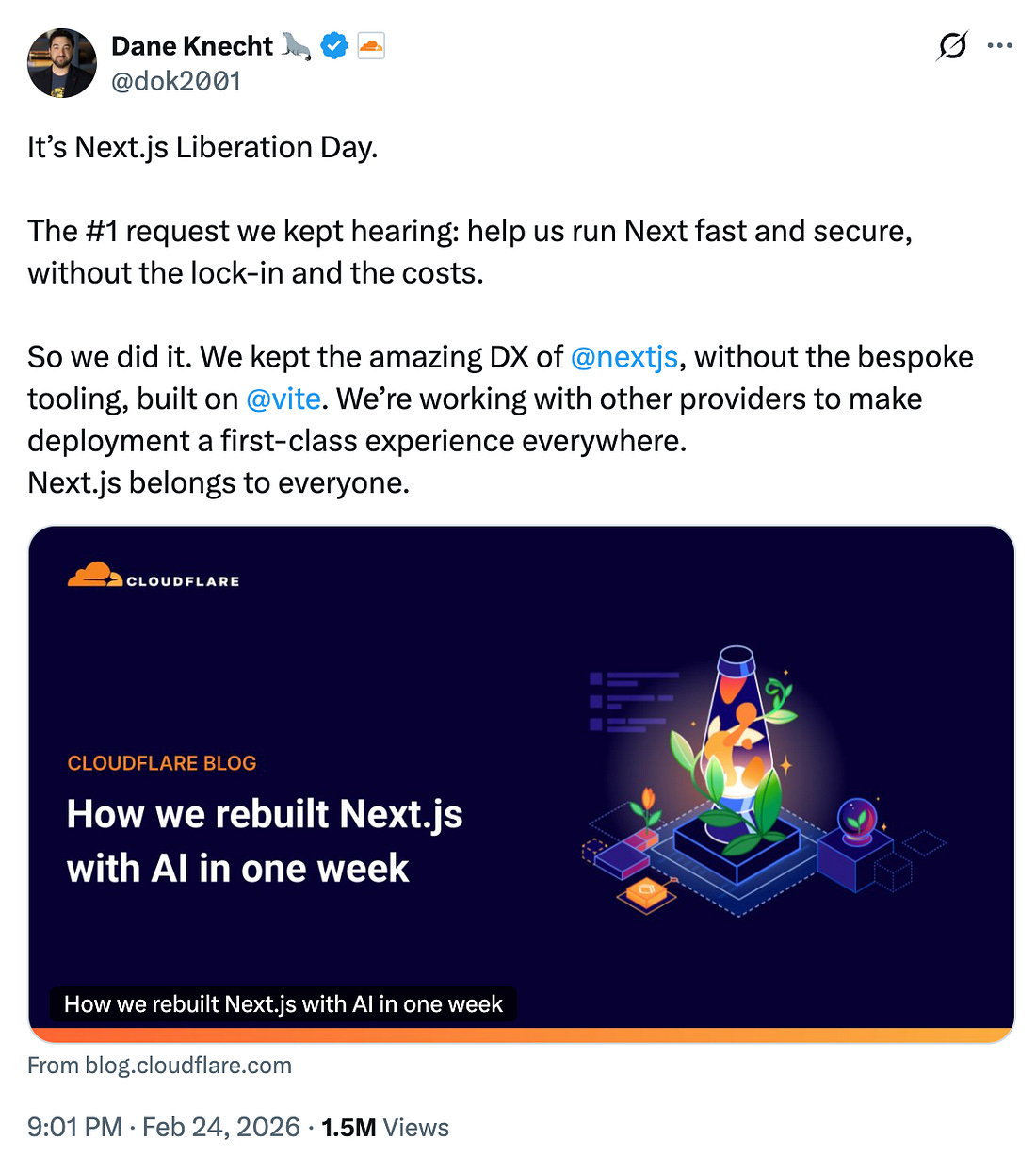
Today’s issue of The Pulse focuses on a single event because it’s a significant one with major potential ripple effects. On Tuesday, Cloudflare shocked the dev world by announcing that they have rewritten Next.js in just one week, with a single developer who used only $1,100 in tokens:
 |
There are several layers to dig into here:
The Next.js ecosystem: a recap. Close to half of React devs use Next.js, and the best place to deploy Next.js is on Vercel – partly thanks to its proprietary build output.
What Cloudflare did with Next.js. Replacing the build engine in Next.js with the more standard Vite one, allowing Next.js apps to be easily deployed on Cloudflare.
AI brings the impossible within reach. What would take years in engineering terms was executed in one week with some tokens.
“AI slop” still an issue. Contrary to Cloudflare’s claims, vinext is not production-ready, and will need plenty of cleanup and auditing to make it on par with Next.js.
New attack vector on commercial open source? AI makes it trivial to “piggyback” off any commercial open source project. That’s a massive problem for commercial open source startups.
Defense or offense? Making test suites private is one defense, and going closed source is another. Code is no longer a moat, but other things like support, community, and infrastructure could become more important.
AI-world reality. Tests are an efficient way to use AI agents, vendors will start deploying “migration agents” like Cloudflare, and more.
1. The Next.js ecosystem: a recap
First, some background. Next.js is the most popular fullstack React framework and around half of all React devs use it, as per recent research such as the 2025 Stack Overflow developer survey. Next.js is an open source project, built and mostly maintained by Vercel, which is the preferred deployment target for Next.js applications for many reasons. One of them is that Next.js is ideal to deploy to Vercel because Next.js applications are built with Vercel’s Turbopack build tool. The output of a build is a proprietary format. As Netlify engineer Eduardo Bouças writes:
“The output of a Next.js build has a proprietary and undocumented format that is used in Vercel deployments to provision the infrastructure needed to power the application.
This means that any hosting providers other than Vercel must build on top of undocumented APIs that can introduce unannounced breaking changes in minor or patch releases. (And they have)”.
Next.js is an interestingly built project, where everything is open source, and the best place to deploy a Next.js application is on Vercel, as it’s optimized to run undocumented build artifacts the most efficiently. This is a smart strategy from Vercel which competitors will dislike, as any hosting provider would prefer Next.js to produce a standard build format. To do this, the build engine, Turbopack, would need to be replaced with something more standard.
Let’s talk about build tools for web development. According to the State of JS 2025 survey, the most popular in the web ecosystem are:
Vite: the most popular choice for new projects due to its speed and developer experience. Uses projects like esbuild and Rollup under the hood
Webpack: a legacy tool that’s not very performant, but still widely deployed in older projects
Turbopack: Created by Vercel and optimized for larger Next.js applications. Built in Rust and intended to be more performant
Bun: a relatively new, all-in-one runtime and bundler. Anthropic acquired the team in December, and some Bun folks are now focused on improving Claude Code’s performance.
So, most of the web ecosystem uses Vite as a build tool; Next.js uses Turbopack, and the majority of React applications with a full-stack React framework use Next.js. Basically, most devs using Next.js are likely to use Vite as their build tool.
2. What Cloudflare did with Next.js
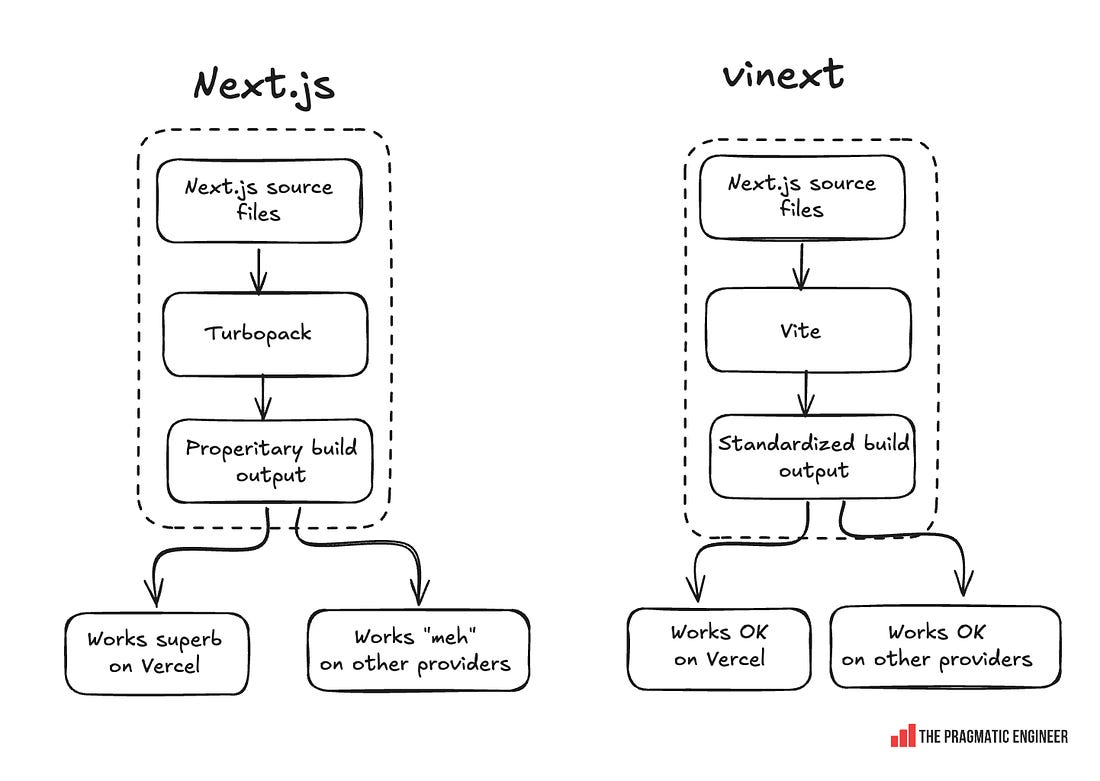
Here’s a naive idea: what if Next.js used Vite to generate build outputs? In that case, build outputs would be standardized and would run equally well on any cloud provider, as there would be nothing proprietary or undocumented to Vercel.
And this is what Cloudflare did: replace Turbopack with Vite and call the new package ‘vinext’:
 |