| | President Donald Trump says he wants to help pick Iran’s new leader, Gulf investors adapt to a new r͏ ͏ ͏ ͏ ͏ ͏ |
| |  | Flagship |  |
| |
|
The World Today |  - Trump wants say in Iran leader
- US, Gulf look to Kyiv for help
- New reality of dealmaking
- Oil shock to US economy
- Trump fires DHS head
- Nvidia stops making H200
- New Chinese billionaires
- China’s AI optimism
- Iran-inspired US drone
- Math genius plagiarized
 The final battles of Apache medicine man Geronimo. |
|
Trump wants to pick new Iran leader |
 Nathan Howard/Reuters Nathan Howard/ReutersUS President Donald Trump on Thursday said he wanted a role in picking Iran’s next leader, further muddying Washington’s war motives. Iranian clerics are close to announcing the new supreme leader, following the killing of Ali Khamenei, whose son is in the running to lead the country. That would be “unacceptable,” Trump told Axios, adding he needs to be involved in selecting who’ll run Iran — just as he was in Venezuela. But analysts noted the vast differences between Tehran’s ideologically-driven regime and Caracas’ strongman-centered government. Trump’s remarks also contradict US officials’ denials that Washington is pursuing regime change, but if it does, a former US diplomat argued, it will likely result in the same “costly chaos” that ensued in previous attempts. |
|
US, Gulf seek Ukraine’s help |
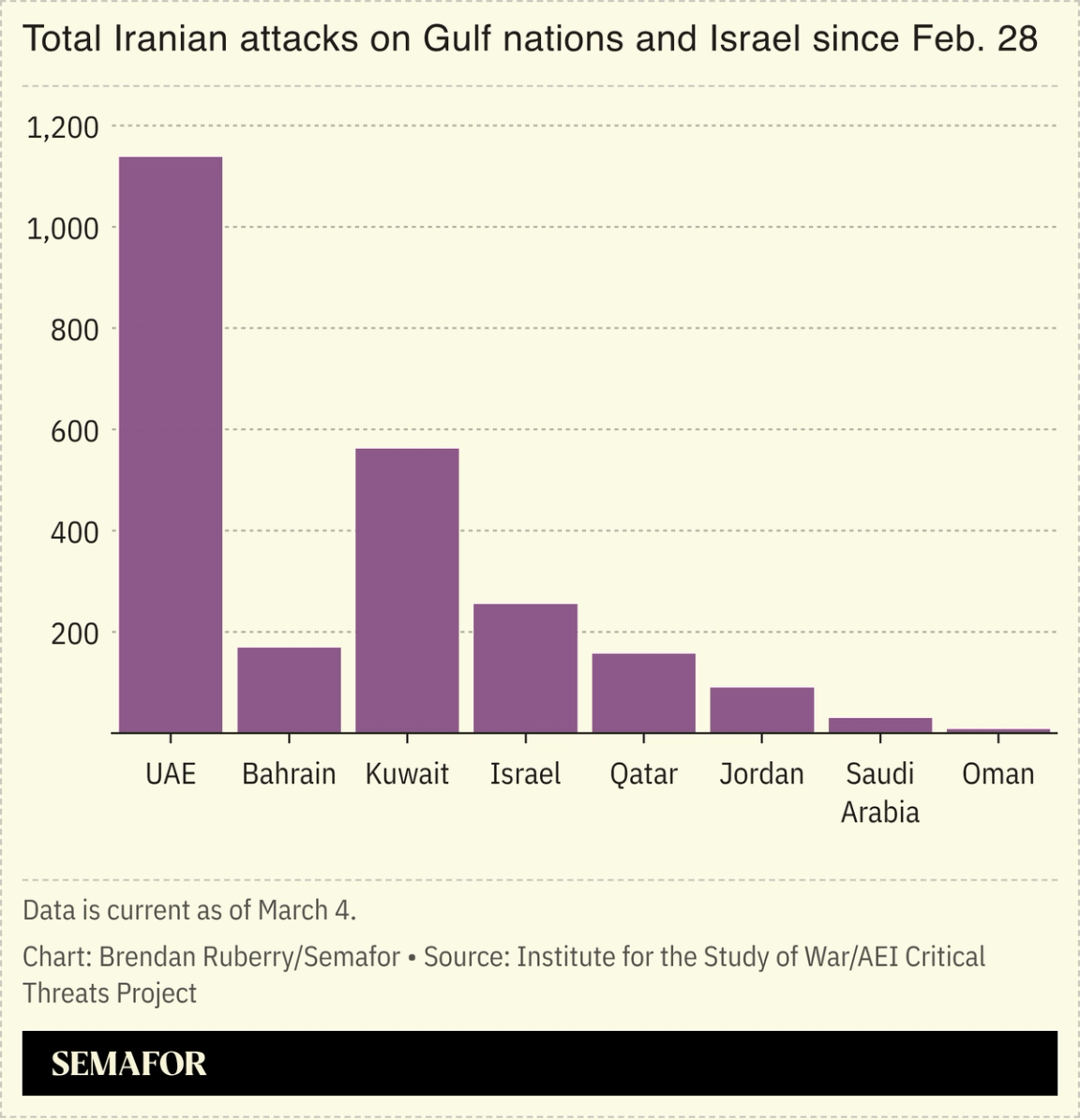 The US and Gulf are turning to Ukraine to help fend off Iranian attacks, even as the Middle East conflict depletes American munitions that Kyiv urgently needs for its own defense. Iran is increasingly using Shahed drones in its Gulf strikes; the Pentagon is reportedly looking to buy Ukraine’s cheap drone interceptors, which Kyiv mass produces to destroy Russian versions of Shaheds in the Ukraine war. Gulf nations are relying on expensive US Patriot missile systems to intercept Iranian strikes, but those stocks are dwindling, prompting Kyiv to suggest a weapons exchange. The Gulf would also benefit from Ukraine’s guidance on defending energy infrastructure, Semafor’s energy editor wrote: “No country in the world has as much experience as Ukraine.” |
|
Business as usual for Gulf |
 Rula Rouhana/Reuters Rula Rouhana/ReutersGulf investors are adapting to the new reality of dealmaking as the Iran conflict widens. “The appetite to show that life carries on as usual by continuing to do outbound deals is high,” Semafor’s Saudi bureau chief wrote. As Iranian missiles targeted Qatar and Bahrain, the Qatari sovereign wealth fund backed a $10.7 billion buyout of a US power company, and Bahrain’s aluminum giant acquired an EU smelter. While Wall Street will breathe easy knowing that Gulf sovereign funds are still writing checks, it might not be business as usual for inbound deals, and takeovers within the region will likely slow: “Who wants to buy an asset that could be hit by a drone next week?” |
|
US to face different kind of oil shock |
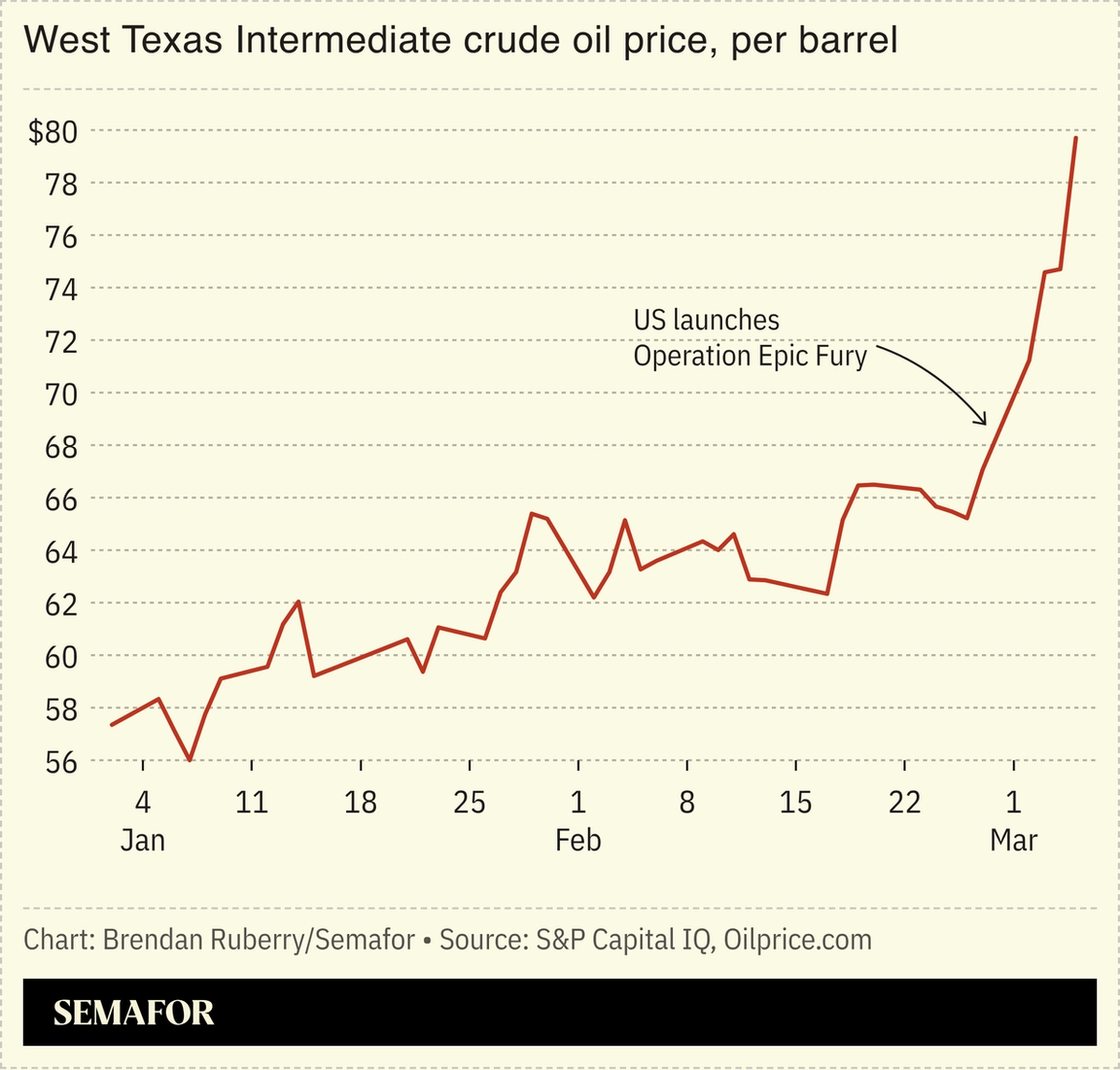 The US is facing a different kind of oil shock than in the past as a result of the Iran war, a Bloomberg columnist argued. Unlike in the 1970s, the primary threat to the US economy of sustained conflict isn’t higher inflation, but lower growth, Jonathan Levin wrote: Companies may respond to higher energy costs by shrinking payrolls, helped by the pretext of labor-saving AI, amid an already weak — and therefore disinflationary — labor market. US crude topped $80 a barrel Thursday, surging more than 16% since Saturday as more ships came under attack in Gulf waters and hundreds of tankers remained stranded outside the Strait of Hormuz. But the US president shrugged off higher gas prices Thursday, telling Reuters “if they rise, they rise.” |
|
Trump fires Noem as DHS secretary |
 Elizabeth Frantz/Reuters Elizabeth Frantz/ReutersUS President Donald Trump fired Kristi Noem as homeland security secretary on Thursday, marking the first Cabinet departure of Trump’s second term. Bucking the White House’s “Fight Club” mentality against ousting advisers, especially those in the crosshairs of Democrats, Noem was “dead man walking” after a series of high-profile missteps, a White House source told Semafor’s DC team: Noem labeled two US citizens killed by immigration agents in Minnesota “domestic terrorists,” but the final straw was her performance in pugilistic Senate hearings this week. Noem became “the face of Trump’s increasingly unpopular mass deportation campaign,” The Wall Street Journal wrote, but her exit is unlikely to resolve a partial government shutdown revolving around proposed changes to immigration enforcement. |
|
Nvidia stops making H200 chips |
 Steve Marcus/Reuters Steve Marcus/ReutersNvidia has stopped making its China-bound AI chips, the Financial Times reported, after months of uncertainty over Washington’s tightening export controls and Beijing’s push for self-sufficiency. Washington approved sales of Nvidia’s powerful H200 processors to China in January, but Beijing restricted Chinese companies from buying them, in a push to support homegrown chip champions. Chinese policymakers have prioritized AI and advanced chips at the annual “Two Sessions” meetings, and while China lags behind the US in semiconductors, experts told CNN that “Beijing is moving with confidence” toward its innovation goals. |
|
China is the world’s billionaire capital |
 Kane Wu/Reuters Kane Wu/ReutersChina surpassed the US to become the world’s billionaire capital, an annual report released Thursday showed. Wealth was “created faster last year than at any point” in the list’s history, Hurun Group’s chairman told the South China Morning Post, largely owing to the global AI boom: Leading Chinese AI firms Zhipu and MiniMax minted two new billionaires. MiniMax’s first post-IPO results this week showed it doubling its revenue, and its models are “helping fuel a new wave of technological nationalism,” Bloomberg wrote. China’s new tech elite is expected to keep a low profile, however, given prohibitions on public displays of wealth, and the omnipresent threat of US sanctions. “The goal is not to get caught,” one Beijing-based adviser said. |
|
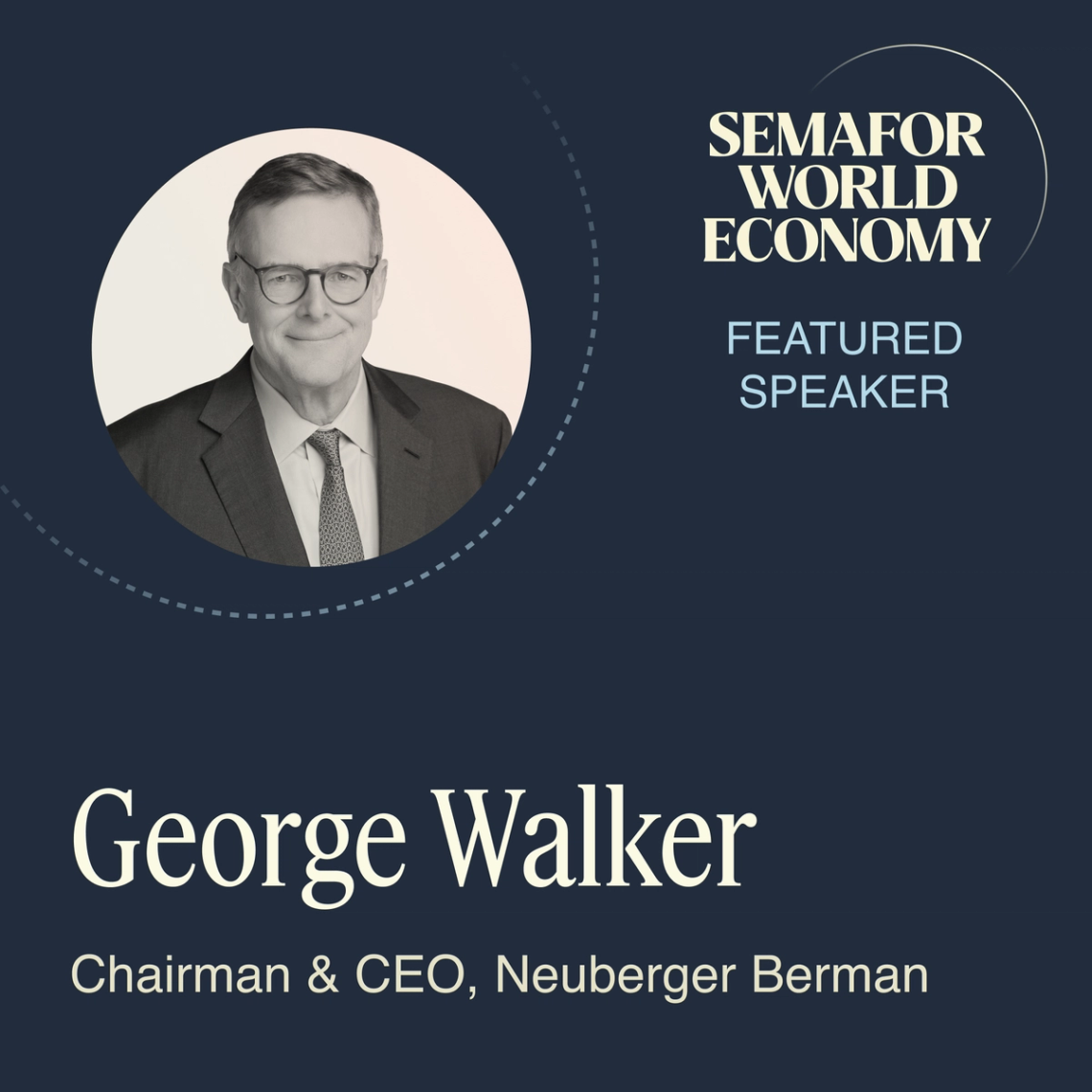 This April, George Walker, Chairman and CEO of Neuberger Berman, will join global leaders at Semafor World Economy — the premier convening for the world’s top executives — to sit down with Semafor editors for conversations on the forces shaping global markets, emerging technologies, and geopolitics. See the first lineup of speakers here. |
|
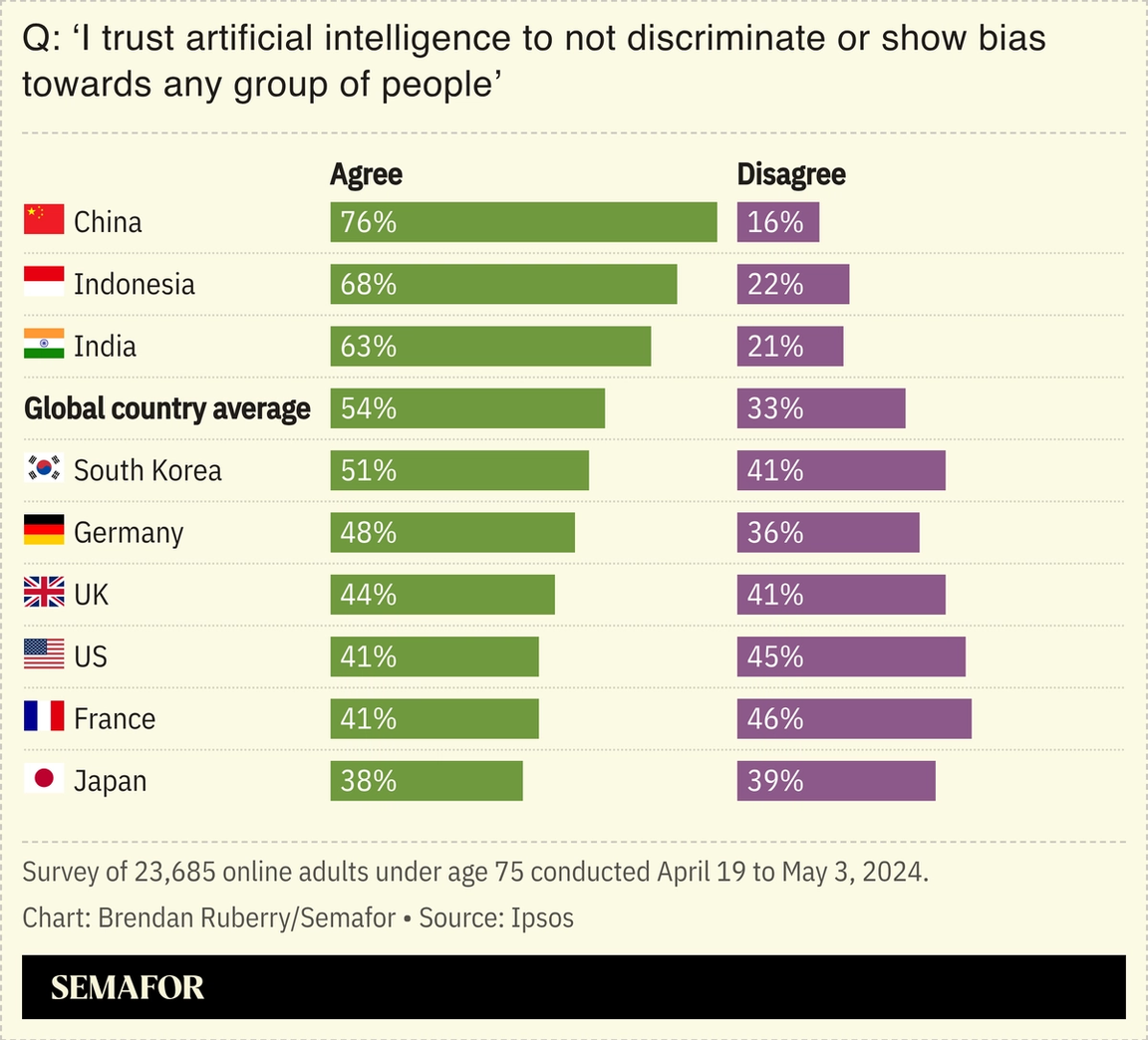 China and the West have had contrasting responses to the rise of AI: Where the US and Europe fear its impacts, Chinese people are optimistic. AI is deeply embedded in Chinese society. Driverless taxis are everywhere, and AIs assistants are common in popular apps. Chinese tech companies have focused on everyday AI applications rather than developing the most cutting-edge model, The New York Times reported, so consumers “are feeling the benefits,” one professor said. Accordingly, 69% say the technology’s benefits outweigh its risks, compared to 35% of Americans. The jobs that AI is expected to replace — notably in software — are also rarer in China, a venture capitalist argued, so fears of a white-collar job apocalypse are less salient. |
|
US deploys Shahed-inspired drone |
 A Russian-Iranian Shahed displayed in Kyiv. Valentyn Ogirenko/Reuters A Russian-Iranian Shahed displayed in Kyiv. Valentyn Ogirenko/ReutersThe US has copied the Iranian Shahed drone and is using it against its maker. The Shahed is slow — around 115 mph — and primitive; but it is cheap, perhaps $50,000, and has been used in huge numbers by Iran and by Russia. Even if shot down, they can “win” — a US Patriot interceptor missile costs $4 million. An Arizona-based firm reverse-engineered it and built its own version, which has now been used in combat for the first time. New technologies change warfare: Cannons made medieval-style castles obsolete; anti-ship missiles did the same to battleships. Cheap, expendable drones could be doing something similar to complex defensive weaponry, an analyst told New Scientist. |
|
|


