| | In today’s edition: Trump finally fires Noem, and the Iran war adds to Ukraine’s challenges.͏ ͏ ͏ ͏ ͏ ͏ |
| |  | Washington, DC |  |
| |
|
 - Can Oversight tackle Epstein?
- Trump fires Noem
- DHS funding vote fails
- Iran weighs on Ukraine
- Venezuela, US resume ties
- Daines’ boss move
- Jobs data in focus
- Push to halt WBD takeover
PDB: Gonzales ends his reelection bid  NYT v. Hegseth in court … Pentagon deems Anthropic a supply chain risk … Brent crude futures ⬆️ 2.8% |
|
House Oversight ups Epstein scrutiny |
 Ken Cedeno/Reuters Ken Cedeno/ReutersThe Republican-led House Oversight Committee is up to something rarely seen on the Hill: It’s scrutinizing an administration from the same party. Its vote to subpoena Attorney General Pam Bondi this week for its Jeffrey Epstein investigation follows an interview arranged with Commerce Secretary Howard Lutnick, who has faced his own tough questions about his ties to the convicted sex offender. “She’s in the batter’s box,” Rep. Tim Burchett, R-Tenn., said of Bondi. “I’d say, let her hit.” Burchett and a handful of other Republicans joined all Democrats in voting to subpoena Bondi. He sidestepped a question on whether Republicans had faith in her leadership but said it was “time to get some answers.” Still, interest isn’t the same as results, and Rep. Thomas Massie, R-Ky., was skeptical that the Oversight panel would generate serious breakthroughs or illuminating disclosures. — Nicholas Wu |
|
Noem firing was long time coming |
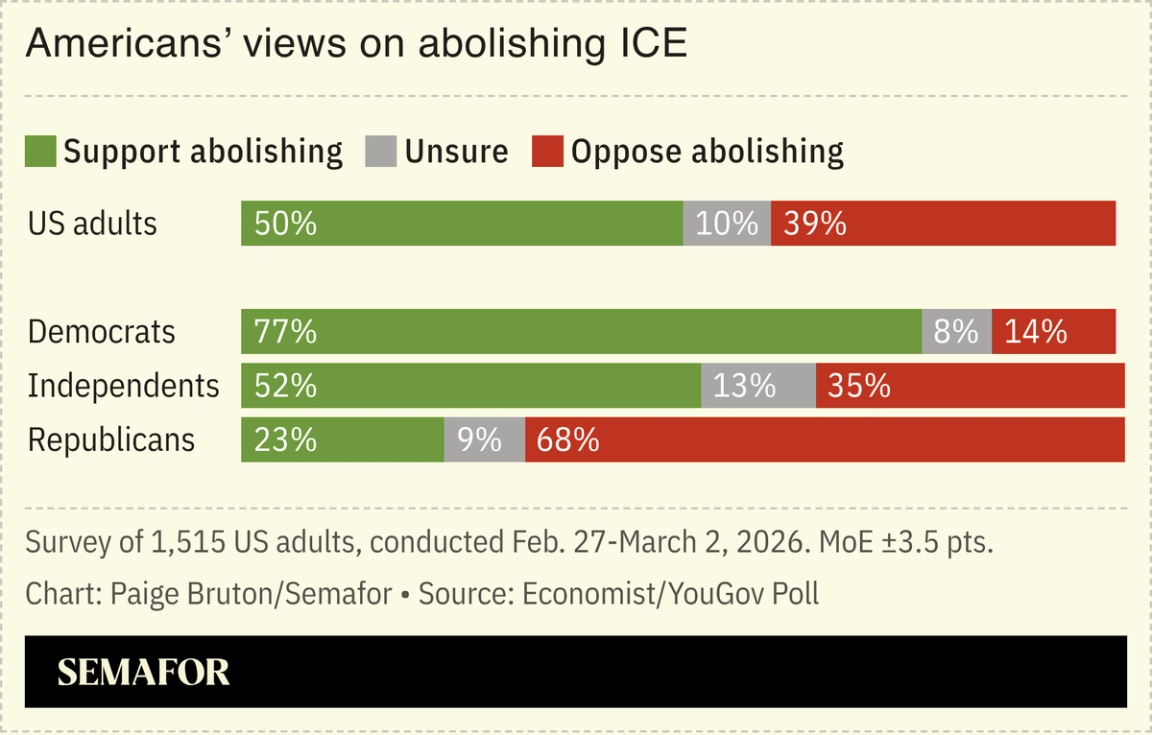 President Donald Trump’s decision to oust Department of Homeland Security Secretary Kristi Noem has been a long time coming, Semafor’s Shelby Talcott reports. Sen. Markwayne Mullin, R-Okla., will replace Noem on March 31 and Noem will take on a new position, titled “special envoy for the Shield of the Americas.” For White House allies and even many inside the administration, the announcement comes as a relief. “Hallelujah,” one person close to the White House told Semafor. For months, senior Trump aides had named Noem as the Cabinet secretary most likely to be replaced. Noem’s series of missteps culminated in a Tuesday Senate hearing where she claimed that Trump had approved a $200 million-plus DHS ad campaign, which Trump later denied. |
|
DHS to remain partly shuttered |
 Annabelle Gordon/Reuters Annabelle Gordon/ReutersThe Department of Homeland Security will stay partially shut down for the foreseeable future. Just a few minutes after Trump confirmed he was getting rid of Noem, Senate Democrats blocked the DHS funding bill again in the Senate, 51-45. Later in the afternoon, a House bill passed 221-209, with four Democrats voting to support it. But that bill still doesn’t have the votes to break a Senate filibuster, and Democrats continue to push for policy changes at the department. It will take bipartisan negotiations on immigration enforcement to reopen DHS, which has now been shuttered for three weeks. But pushing Noem out won’t be enough to break the logjam, with House Minority Leader Hakeem Jeffries telling reporters a “change in personnel is not sufficient. We need a change in policy and that has to be bold, dramatic, transformational and meaningful.” — Nicholas Wu and Burgess Everett |
|
Iran conflict weighs on Ukraine |
 Jens Buttner/Pool via Reuters Jens Buttner/Pool via ReutersThe war in the Middle East is pulling in Ukraine. The US requested Kyiv’s help combatting Iran’s Shahed drones, which Russia has used extensively against Ukraine. Ukrainian President Volodymyr Zelenskyy suggested Thursday there could be a trade: “We would like to fill our deficit of Patriot missiles and supply a certain number of interceptors,” he said, per Bloomberg, later writing that Ukraine would offer the US “instructions” and “specialists” to counter the drones. Meanwhile, the Iran war is burning through the munitions Ukraine itself needs. “While it might in the end weaken Russia,” Kajsa Ollongren, EU special representative for human rights, told Semafor, “if this would be a longer war, in terms of [Ukraine’s] capabilities, it could present a problem.” The conflict continues to widen: Iran launched missiles at Tel Aviv; Israel struck Beirut and Tehran; and the crucial Strait of Hormuz was almost totally closed. — Morgan Chalfant |
|
Venezuela, US resume diplomatic ties |
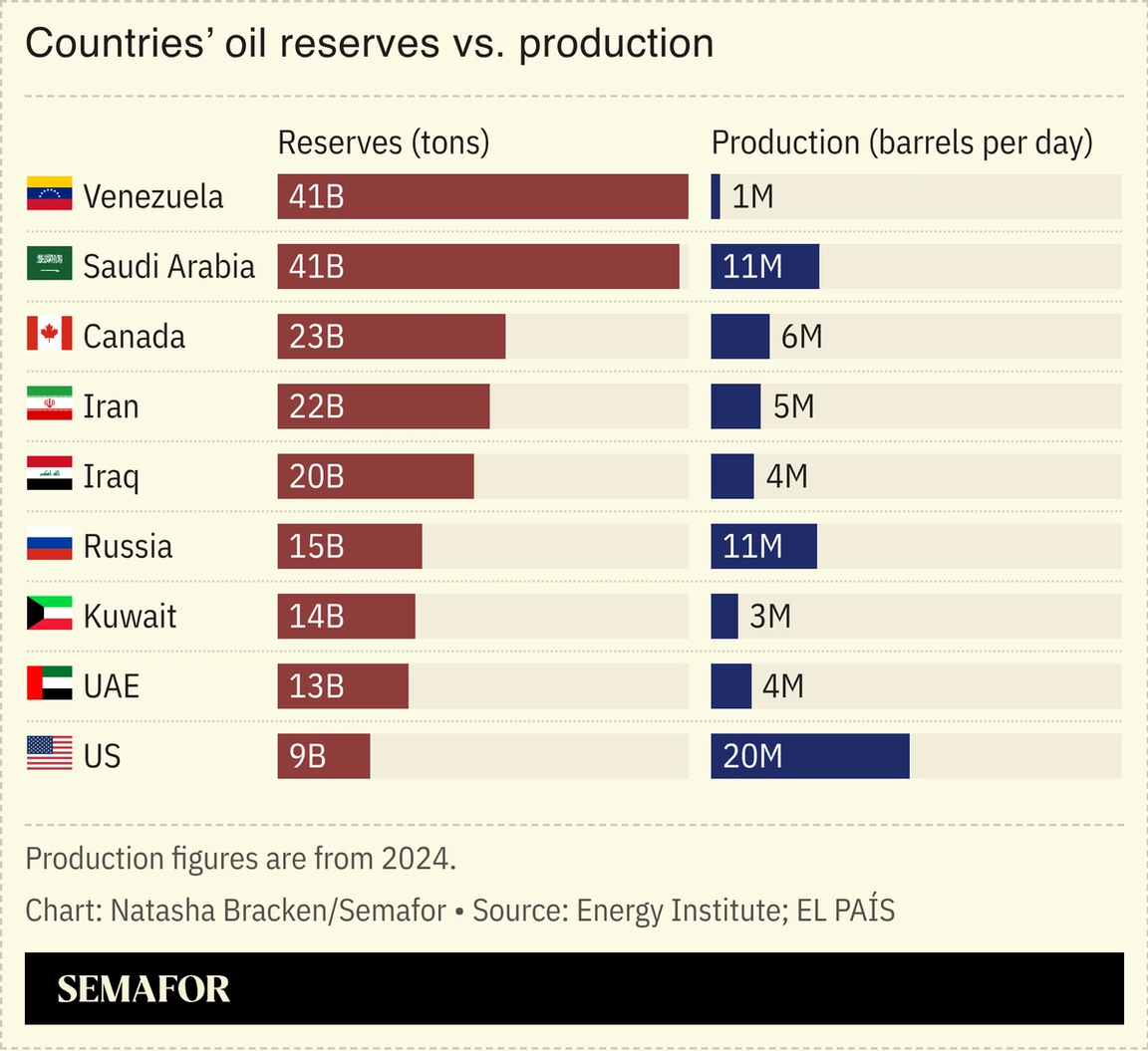 The US and Venezuela agreed to reestablish official diplomatic ties, a landmark moment in the wake of Washington’s ouster of the Latin American nation’s leader. The announcement followed a raft of visits by top US officials, most recently the interior secretary, and a series of moves by Washington to normalize its economic relations with Caracas. Though the agreement officially suggests a peer relationship, the US has in reality been putting huge pressure on Venezuela’s leadership, in particular over the redevelopment of its lucrative crude fields, the world’s largest proven reserves: Washington has in effect exercised control over who Caracas can sell its oil to. |
|
Behind Daines’ surprise withdrawal |
 Elizabeth Frantz/Reuters Elizabeth Frantz/ReutersThere was a method behind what looked like madness when Montana GOP Sen. Steve Daines withdrew his reelection bid in Montana and endorsed US attorney Kurt Alme: He wanted to prevent a top-tier Democrat from getting in at the last minute. The former campaign arm chair sat down with Semafor’s Burgess Everett to explain his exit strategy aimed at keeping the Senate in GOP hands next year (which include a presidential endorsement of Alme). He sought to block out well-known Montana Democrats Jon Tester, Brian Schweitzer, or Steve Bullock from last-minute bids. “Out of an abundance of caution, I wanted to try to make sure we didn’t have a very expensive Senate race with one of those three possibly in it,” Daines said. Tester told us he’s not buying it: “None of us were running. He f*cked his own party.” |
|
Labor Dept releases pre-Iran snapshot |
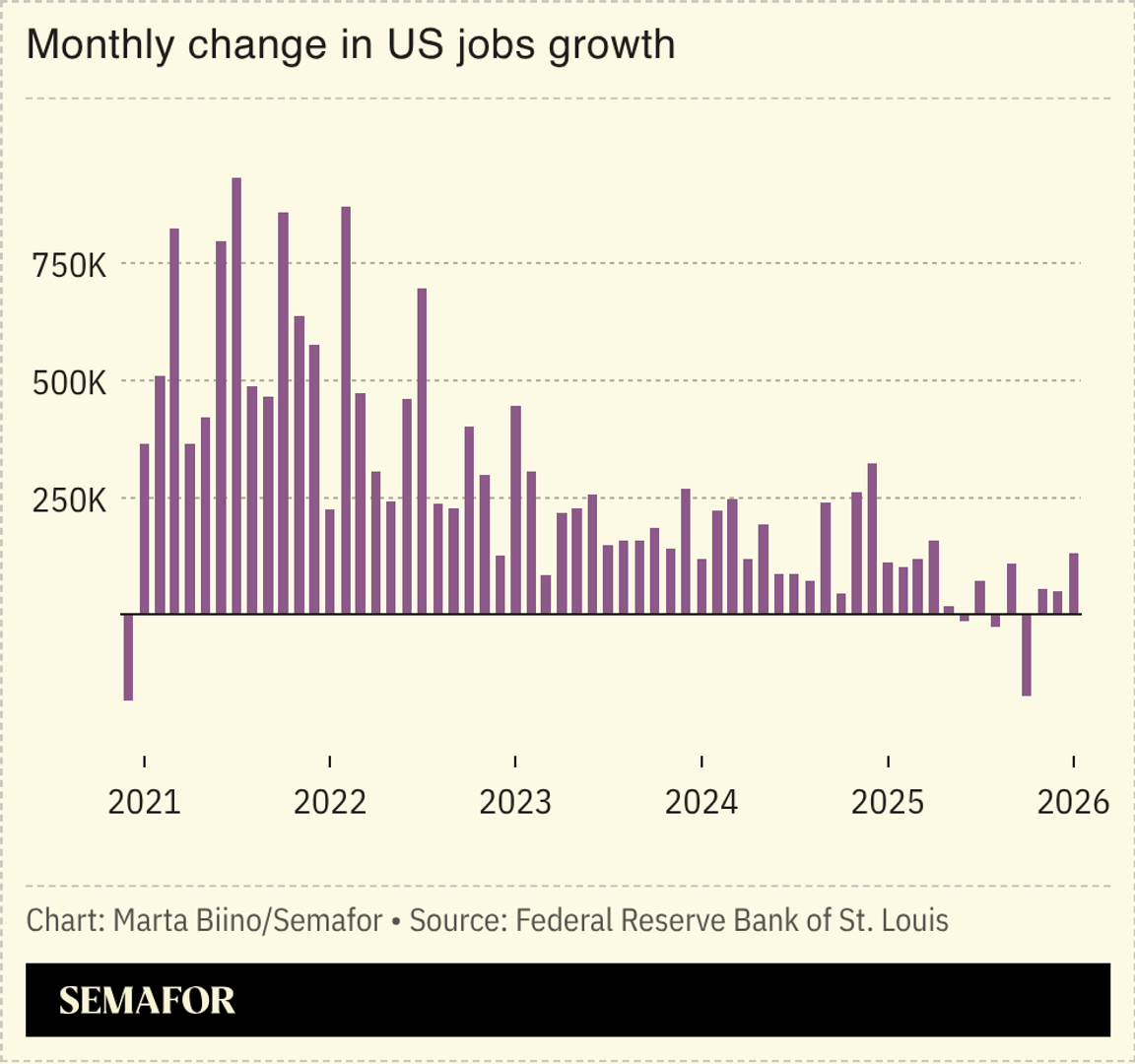 The Labor Department’s Bureau of Labor Statistics will provide key insight into how the US economy was faring before Trump ordered strikes on Iran when it releases the February jobs report this morning. Economists predict that employers will have added some 60,000 jobs — fewer than half as many as they did in January — in part because tens of thousands of health care workers were on strike. Though annual revisions may make the data less reliable, stronger-than-expected numbers could still drive the dollar higher, for its best week in more than three years. Because the data collection ended before the war began, the report will provide a crucial comparison point as policymakers try to assess how the ongoing conflict is affecting the labor market and broader economy. — Eleanor Mueller |
|
AGs urged to block Paramount-WBD |
 Daniel Cole/Reuters Daniel Cole/ReutersA coalition of center-left and progressive groups is sending a message to Democratic attorneys general: Stop Paramount’s acquisition of Warner Bros. Discovery. In a letter shared with Semafor’s Max Tani, nearly two dozen groups told top Democratic state law enforcement officials to take antitrust action against Paramount, saying a merger with WBD would result in higher consumer costs, thousands of layoffs, and the consolidation of media properties under CEO David Ellison. If the deal is approved, CNN and CBS “will fall under the control of billionaires who are seemingly willing and able to suppress credible reporting, tamp out dissent, and slant national news to favor the administration,” the groups wrote. That they’re worried isn’t surprising, but the letter could “foreshadow how Democrats are likely to use their regulatory and investigative focus if they return to power,” Max writes. |
|
 On Thursday, March 19, Amb. Stig P. Piras, Deputy Chief of Mission at the Embassy of Denmark in the US, will join Semafor for The State of Happiness in 2026: Wellbeing in the Digital Age. The 2026 World Happiness Report, powered by new global data from Gallup, reveals striking generational shifts in wellbeing. From rising loneliness to changing patterns of social connection, the findings challenge assumptions about technology, social media, and happiness. In partnership with Gallup, Semafor will bring together leaders across research, policy, media, and technology to explore what the evidence means — and how institutions and communities can foster deeper connection in a rapidly evolving digital world. Join us for a forward-looking conversation on resilience, belonging, and the future of human connection. March 19 | Washington, DC | RSVP |
|
Debatable: US’ relations with junta-run governments |
 Warming ties between the Trump administration and Africa’s junta-led governments have revived a long-running debate about Washington’s prioritization of its strategic interests versus the promotion of democracy abroad, Semafor’s Adrian Elimian reports. Recent Trump administration moves suggest Washington is actively rebuilding ties with these military-led nations. The State Department’s Nick Checker told Semafor that US “efforts toward normalization with the transitional governments in the Sahel are not an endorsement of how the authorities came to power” and that the administration’s “focus reflects pragmatic cooperation based on shared interests and preserving the space for a credible transition over time.” But critics say the moves could undermine ties long-term. “US policymakers must make a return to civilian rule a prerequisite for any real rapprochement or security assistance,” argued Brookings’ Alex Noyes. |
|
 Beltway Newsletters |
|
|


