|
 |
Hi, y’all. Welcome back to The Opposition. In case you missed the big news in the Bulwark family, our Sarah Longwell wrote a book! How to Eat an Elephant comes out this September, and you can pre-order it now. My first introduction to The Bulwark (before I was an official member of the team) was Sarah’s Focus Group podcast, which I continue to believe is some of the most essential listening if you want to better understand the country. So, I’m pretty excited about this book.
Thanks, as always, for reading—and if you’ve ever considered becoming a Bulwark+ member, please do so. Every day, as the headlines get stranger and darker, the need for the kind of independent reporting and savvy commentary we offer grows stronger. Sign up here:
–Lauren
Dems Slowly Figuring Out How to Talk About Israel
Trump’s Iran war—and Netanyahu’s role in it—is just the latest complication.
|

| ||||||||||||


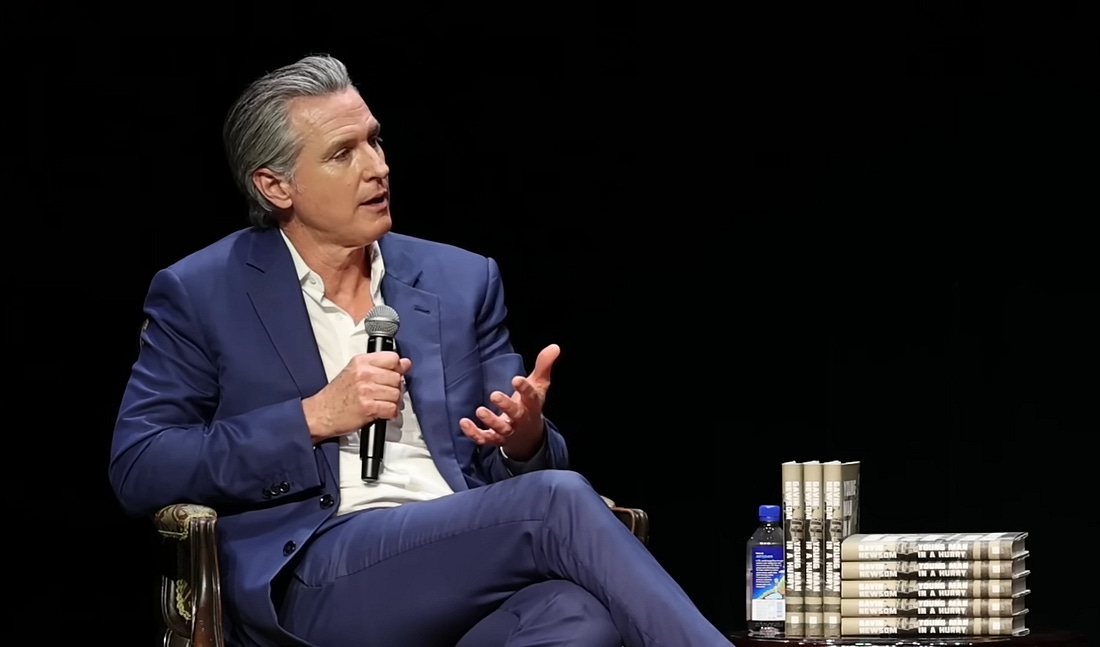 |
GAVIN NEWSOM SAT DOWN at the Wilshire Ebell Theatre in Los Angeles last Tuesday to talk to a crowd of adoring fans about his new memoir. But it took only a few minutes before the moderators, Pod Save America hosts Jon Favreau and Tommy Vietor, steered the conversation toward Donald Trump’s war in Iran and the California governor’s position on the U.S.-Israel relationship.
With a stack of copies of his book on a table at his side, Newsom likened Israel to an “apartheid state” and said that the “current leadership in Israel is walking us down that path where I don’t think you have a choice” but to rethink U.S. military support. It was a telling shift for Newsom, who has historically been a firm supporter of Israel—as when he traveled to the country in the wake of the October 7th attacks to meet with survivors and with Prime Minister Benjamin Netanyahu.
Democratic operatives whom I spoke with this week said that Newsom’s comments were an indication of where the wind is blowing. Several predicted that the party’s voters would become even more polarized on the issue.
And it’s not just voters: Newsom’s remarks are illustrative of how Democratic leaders, too, especially those with an eye on the presidential nomination, are growing more skeptical of Israel. The party’s response to Trump’s attack on Iran—especially following reports that Netanyahu convinced Trump to strike—is just the latest instance. Party officials told me that the rift has been a decade in the making, going back to 2015 when Republicans invited Netanyahu to speak to Congress and he used the occasion to criticize President Obama’s plans for a nuclear deal with Iran. That rift widened during Israel’s retaliation for the October 7th attacks, as it leveled Gaza and brutally killed tens of thousands of innocent civilians. And the fact that the Biden administration did little to pressure Netanyahu to stop created tension between the party’s base and its leaders, with Democratic officeholders and candidates stuck in the middle.
A Gallup survey published last month found that for the first time more Americans sympathize with Palestinians than Israelis. This echoes a finding the New York Times reported last year: that more voters sided with Palestinians over Israelis for the first time since the newspaper began asking the question in 1998. And while foreign policy typically isn’t what motivates voters in elections, Democratic officials believe that the debate has come to represent much more than a policy position.
PARTY OFFICIALS TOLD ME they think Democratic voters will be motivated in the upcoming elections to back candidates who feel authentic—candidates who seem like independent thinkers unafraid to say what they truly believe. Following Joe Biden’s presidency, being critical of Israel is increasingly viewed as a way to demonstrate independence and regain voter trust that deteriorated under Biden. Rep. Ro Khanna (D-Calif.), who has been outspoken about Israel’s human rights violations, has predicted that the nature of the U.S. relationship with Israel will be a “defining moral issue for our party and nation in 2026 and 2028.”
“It’s not just a debate over Gaza or Palestine and it’s more than just a debate about foreign policy. It is a bigger debate about how America acts in the world. But it’s also a question of ‘Can we trust our leaders?,’” said Matt Duss, a former foreign policy adviser to Sen. Bernie Sanders (I-Vt.) and executive vice president at the progressive think tank Center for International Policy. “When any candidate is running for office and they’re telling you, ‘Here’s what I’m going to do for you,’ but then when they ask about this one issue they revert to these same bullshit talking points—that seriously undermines their credibility. I think that’s what it did for Harris. And I think the reverse is true for Mamdani.”
“It really has become a litmus-test issue,” Duss added. “There’s still a lot of very justifiable anger on the part of progressive Democrats who felt that they were just completely gaslit and lied to by the Biden administration.”