| Forwarded this email? Subscribe for more |



 |
| By The Free Press |
It’s Monday, March 9. This is The Front Page, your daily window into the world of The Free Press—and our take on the world at large. Today: Terror on the Upper East Side—and an unbothered mayor. The cities vying to become the next Dubai. Lessons from a musician living under a dictatorship. And much more.
But first: The latest on the war in Iran.
The conflict in the Middle East has entered its second week. On Saturday, a week since the U.S. and Israel struck Iran and killed its leader, Ayatollah Ali Khamenei, Israel targeted regime-controlled oil refineries near Tehran and black smoke filled the city’s skyline. The next day, the regime announced its new leader: Mojtaba Khamenei, the 56-year-old son of the slain Supreme Leader Khamenei. Here’s what else is new:
The Pentagon announced the seventh U.S. casualty of the war. The service member was seriously injured in a strike on a Saudi military base on March 1 and died of those injuries.
Oil prices have surged to more than $100 per barrel.
Israel did not rule out targeting Iran’s new leader.
Iran’s president Masoud Pezeshkian announced Saturday that the Islamic Republic would no longer attack neighboring countries, but the strikes resumed soon after.
An Iranian drone struck a water desalination plant in Bahrain, marking the first time the war has impacted the most essential resource in the Gulf.
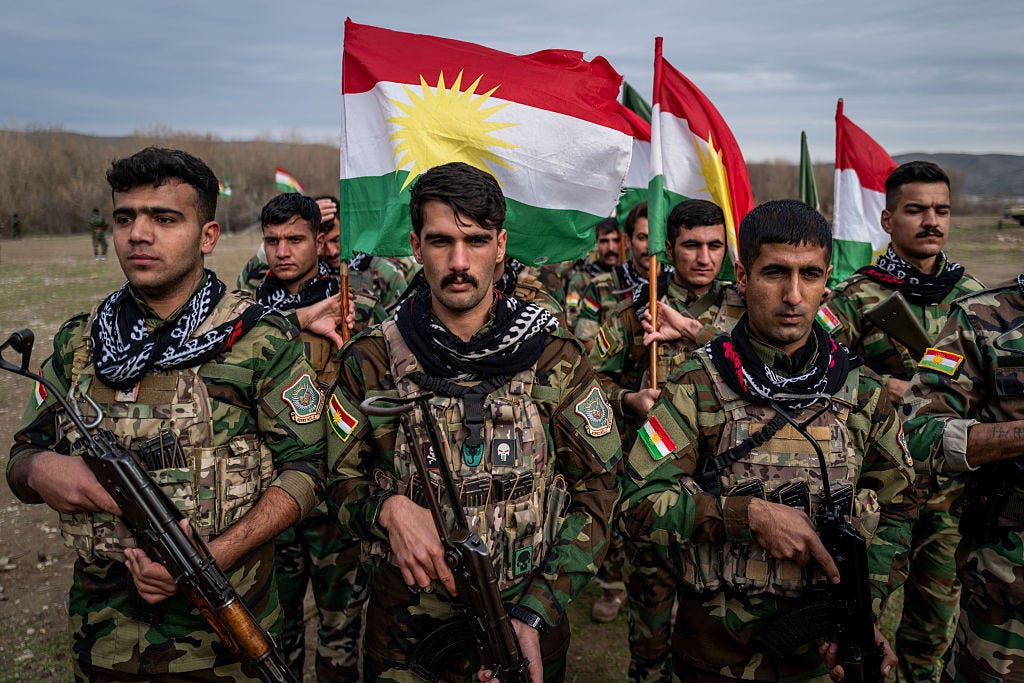
As Iranian oil burns and Mojtaba takes the reins of a teetering regime, the question of what will come next for Iran remains as uncertain as it was a week ago. One crucial factor will be the Kurds. But what sort of role will they play in the fight for Iran’s future? After reports that the CIA were arming Kurdish forces, Trump said on Saturday, “I don’t want the Kurds to go into Iran.”
Trump’s words echo in Eli Lake’s latest reporting. He talks to a senior Kurdish leader about the likelihood that Kurdish fighters will enter the war. Read his report on why Iran’s Kurds won’t march on Iran.
The Kurds may not be about to take up arms and fight, but Roya Hakakian argues that they remain central to this crucial chapter in Iranian history. Why? Because they are the Islamic Republic’s most defiant opponents. And no one serious about change in Iran can do it without them. Read Roya on the ayatollahs’ oldest opponents.
From Kurdistan to the Strait of Hormuz, which is ground zero for an emerging energy crisis. The shipping lane off the coast of Iran ordinarily transits 20 million barrels of oil a day, but is now effectively empty after Iran has threatened to target any tankers that use it. Ellen R. Wald breaks down the global impact of the blockage of the strait, and explains why we are approaching the “worst-case scenario” in the world’s most important maritime choke point.
Farther up the Persian Gulf sits another strategically vital site for the Iranian regime: Kharg Island, where 90 percent of Iranian oil exports are processed. Jay Solomon talks to officials in the Trump administration and Arab governments who say that the U.S. and Israel have the island in their sights. “It’s amazing they’d place so many of their oil eggs in one basket,” says one. Read Jay’s full report on the tiny island at the center of the conflict.
For more on the conflict in the Middle East, listen to the latest episode of our new podcast, School of War. Today, host Aaron MacLean talks to Mark Montgomery, a retired U.S. Navy rear admiral and senior director of the Center on Cyber and Technology Innovation at the Foundation for Defense of Democracies. Aaron and Mark go deep on everything from the situation in the Strait of Hormuz to the growing parts Ukraine and Russia are playing in the war.


 |
A Tale of Two Cities
Glamorous Gulf cities like Dubai and Doha have long been sold as the go-to for the world’s richest, promising the fruits of Middle Eastern oil money without the sectarian violence of the northern countries like Iraq and Syria. Those illusions were shattered after these cities came under attack from Iran in retaliation to Operation Epic Fury. Now Singapore is preparing to take their place as an offshore financial hub. Jeevan Vasagar thinks the Southeast Asian island nation could be the war’s biggest winner. Read his piece for us to find out why:
Free Press columnist Tyler Cowen has a less likely candidate to fill the gap. Writing from South Africa, he makes the case for Cape Town. Yes, it has a serious crime problem, but the sights, weather, food, and culture are world-class and crucially, no belligerent militarized neighbors threaten its millions of residents. Read Tyler’s latest:
 |