| | Oil swings rattle experienced traders, India eases Chinese investment curbs, and flying taxis may be͏ ͏ ͏ ͏ ͏ ͏ |
| |  | Flagship |  |
| |
|
The World Today |  - US mixed signals on Iran
- Traders rattled by oil swings
- Conflict gives layoffs cover
- China’s Iran vulnerabilities
- India eases China curbs
- German critical minerals push
- China embraces AI agents
- Flying taxis coming soon
- Digital fly is very fly-like
- Hollywood number crunchers
 Reviving woodlands, one coppice at a time. |
|
US digs in on Iran campaign |
 US Navy/Handout via Reuters US Navy/Handout via ReutersThe US defense chief said Tuesday’s strikes on Iran would be the most intense of the war, as President Donald Trump threatened further escalation. Residents of Iran’s capital have reported a punishing barrage in recent days, with one warning: “Nothing will remain of Tehran” if the attacks continue. Washington has sent mixed messages about the length and goal of the war; Trump on Tuesday threatened consequences “at a level never seen before” following reports that Iran was laying mines in the Strait of Hormuz. Businesses are left wondering when Trump — who said the war would be over “very soon” — might cease hostilities: Some of Trump’s advisers have privately urged him to find an exit ramp, The Wall Street Journal reported. |
|
Oil slides further but volatility persists |
 Oil continued its slide Tuesday, but the wild price swings triggered by Washington’s Iran war messaging have rattled even the most experienced traders. After Monday’s surge to nearly $120 a barrel, crude prices settled on optimism over large economies possibly releasing strategic oil reserves. But the CEO of Saudi Arabia’s state-owned oil company warned of “catastrophic consequences” for the world economy if shipments through the Strait of Hormuz remain frozen. The oscillations have even the most sanguine experts sounding the alarm, and are testing traders who “typically thrive on volatility,” Bloomberg wrote. One said, “we’re being stress-tested by headlines and tweets,” while a London trader compared it to playing a video game “for 24 hours straight.” |
|
War could give execs layoff cover |
 Mina Kim/Reuters Mina Kim/ReutersThe Middle East conflict could give bosses cover to lay more workers off, Semafor’s business editor argued. AI mania has already triggered corporate job losses, driven in some cases by the mere possibility that the tech could replace humans. Recession fears sparked by the war in Iran could trigger more layoffs “not because the economic conditions demand it — but because the economic fears allow it,” Liz Hoffman wrote. (Look out for euphemisms like “uncertain macroeconomic outlook” and “financial discipline.”) Investors are now grappling with a convergence of fears over Iran, AI, a softening US labor market, and cracks in private credit, Bloomberg wrote: “Together, they are creating new fragilities in global markets that no single policy lever can fix.” |
|
MidEast conflict could hurt Chinese business |
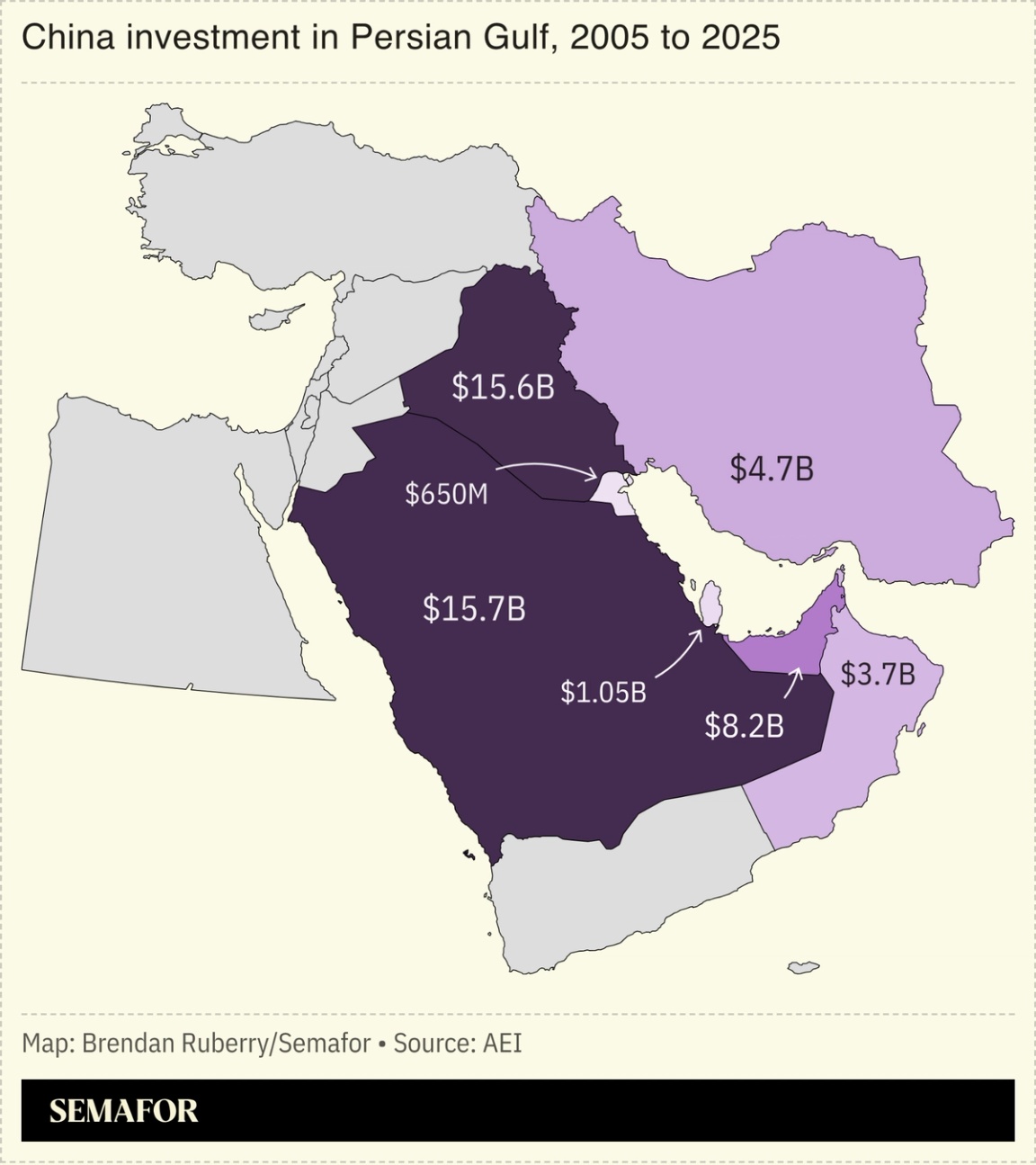 Analysts say China may benefit geopolitically from a prolonged Iran war, but it could start to feel the pain economically. The Middle East has been a growing market for Chinese steel and clean energy, but trade ties are now at risk given the expanding conflict. The effective closure of the Strait of Hormuz has also caused Chinese prices for sulphur — a raw fertilizer material, much of which comes from the Gulf — to rise just as the planting season begins. And while China has a considerable oil stockpile, the war cuts Beijing off from Tehran’s cheap, sanctioned crude. Chinese tech companies, from robotaxis to smartphones, have also expanded rapidly in the Gulf, but strikes in the region disrupted their operations. |
|
India eases rules on China investment |
 Francis Mascarenhas/Reuters Francis Mascarenhas/ReutersIndia eased rules over Chinese investment in local firms, extending the countries’ diplomatic and economic thaw. The curbs were initially enacted in 2020 after a border skirmish escalated tensions between the world’s two most populous nations; the regulations stymied plans by China’s EV giant BYD to make inroads in India, while high profile Chinese investors pulled out of deals involving Indian startups. But relations have gradually improved — direct flights between the countries resumed last fall — and India is looking to attract more capital and become a global manufacturing hub, especially as economic ties with the US remain rocky and the Iran war introduces fresh uncertainty. |
|
German giants’ critical minerals push |
 Annegret Hilse/Reuters Annegret Hilse/ReutersGermany’s industrial giants reportedly plan to join forces to buy critical minerals, increasing their negotiating power and reducing their reliance on China. The idea emulates Japan, which created a centralized agency offering financial support to trading houses after China imposed rare-earth export restrictions in 2010; Germany’s chancellor called Japan’s prime minister to discuss the model. Beijing demonstrated its willingness to weaponize export controls for geopolitical purposes last year, which left European countries “scarred” despite a recent reprieve, the Financial Times reported. Defense giant Rheinmetall and carmaker BMW are among the companies pushing the new central trading-house model, with particular focus on raw materials for industry, such as lithium, as well as oil and gas. |
|
AI agents take off in China |
|
 Bilt Rewards launched in 2019 with a simple idea. If you can get credit-card rewards for buying a round of drinks, why can’t you get them for paying your rent? After a shambolic and short-lived partnership with Wells Fargo, the company is back with bigger ambitions: to be the platform powering 12% of the economy — housing services — plus a big chunk of what people spend on dining, workouts, healthcare, and other local services. On this week’s episode of Compound Interest, co-hosts Liz Hoffman and Rohan Goswami sit down with Bilt CEO Ankur Jain to unpack its Amex-Shopify-Square ambitions — and why every company wants to be a membership club.
|
|
Flying taxis coming soon to US |
 Archer Aviation Archer AviationFlying taxis may start operating in 26 US states as soon as June. Federal regulators approved eight trial programs for electric vertical takeoff and landing (eVTOL) aircraft, allowing them to be tested without full certification. The CEO of Archer Aviation, one of the firms involved, called it a “Waymo moment” for the industry; stocks of the company, and its rivals, jumped on the news. China is some way ahead of the US on eVTOL, and one firm already has regulatory approval for commercial autonomous air taxis. The White House has promised to cut “burdensome red tape” on aviation, WIRED noted, and lifted a ban on supersonic flight over land as new technologies have made it quieter. |
|
Fruit fly brain used in simulation |
 Dr. Alex Wissner-Gross/X Dr. Alex Wissner-Gross/XScientists used a digital model of a fly’s brain to control a digital fly. In 2024, an international project mapped a fruit fly’s brain; now, a startup has used that map in a neuron-for-neuron digital model, and installed it in a simulated body in a simulated world. The digital fly demonstrated fly-like actions. The simulation is incomplete — the researchers treated all neurons as basic and identical, when they are complex and varied. The wider nervous system was not scanned, so researchers had to guess how neurons controlled muscles. But it raises the possibility of simulations of more complex beings, although humans may be some way off: Fruit flies have roughly 600,000 times fewer neurons than people. |
|
|


