Meta has acquired Moltbook, the AI-only social network where humans are allowed to read, but only AI agents are allowed to post. If you’re a human who wants to infiltrate, you’ll have to solve a reverse CAPTCHA, a lobster-themed math word problem with two numbers and one operation. Despite the business keeping people out, Meta’s acquisition seems to really be about grabbing the two human founders of the strange platform.
Stocks whipsawed on Tuesday, with the S&P 500, Nasdaq 100, and Russell 2000 closing lower. Bitcoin showed signs of stabilization, with traders remaining cautious as the asset hovered around $70,000.
Crude oil fell, trimming steeper losses as the White House confirmed that the US has not escorted a tanker through the Strait of Hormuz, contradicting a since deleted post on X by Energy Secretary Chris Wright. |
|
|
- Sales of $17.2 billion (estimate: $16.9 billion).
- Adjusted earnings per share of $1.79 (estimate: $1.70).
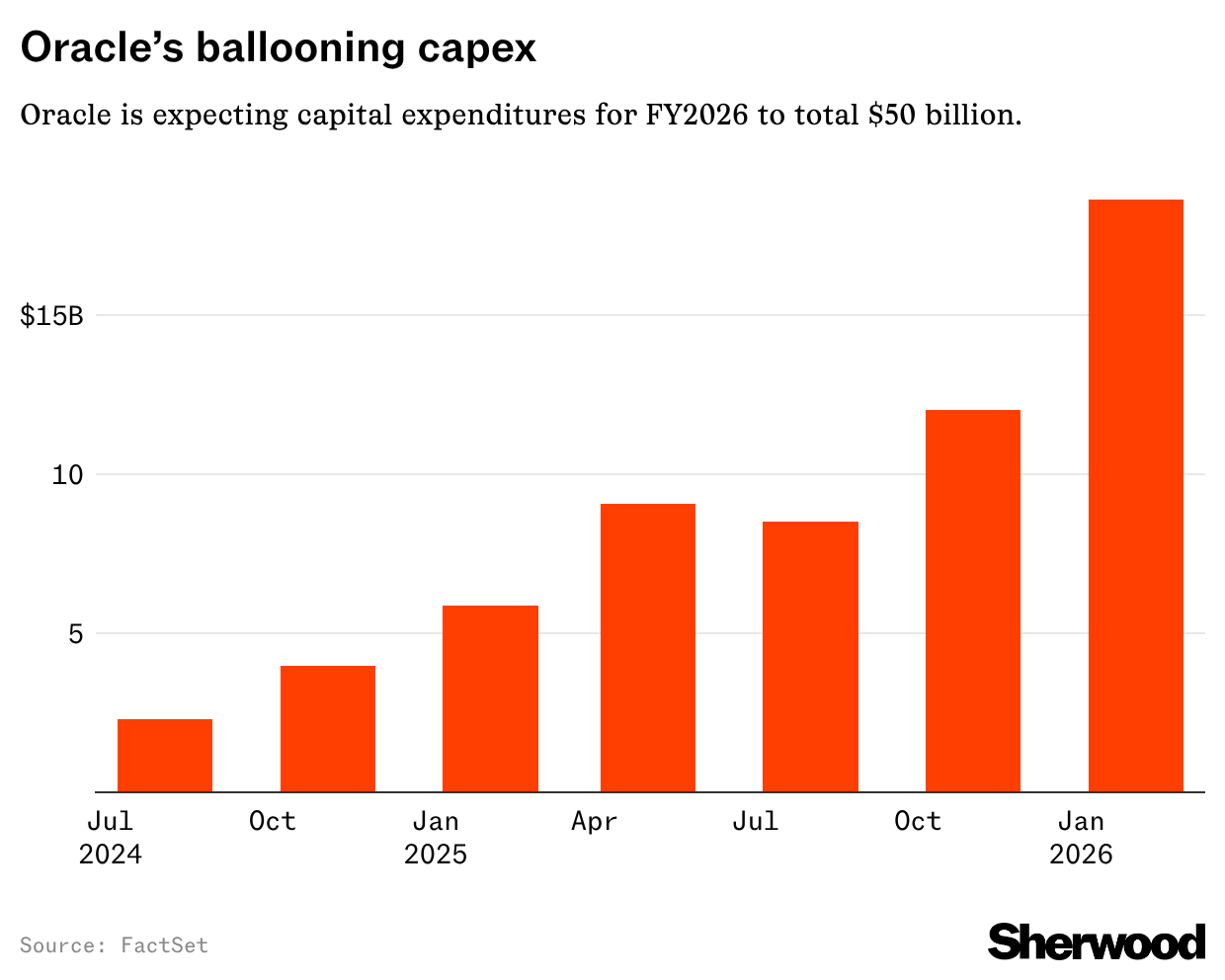
- Oracle’s closely watched capex for the quarter was $18.64 billion (estimate: $14 billion).
|
Looking forward, the company’s RPO (remaining performance obligations, or backlog) swelled to a massive $553 billion, far above analysts’ consensus expectation of $537.8 billion and a strong sign of future sales growth.
Management also raised its sales outlook for the next fiscal year to $90 billion, with analysts forecasting $86.7 billion. The math the company supplied one quarter ago for its fiscal 2027 sales equaled an even lower figure than that. |
- Lorem ipsum dolor sit amet, consectetur adipiscing elit, sed do eiusmod tempor incididunt ut labore et dolore magna aliqua. Non consectetur a erat nam.
-
Est ullamcorper eget nulla facilisi etiam. Etiam tempor orci eu lobortis elementum nibh tellus molestie. Venenatis cras sed felis eget velit aliquet sagittis id consectetur.
|
|
|
It’s been a rough 2026 for the hyperscaler: shares of Oracle were down by more than 20% since the start of the year as of the close of trading Tuesday. Investors have viewed Oracle as “a poster child for AI Capex excess,” and it’s been stained by the “negative sentiment around OpenAI.” What traders were looking for was a sign that all that capex spending was turning into revenue now and even more revenue in the future, and much to shareholders’ relief, Oracle overdelivered... at least at first. The company didn’t offer a capex outlook for its next fiscal year. If management serves up an investment binge persistently larger than hoped for, the nascent faith traders have in the stock could be short-lived.
|
|
|
It may be months away, but it feels like the countdown to Elon Musk’s SpaceX IPO is heating up. And for good reason: it’s not every day a company run by the world’s richest man goes public, and at a potential $1.75 trillion valuation (up from $1.25 trillion just a month earlier), it’s almost certain to be the biggest American company IPO ever, and if not the biggest, it will be the second-biggest IPO of all time.
Now some details are coming out about where the stock will list: |
-
Reuters reported that SpaceX is leaning toward listing on the Nasdaq, but there’s a catch: Musk reportedly wants a promise of early inclusion on the exchange’s Nasdaq 100 Index, which is what huge index ETFs like QQQ are based on.
- Typically companies have to wait up to a year before being considered for inclusion in indexes like the S&P 500 or the Nasdaq 100, but Nasdaq recently proposed a change that could decrease that wait time significantly for megacap companies.
-
Getting into a major index is almost always a boon for stocks — as the S&P 500’s newest members have seen. The inclusion sparks automatic buying from index funds, lifting demand and liquidity while expanding its investor base.
-
The listing would also be a major win for the Nasdaq, reinforcing its dominance in Big Tech IPOs and driving billions in index licensing and trading revenue.
|
Interestingly, whichever listing SpaceX goes with — NYSE is still in the running as well — the newest rebalancing of the S&P 500 means that index investors will soon have pre-IPO exposure to SpaceX through EchoStar, which will go into the index on March 23. EchoStar has struck deals for shares that would give it a roughly 2.8% stake in SpaceX, according to analysts.
|
|
|
|