“We want to do this as a profession,” Milzfort says. “Our dream is to have the page be our main income, because we love this, and we feel like this has the potential to become our profession.” They’ve been in contact with Meta and Instagram in the past, they say, though it has not led to much. The platform can help “creators”—as in, content creators—grow, but usually when there is an external figure it can introduce to partners and stand behind.
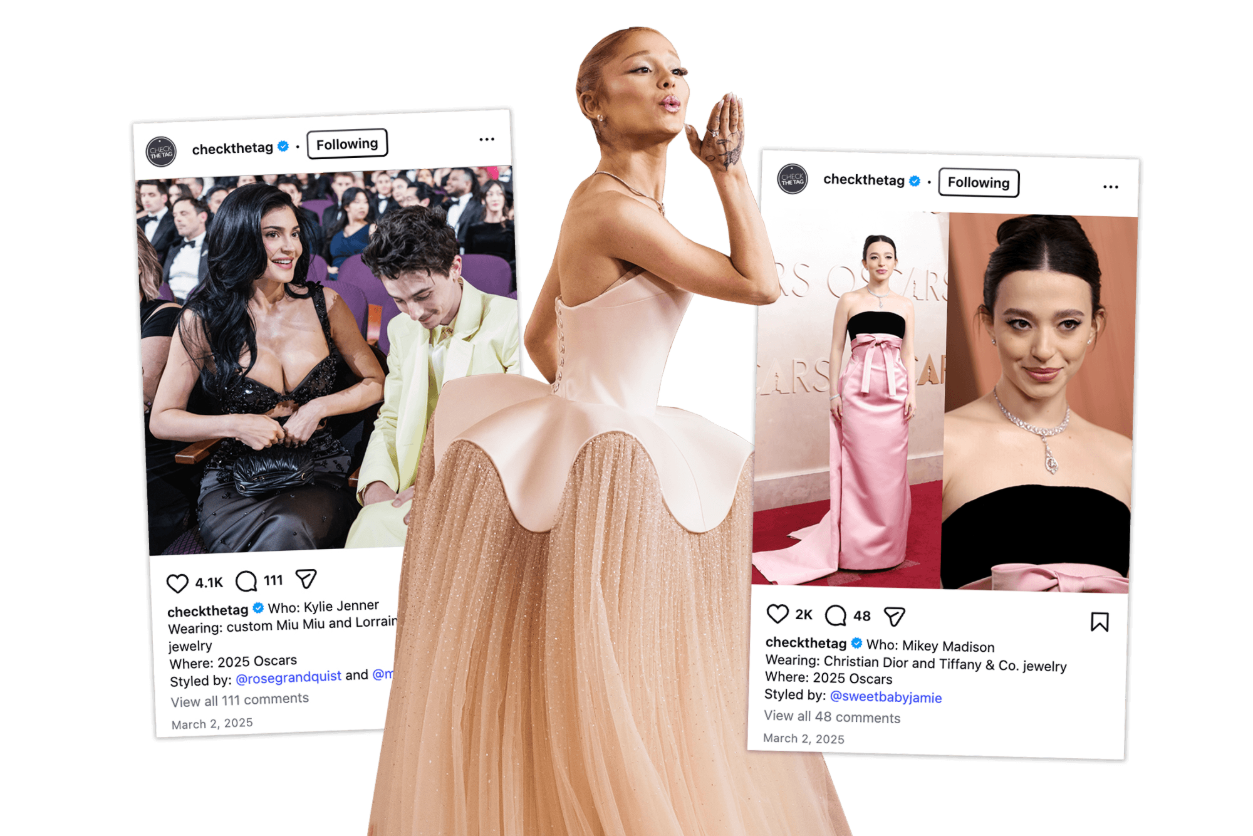
Their account’s other distinguishing features include the volume of red-carpet posts, be they from an awards ceremony or a premiere, and the speed at which they’re made. The founders post practically in real time. “When we give our credits, we do vogue.com, instyle.com, WWD, and now we do it with Check the Tag, because everybody watches that in real time,” stylist Jessica Paster says. Paster’s assistants will typically send credits to the Check the Tag sisters once talent has hit the red carpet, and sometimes she will DM the information to them herself. Paster also likes that they’re Brazilian, saying that she wants to support her fellow Latinas. “I love it that a Brazilian gets a piece of the pie,” she says.
It’s an arduous task; on one hand because it’s just the two of them—there was a third member whom they parted ways with because he’s pursuing a political career in the United States—and on the other because it requires a lot of speedy, organized work. There’s a master spreadsheet of credits, there’s back-and-forth communication with brands and stylists, and there’s just a lot of frantic work in posting the actual content. This Sunday, for instance, they’ll work long LA hours from Brazil, posting well through the night as they cover both the Academy Awards ceremony and Vanity Fair’s party. Frankly, it doesn’t sound too far off from the goings-on at any given fashion magazine on a day like the Oscars.
Except that magazine editors are working their full-time jobs. Miozzo and Milzfort are not. They are doing this on the side while working day-to-day jobs as translators, which makes it all the more impressive.
Miozzo estimates that 60% of their credits information comes from brands and stylists directly. The balance comes from their ability to clock a look or find it online—and quickly.
“I consider Check the Tag resourceful in different ways,” says Brandon Tan, who styles Omar Apollo and Sombr. “As a stylist, their key values to me are in amplification and research. At a very basic level, brands agree to dress your client with the goal of exposure. Check the Tag helps get those looks in front of a focused audience while encouraging engagement and discourse like a special interest forum.”
The account, in a way, also works as a press release, Tan says. He doesn’t share information in advance, but he does share it immediately once he’s seen images become available online. He also argues that it has become instrumental for magazine editors when it comes to putting together a best-dressed list. He would know; he’s worked at GQ and is currently fashion director at Cosmopolitan. “I’ve seen editors refresh that Instagram page every minute during an event’s red carpet,” Tan says.
Miozzo and Milzfort’s ascent with Check the Tag has not gone without a snafu or two. They say they try to cover as many events as they can, though they now completely abstain from politics. Miozzo recalls declaring that they would not be covering Donald Trump’s second inauguration last year, which she says prompted both overwhelming support and a flurry of disgruntled feedback. They also cover events in Brazil, like the wedding of socialite Esther Marques, who wore Alaïa by Pieter Mulier. Check the Tag’s audience is around 60% US-based and 20% Brazilian, with the remaining 20% split across the rest of the world.
They’ve also been asked to take down looks when they’ve received negative feedback in the comments, or when the final outfit was out of the stylist’s control, or when someone wore a look by a brand without its blessing, either by purchasing it or borrowing it from a retailer.
But budging is not their style. Keeping their posts a forum for commentary is. Tan, for example, will oftentimes read the comments under a post to vibe-check an outfit. But people can be mean. The internet is the Wild West, and Check the Tag has no intention of becoming its sheriff. Picture it more like an old-timey saloon.
Still, the goal down the line is to grow the account and find ways to make it a viable business. The founders currently share the information they collate for their spreadsheet with outlets like E! News—for a price, of course. And after securing a spot with the media on the red carpet for the Brazilian premiere of All’s Fair, they have raised their ambitions once more, aspiring to create and share more live, in-person content. “I haven’t really been active in journalism for years and years, and I [came] out of retirement with Kim [Kardashian],” Milzfort recalls, laughing.
Yet they are aware that to thrive in the age of social media, Check the Tag will likely need a face in order to continue growing. They will, at the very least, need to establish more content verticals and diversify their platforms for reach, even if the initial idea is to stay on social media. Miozzo and Milzfort have not yet committed to either of these ideas. But big ambitions come with concessions.