| | Energy-related inflation is the inescapable deciding factor for global politics this year.͏ ͏ ͏ ͏ ͏ ͏ |
| |  | Energy |  |
| |
|
 - Oil release of little help
- Russian fossil revenue rises
- Few lessons from past shocks
- US solar dims
- CATL’s biggest year
 Chevron and Shell make progress in Venezuela, and BP faces a new fight with activists. |
|
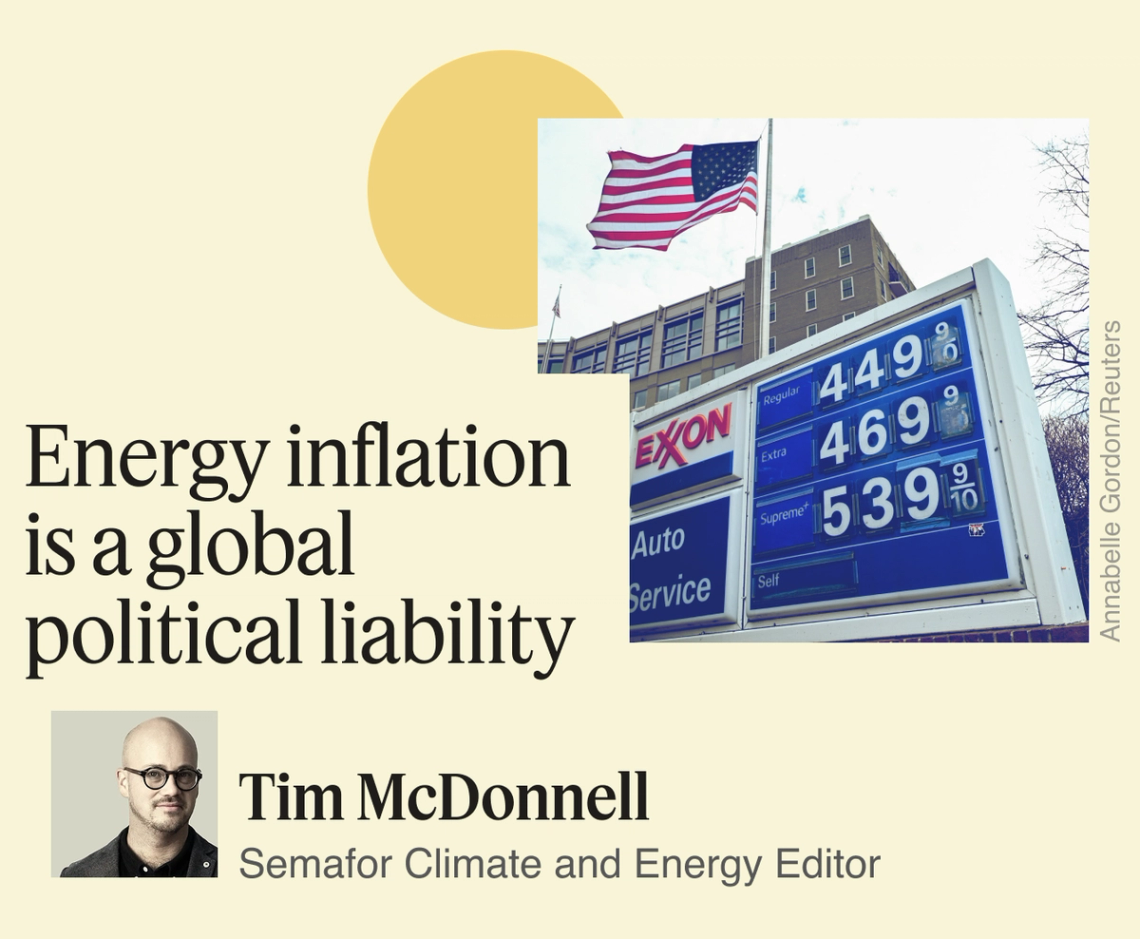 Energy-related inflation is the inescapable deciding factor for global politics this year. Gas prices — emblazoned in big numbers on signboards across every city — are the most tangible and emotional touchpoint of the global economy for US voters, and infamously decisive in national elections. The national average price of gasoline passed $3.50 per gallon this week, the highest level since 2024, following the disruption to global oil trade caused by the US and Israeli bombing campaign against Iran. That is an issue for President Donald Trump, who has crowed countless times on the stump about how much higher prices were under his predecessor. Republicans are beginning to worry that gas prices will become an albatross in the midterm elections this fall, and key Trump opponents like Gov. Gavin Newsom of California have been quick to weaponize the price spike. Given the unprecedented volume of oil and gas that has been disrupted, measures like releasing oil from strategic reserves and providing military escort for tankers amount to tinkering around the edges: Prices will continue to rise until normal traffic resumes through the Strait of Hormuz, and even beyond then as Gulf producers take time to repair damaged infrastructure and bring shut-in drilling rigs back online. Those higher oil prices will ripple across the economy to push up the cost of electricity and grocery bills, computer chip manufacturing, construction, and just about every other sector, and will likely sap any enthusiasm by the Federal Reserve in continuing to lower interest rates further. “The administration’s foreign policy actions have collided directly with the affordability message Republicans are trying to cement ahead of the election,” Heidi Crebo-Rediker, senior fellow at the Council on Foreign Relations and former Obama administration economist, told me. And it’s not just in the US: Hungarian Prime Minister Viktor Orbán, up for reelection next month, has used the crisis to amplify his argument that breaking away from Russian energy was a strategic blunder by Europe. “European governments have less space to deal with increases in prices right now, because they are managing a lot of other competing interests” in their budgets, Crebo-Rediker said. Mortgage rates in the UK are already rising. Brazil, Nigeria, France, and other countries that already struggled with inflation also have federal elections upcoming in the next year or two, making Trump’s decision to bomb Tehran a political liability for many other world leaders. The coming days will tell whether, as US Energy Secretary Chris Wright predicted, there’s now enough oil from non-Gulf sources that prices will “blip up and then [go] back down.” In the meantime, voters will pay the price. |
|
Oil release doesn’t help much |
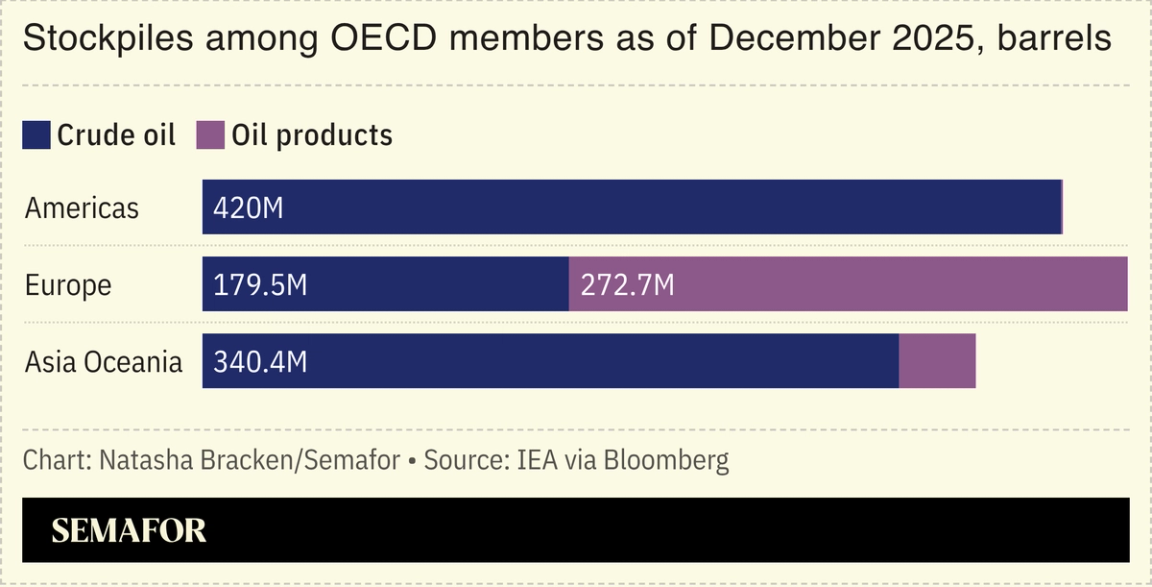 The International Energy Agency’s member states agreed to release 400 million barrels of oil to cushion a supply disruption triggered by the war in Iran. The figure includes 172 million barrels from the US Strategic Petroleum Reserve, the largest release since 2022. But the move did little to calm energy markets, as shipments through the Strait of Hormuz remain effectively frozen: Oil prices jumped back up above $100 per barrel following a fresh series of attacks on tankers and storage facilities, and worries of a sustained interruption to global flows. US President Donald Trump suggested oil companies could use the Strait, but strikes on ships have escalated, Iran has reportedly laid at least a dozen marine mines in the Strait, and the US military declined to escort tankers until the threat of Iranian attacks subsides. Still, even as Tehran has jeopardized global oil supplies, it has shipped nearly 12 million barrels of its own crude to China since the war began. |
|
Russian fossil revenue rises |
 Russia’s daily fossil fuel revenue increased 14% above February levels as a result of higher oil and gas prices and the relaxation of some US sanctions. According to an analysis by the Centre for Research on Energy and Clean Air, Moscow has pocketed €6 billion ($6.9 billion) in fossil fuel revenue since the war in Iran began. President Donald Trump spoke to Russian President Vladimir Putin on Monday, during which Putin offered to reengage with European importers as a way to ease the global energy crisis. The US Treasury Department already granted India a waiver to purchase Russian crude, and according to Reuters is considering additional sanctions rollbacks to alleviate the market shortage. Prior to the Iran war, Western sanctions had been effective in driving down Russia’s fossil fuel revenue; oil exports fell for a third consecutive month in February. In the meantime, Europe’s clean energy push is already paying some dividends: according to CREA, the expansion of solar power saved the region about 2 billion cubic meters of gas per month in 2025. |
|
View: Few lessons from past shocks |
 Benoit Tessier/Reuters Benoit Tessier/ReutersFor all the talk of how resilient the US economy has become to energy shocks, betting that it can absorb weeks of costlier oil is fraught with risks for President Donald Trump, and even more so for US allies, Alaa Shahine Salha, a senior executive at Saudi Research & Media Group, writes in a column for Semafor. Understanding past oil shocks is important, he argues, but relying on them too heavily can encourage the wrong conclusion: that we are either headed for a 1979-style crisis or that the economic consequences will be negligible. As Shahine Salha notes, the world is at least far less reliant on oil today: The global economy has a more diverse mix of energy sources, while the US has shifted from being the world’s biggest crude importer to a net exporter of energy. When it comes to inflation, the starting point is also much lower than at the time of the 2022 shock following Russia’s invasion of Ukraine. But stripping out the geoeconomic nuance risks creating a false sense of security. |
|
 US solar capacity installations fell 14% in 2025 compared with the previous year, a new report found, as the Trump administration’s rollback of solar tax credits began hitting the sector. A combination of tariffs, scrapped subsidies, and a White House energy agenda built around fossil fuels and nuclear power drove utility-scale solar down 16% and community solar down 25%, according to a Solar Energy Industries Association and Wood Mackenzie study. Still, solar remained the largest source of new electricity added to the grid, kept alive by its appealing economics and a rising urgency to meet demand from energy-hungry data centers. “It’s clear that solar will continue to be the dominant source of new power capacity in the US even as gas generation continues to grow,” the report’s authors wrote. —Natasha Bracken |
|
 Bilt Rewards launched in 2019 with a simple idea. If you can get credit-card rewards for buying a round of drinks, why can’t you get them for paying your rent? After a shambolic and short-lived partnership with Wells Fargo, the company is back with bigger ambitions: to be the platform powering 12% of the economy — housing services — plus a big chunk of what people spend on dining, workouts, healthcare, and other local services. On this week’s episode of Compound Interest, co-hosts Liz Hoffman and Rohan Goswami sit down with Bilt CEO Ankur Jain to unpack its Amex-Shopify-Square ambitions — and why every company wants to be a membership club. Listen to the latest Compound Interest now. |
|
 China’s leading battery manufacturer CATL beat profit expectations for 2025, driving a 10% bump in its share price. The company reported a $10.4 billion profit for the year, 42% higher than 2024, even as demand for EVs in China slowed. CATL was buoyed by rising demand for grid-scale batteries, and insulated from mineral price swings due to its investments in upstream lithium mining. CATL’s expansion into non-EV batteries also widened its $120 billion valuation lead over rival BYD. CATL’s newest factory, in Hungary, is due to open within the next month, and is already fully sold out of its production capacity, the company said. |
|
 New Energy- The nuclear industry is set to benefit from Donald Trump’s war in Iran as countries seek out more stable energy sources to avoid future shocks from oil and gas supply shortages.
 Manon Cruz/File Photo/Reuters Manon Cruz/File Photo/Reuters- The UK’s Climate Change Committee argued that achieving net zero by 2050 will cost less than the economic impact of another fossil fuel price spike like the one triggered by Russia’s invasion of Ukraine.
- Germany’s RWE is set to spend $20 billion on building new gas-fired power plants in the US, looking to capitalize on rising energy demand from data centers.
Fossil Fuels- Ukraine’s central bank chief warned that the war in Iran risks hitting the country’s already war-torn economy, while handing additional revenue to Moscow with rising oil prices.
- Iran is exporting more oil through the Strait of Hormuz than it was before the war began, new data from Kpler found, while the key chokepoint has been essentially closed to the rest of the Gulf oil producers.
- Chinese oil refiners have started canceling fuel export cargoes so Beijing can prioritize its domestic market while oil and gas markets in the Persian Gulf are still upended.
- Oil giants Chevron and Shell are closing in on the first major oil production deals with Venezuela since Trump captured Nicolás Maduro in January, Reuters reported.
Finance- Activist climate investors threatened BP with legal action over the energy company’s refusal to include a climate resolution they filed for next month’s shareholder meeting, which proposed that the company develop strategies to protect shareholder value in the event of a decline in oil and gas demand.
Personnel |
|
|


