| | Israel kills Iran’s top security official, diesel surpasses $5 a gallon in the US, and Nvidia restar͏ ͏ ͏ ͏ ͏ ͏ |
| |  | Flagship |  |
| |
|
The World Today | 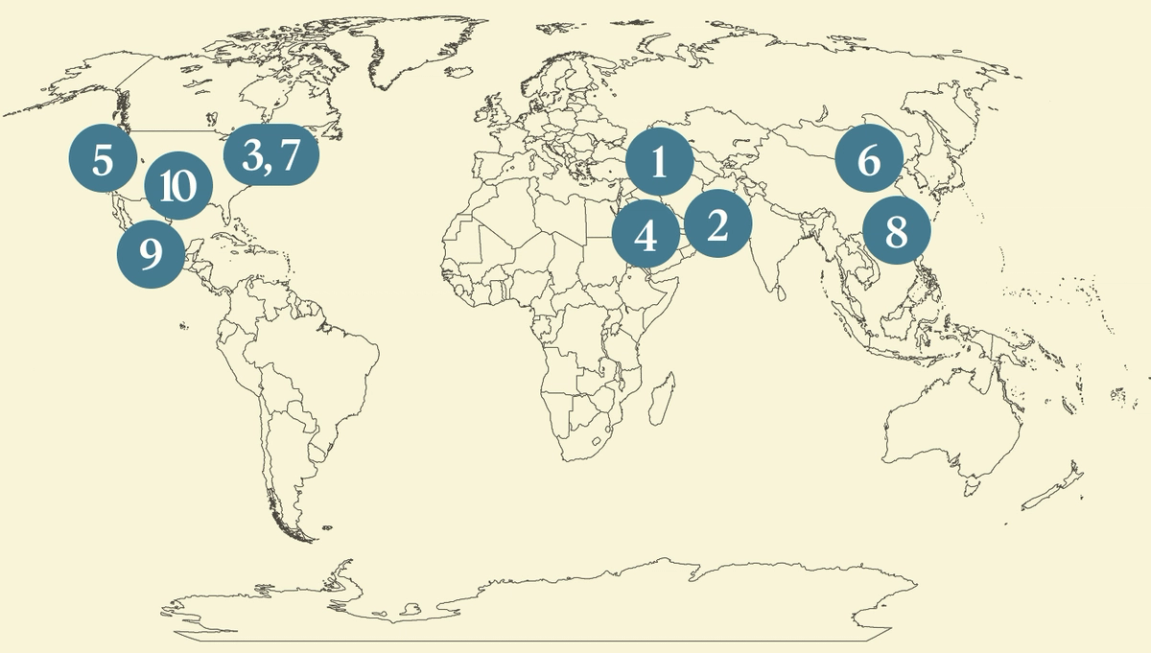 - More Iran leaders killed
- Diesel prices are surging
- US counterterrorism chief out
- Gulf economies could contract
- Nvidia gets China chip orders
- US-China ‘Board of Trade’
- Pentagon looks for Claude alts
- Hong Kong IPO restrictions
- Mezcal’s environmental costs
- First modern rocket launch
 A page-turner of a book about a tragedy in Mozambique. |
|
Israel kills powerful Iran security chief |
 Omar Sanadiki/Reuters Omar Sanadiki/ReutersIsrael killed Iran’s top security official as well as the head of its paramilitary force, Iranian state media confirmed Tuesday, in a major double blow to Tehran’s leadership. Ali Larijani ran Iran’s national security council and was seen as the country’s de facto leader after the former ayatollah was assassinated. He was central to Tehran’s violent crackdown on protests in January, and was also known to possess the pragmatism and clout to negotiate with the US. Despite the seismic hits to Iran’s power structure, the regime has “powerful incentives to pursue continued conflict,” an Atlantic Council expert wrote: It’s aiming to “impose such high costs” on the global economy that the US will settle for a ceasefire. |
|
US diesel prices top $5 a gallon |
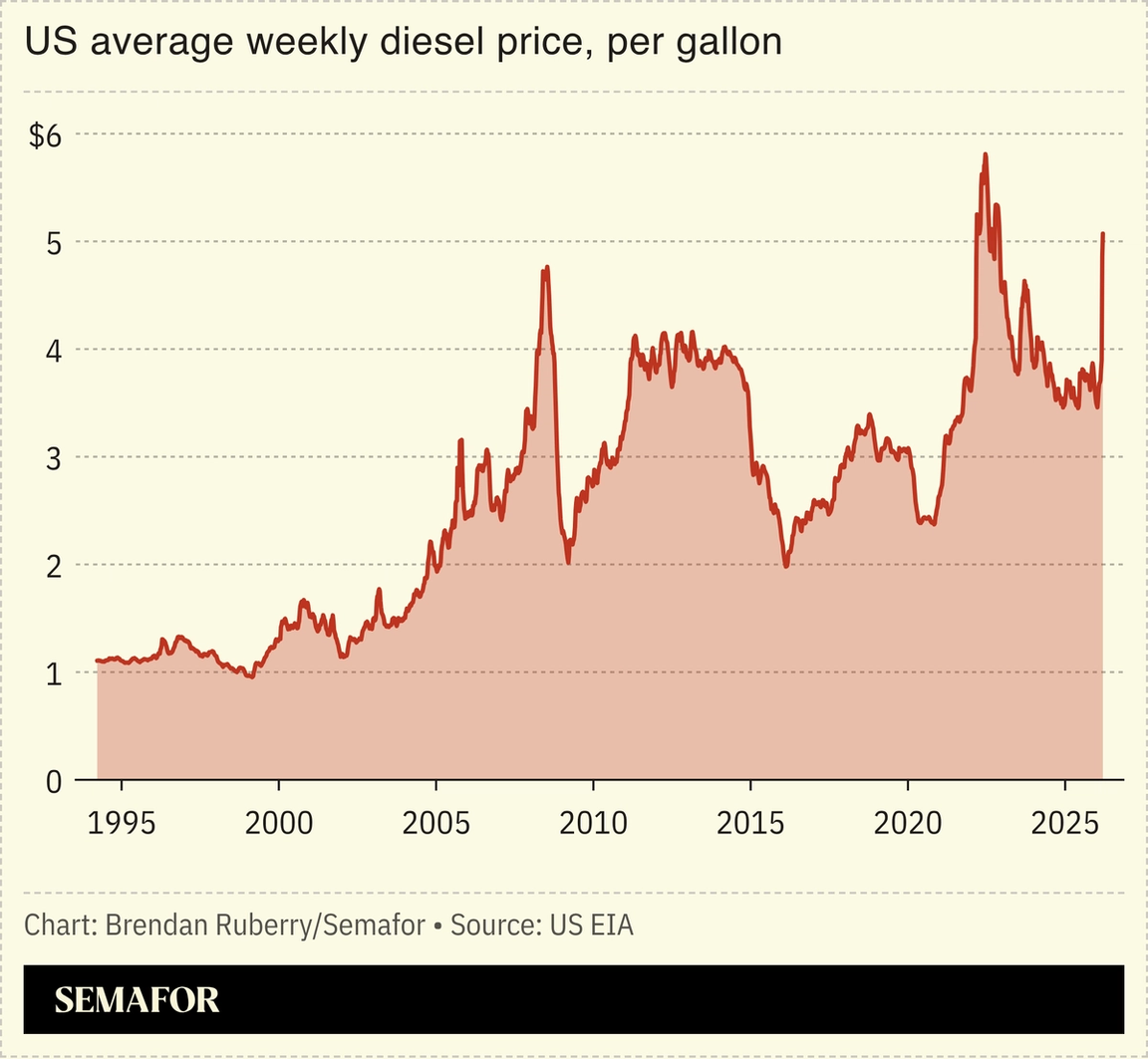 US diesel prices surpassed $5 per gallon on Tuesday for the first time since 2022, as the Iran conflict triggers historic supply disruptions. “Diesel is the lifeblood of the global economy,” Bloomberg wrote, and with prices expected to keep rising until the Strait of Hormuz is reopened, US President Donald Trump is under even more pressure to resolve the conflict. He abandoned efforts to build an international coalition to escort tankers through Hormuz after allies rebuffed his requests, even as Tehran appears to be tightening control of the chokepoint. But even if near-term security in the strait improves, the conflict will usher in a costlier era for energy because of security premiums that get baked into pricing, Semafor’s energy editor wrote. |
|
US counterterrorism chief quits over Iran |
 Elizabeth Frantz/Reuters Elizabeth Frantz/ReutersA top US counterterrorism official resigned Tuesday, citing his opposition to the Iran war and saying Tehran did not pose an imminent threat to the US. Joe Kent’s exit signals unease from some within President Donald Trump’s base about the US’ involvement in the conflict: Some of Trump’s “America First” allies now worry Iran holds more cards, and that the president “is drifting toward the kind of open-ended Middle East conflict he has long railed against,” Politico wrote. In Washington, patriotic acknowledgement of the war is notably absent, Semafor’s Ben Smith wrote. The White House hoped the conflict would be won swiftly and “made a choice not to put the city on war footing — or on alert.” |
|
Gulf economies set to shrink |
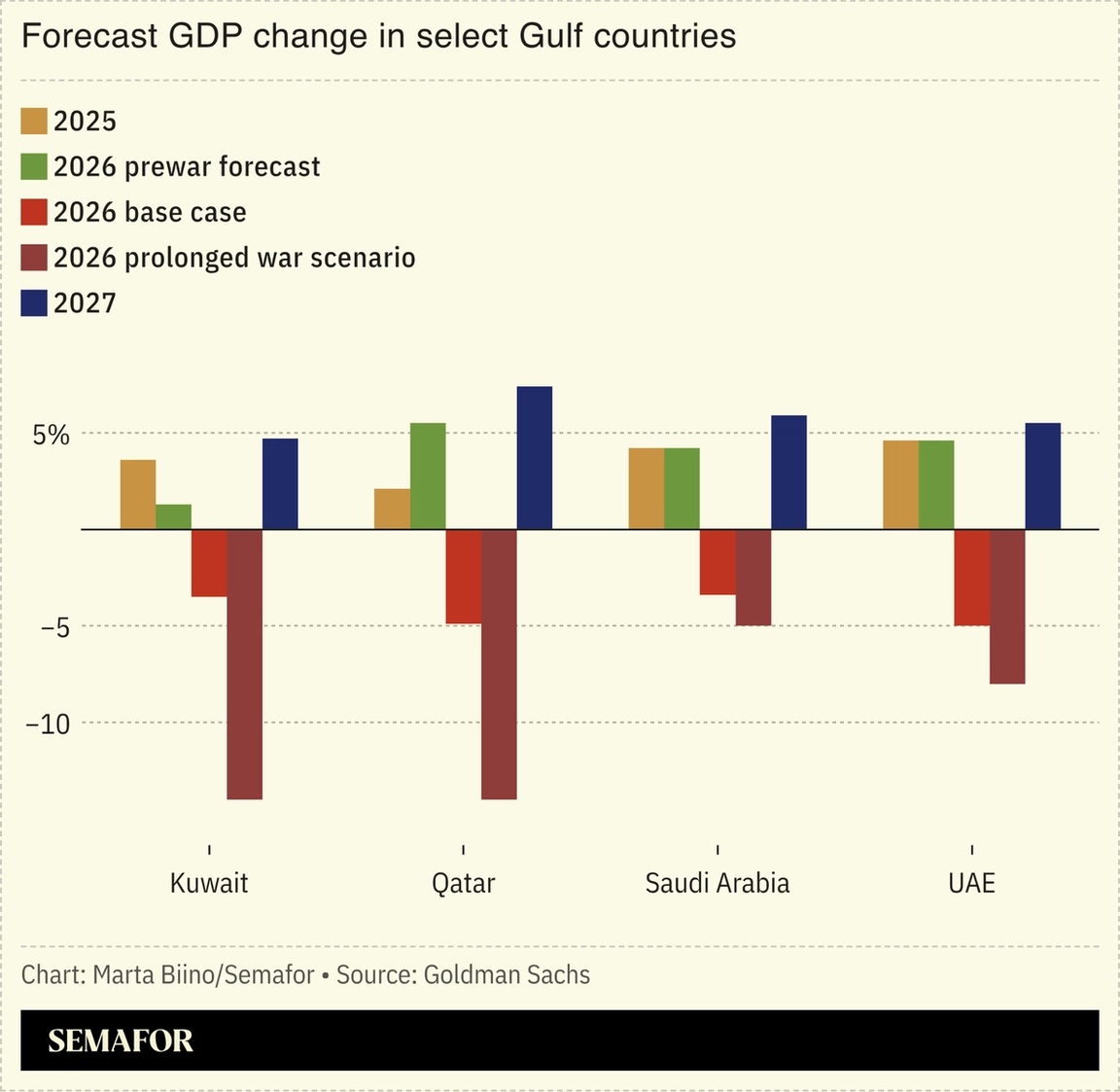 Gulf economies could contract sharply this year as a result of the war, according to Goldman Sachs. The bank’s base case assumes the Strait of Hormuz will be closed for most of March, leading each Gulf economy to shrink between 2% and 5% this year. Saudi Arabia’s ability to export some oil from a Red Sea port, coupled with its lower reliance on expatriate workers and tourism, means it should be more insulated than its peers; Kuwait and Qatar are seen as most at risk because they rely entirely on Hormuz for energy exports. One bright spot: Goldman forecasts a significant rebound in growth next year if oil exports return to normal and the region benefits from higher prices. |
|
Nvidia restarts AI chipmaking for China |
 Carlos Barria/Reuters Carlos Barria/ReutersNvidia is restarting manufacturing of its H200 processors, CEO Jensen Huang said Tuesday, weeks after the company reportedly halted production of the powerful chips intended for the Chinese market. Huang said Nvidia had been licensed “for many customers in China for H200s,” acknowledging the change in outlook. Washington had greenlit sales of the China-bound chips in December, but Beijing restricted Chinese companies from buying them amid its push to support homegrown champions. Huang said Nvidia was trying to balance maintaining global market share and complying with export controls. He added that while President Donald Trump aimed to keep the US in a leadership position, “he would like us to compete worldwide and not concede those markets unnecessarily.” |
|
US, China mulling ‘Board of Trade’ |
 The US Treasury/Handout via Reuters The US Treasury/Handout via ReutersThe US and China are discussing launching a new “Board of Trade” to help manage what both countries could sell to each other. The mechanism, floated after trade talks in Paris, could lower barriers for commerce in non-sensitive sectors — essentially finding ways to increase trade without raising national security red flags on either side — though details remain unclear. Beijing voiced openness to increasing its purchases of US agricultural goods, and Washington suggested it welcomed more Chinese investments. Both sides seem “interested in reaching something broader” than the extension of the trade truce reached last fall, a Trivium China analyst said. A delay of US President Donald Trump’s trip to Beijing appears unlikely to derail trade negotiations, experts noted. |
|
Risk capital plows into defense |
|
 David Ulevitch leads Andreessen Horowitz’s American Dynamism fund, a $1.776 billion pot dedicated to defense, energy, public safety, and other national priorities. This week, Compound Interest co-hosts Liz Hoffman and Rohan Goswami talked with Ulevitch about whether those industries deserve their conservative coding, why venture capital — with its roots in capital-light code — has a right to win in heavy industry, and why he doesn’t want the “moral liability” of deciding how the Pentagon uses the weapons Silicon Valley is building.
|
|
China eyes Hong Kong IPO curbs |
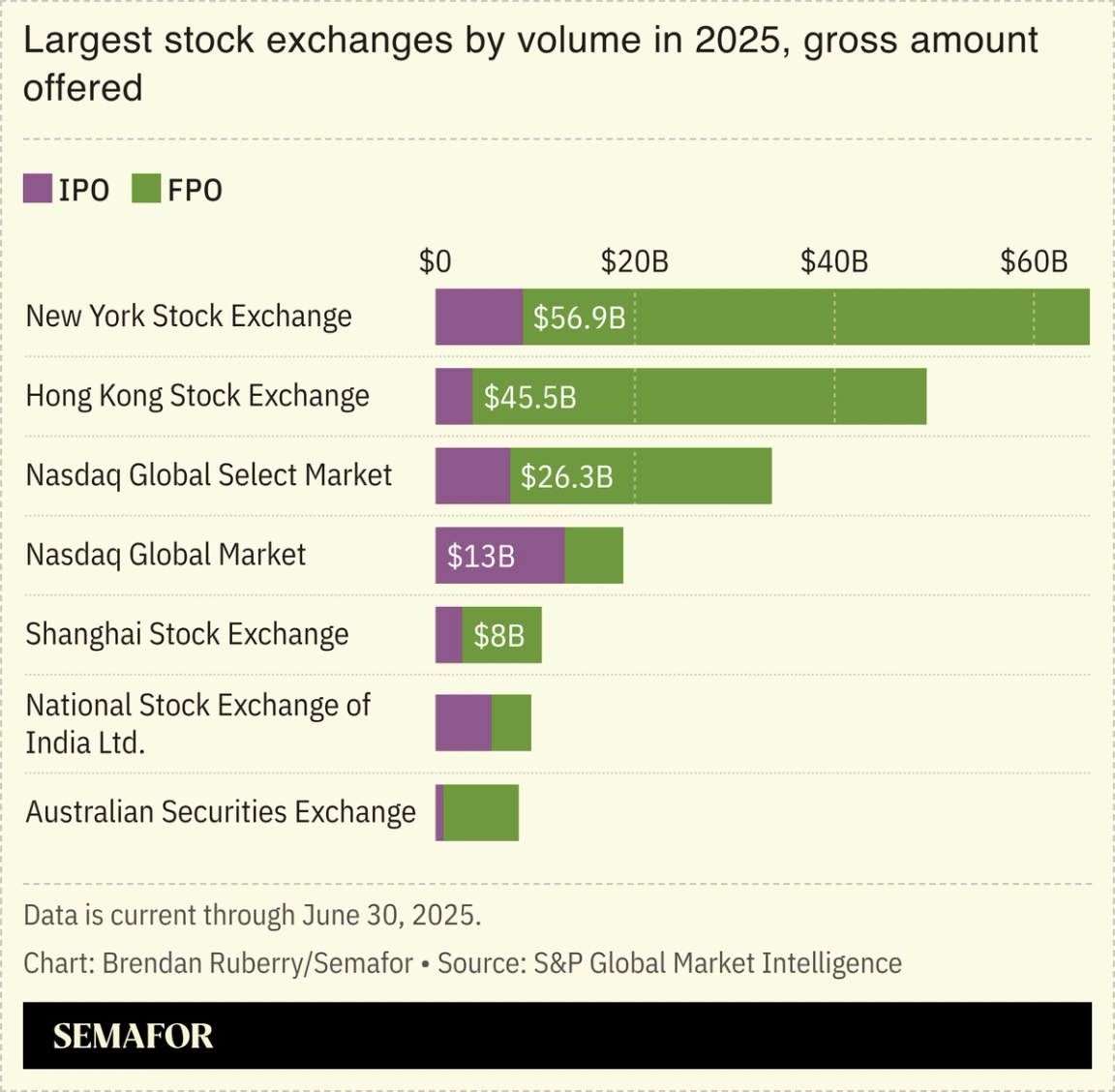 Chinese authorities are reportedly restricting the country’s companies incorporated abroad from pursuing IPOs in Hong Kong, signaling potential upheaval to a longrunning strategy for firms to raise funds. The move falls short of an outright ban, Bloomberg wrote, instead discouraging overseas-headquartered companies with Chinese assets from listing in Hong Kong — pushing them to incorporate on the mainland before pursuing an IPO. The pressure could dent Hong Kong’s IPO market, which had only recently revived momentum. Beijing has asserted more control over the city since a national security law took effect in 2020, a shift that has also hit the once-vibrant media ecosystem. Yahoo Hong Kong on Tuesday became the latest outlet to announce it is ceasing publishing original content. |
|
Mezcal popularity fuels deforestation |
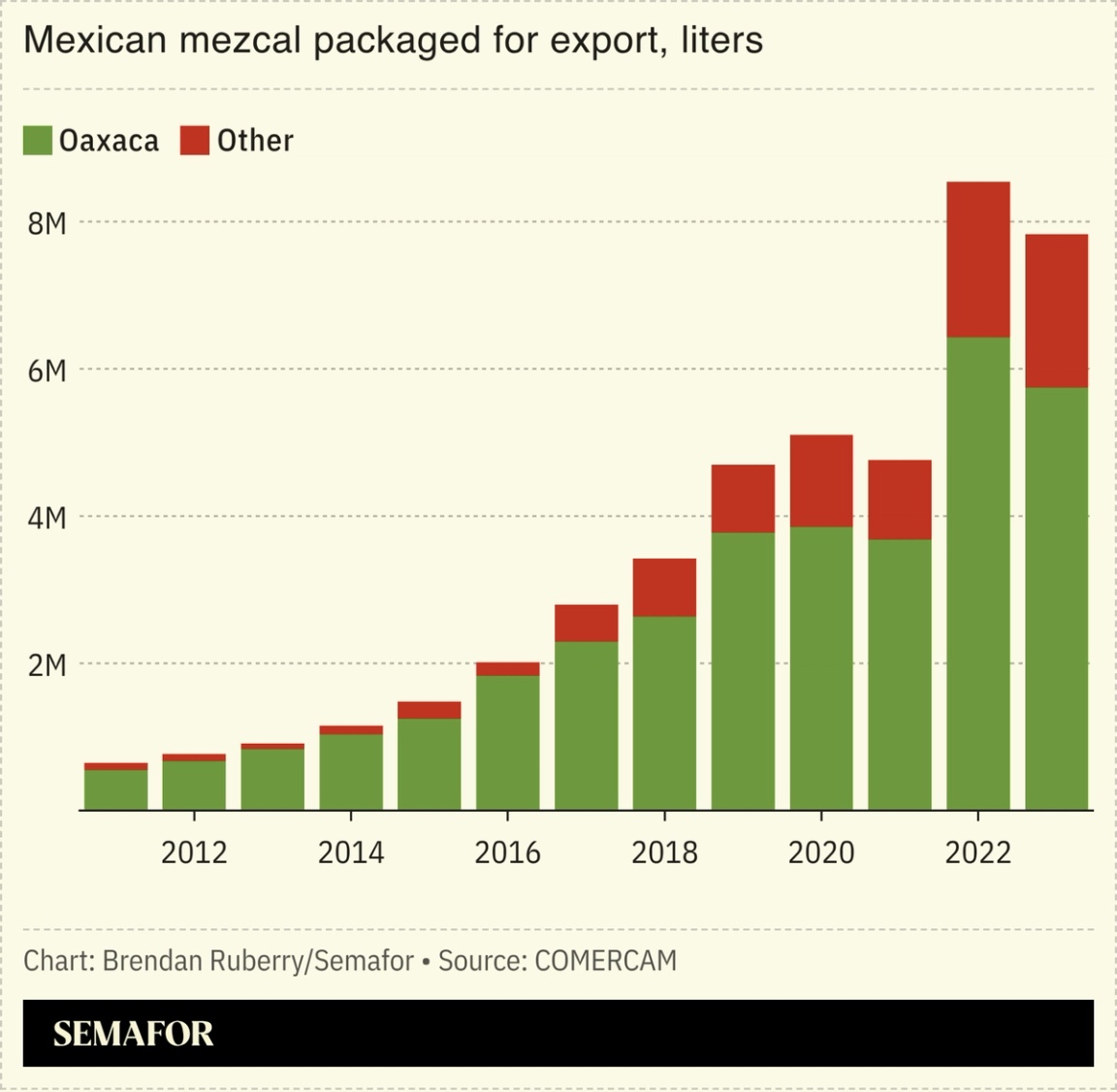 The global popularity of mezcal is driving deforestation in the Mexican state of Oaxaca. Production of the agave-based spirit soared from about 264,000 gallons in 2010 to 2.9 gallons in 2024; about 70% is exported, with three-quarters of that going to the US. Agave plantations have expanded 400% in three decades, and 86,000 acres of forest lost, The Associated Press reported. The industry’s growth has caused soil run-off, water loss, and river pollution, while the boom has also created thousands of jobs, and brought hundreds of millions of dollars into the Mexican economy. “Mezcal is a way of life,” said the founder of Guardians of Mezcal, a women-run collective promoting sustainably made mezcal. |
|
|


