|
I Finally Quit ChatGPT. Here's How I Stopped Hitting Claude's Usage Limits
Just follow these Claude best practices (so you stop going back to ChatGPT)
|

| |||||||||||||||


If you're a Claude-only user (or want to be), you've probably hit the usage limit more times than you'd like to admit.
I have too.
But here’s the thing: Claude doesn’t count messages. It counts tokens. Some chats eat through your limit 10x faster than others.
So I put together the best practices to stretch your Claude plan as far as it can go.
You don't have to follow all of them. Think of it like one of those iPhone tutorials to save battery. You could follow every tip, but you wouldn't have as much fun with it if you did.
Pick the ones that fit how you work. Even 2–3 of these will make a noticeable difference.
A new week, a new Claude guide
Click here to browse the full collection
If you want to keep these Claude guides coming, consider supporting me by becoming a paid subscriber 👇
#1 Edit your prompt. Don’t send a follow-up
When Claude’s answer misses the mark, most people send another message like “no, I meant...” or “can you try again but...”
Every follow-up message adds to the conversation history.
Claude re-reads the entire conversation every single turn. So by message 10, you’re not just paying for message 10 — you’re paying for messages 1 through 9 all over again.
This adds up fast.
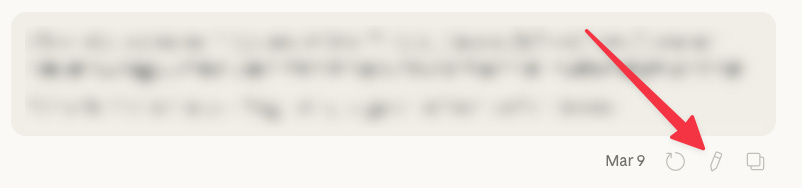
Instead of sending a new message, click the edit icon on your original message, fix the prompt, and regenerate. The old exchange gets replaced instead of added.
Here’s how to do it
Go to the prompt you wrote → click the pencil icon → rewrite your prompt → hit send. Claude regenerates as if the bad response never happened.
 |
#2 Start fresh every 15–20 messages
Again, Claude re-reads your entire conversation history every single turn.
Your first message costs hundreds of tokens. By message 20, a simple question can cost thousands of tokens. The longer the chat, the more expensive every message becomes.
Long chats are expensive chats.
Start a new conversation every 15–20 messages.
If you need context from the old chat, ask Claude for a summary, copy it, and paste it into the new chat as your first message.
Here’s how to do it
When a conversation starts getting long → ask Claude: “Summarize everything we’ve discussed so far” → copy the summary → open a new chat → paste it as your first message → start fresh
 |
You get fresh context without the bloated token cost.
#3 Combine multiple questions into one
Sending three separate messages means Claude loads the conversation context three separate times.
Batch your questions into a single message.
Instead of sending “Summarize this article,” then “List the main points as bullets,” then “Suggest a headline,” send all three at once.
Write one message like: “Summarize this article, list the main points as bullets, then suggest a headline.”
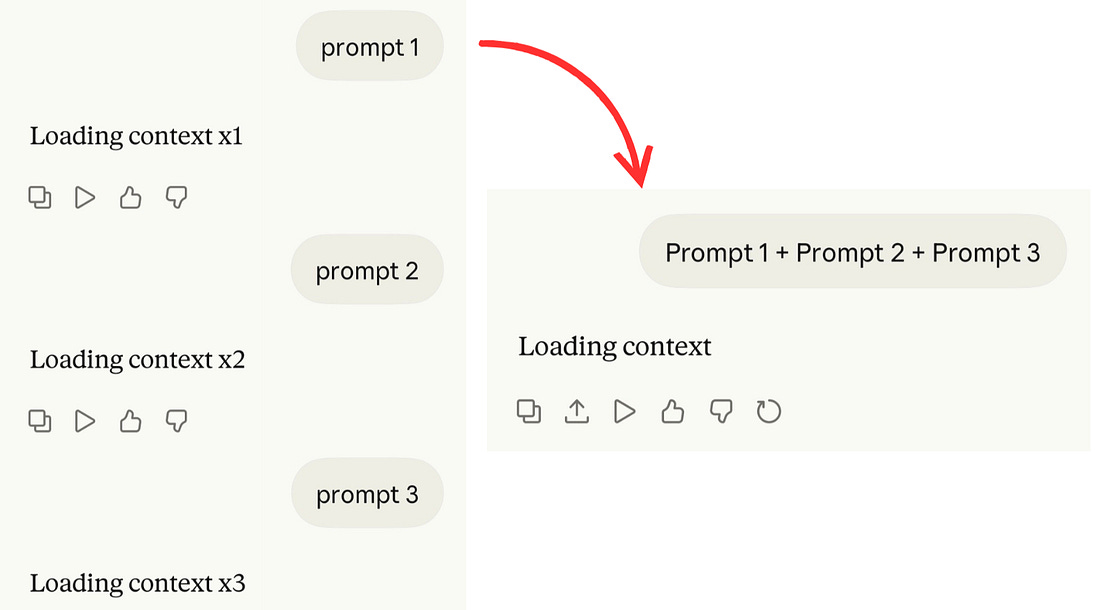 |
One message. Three answers. One context load.