| | The US and Iran threaten to target critical civilian infrastructure, Washington waives oil sanctions͏ ͏ ͏ ͏ ͏ ͏ |
| |  | Flagship |  |
| |
|
The World Today | 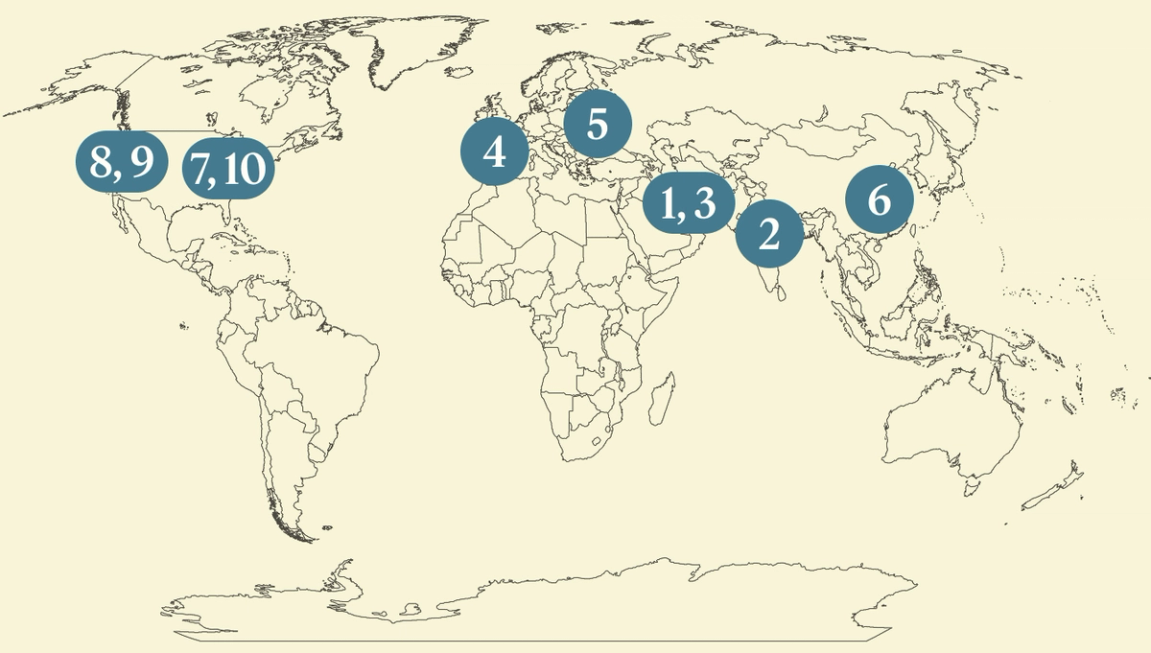 - Trump gives Iran ultimatum
- US waives Iran oil sanctions
- Conflict’s lasting impacts
- Nations’ energy prices vary
- How Starlink helps Ukraine
- China makes investment pitch
- ICE headed to US airports
- OpenAI doubling workforce
- AI’s ‘intelligence explosion’
- Kids faring better than thought
 A ‘powerhouse play’ about Roald Dahl and antisemitism. |
|
US and Iran ramp up threats |
 Amir Cohen/Reuters Amir Cohen/ReutersThe US and Israel’s war against Iran escalated Sunday as Washington and Tehran ramped up threats to target civilian infrastructure. President Donald Trump said the US would “obliterate” Iranian power plants if Tehran did not fully reopen the Strait of Hormuz within 48 hours. Iran responded by threatening to target energy facilities and water desalination plants across the region. Trump’s ultimatum came as Iran launched one of its most intense attacks on Israel since the war broke out, while the risk of an expanding war grew: Iran fired its first known long-range ballistic missiles toward a US-British Indian Ocean base on Friday. Markets are facing a “ticking time bomb of elevated uncertainty,” one analyst said. |
|
US waives Iran oil sanctions |
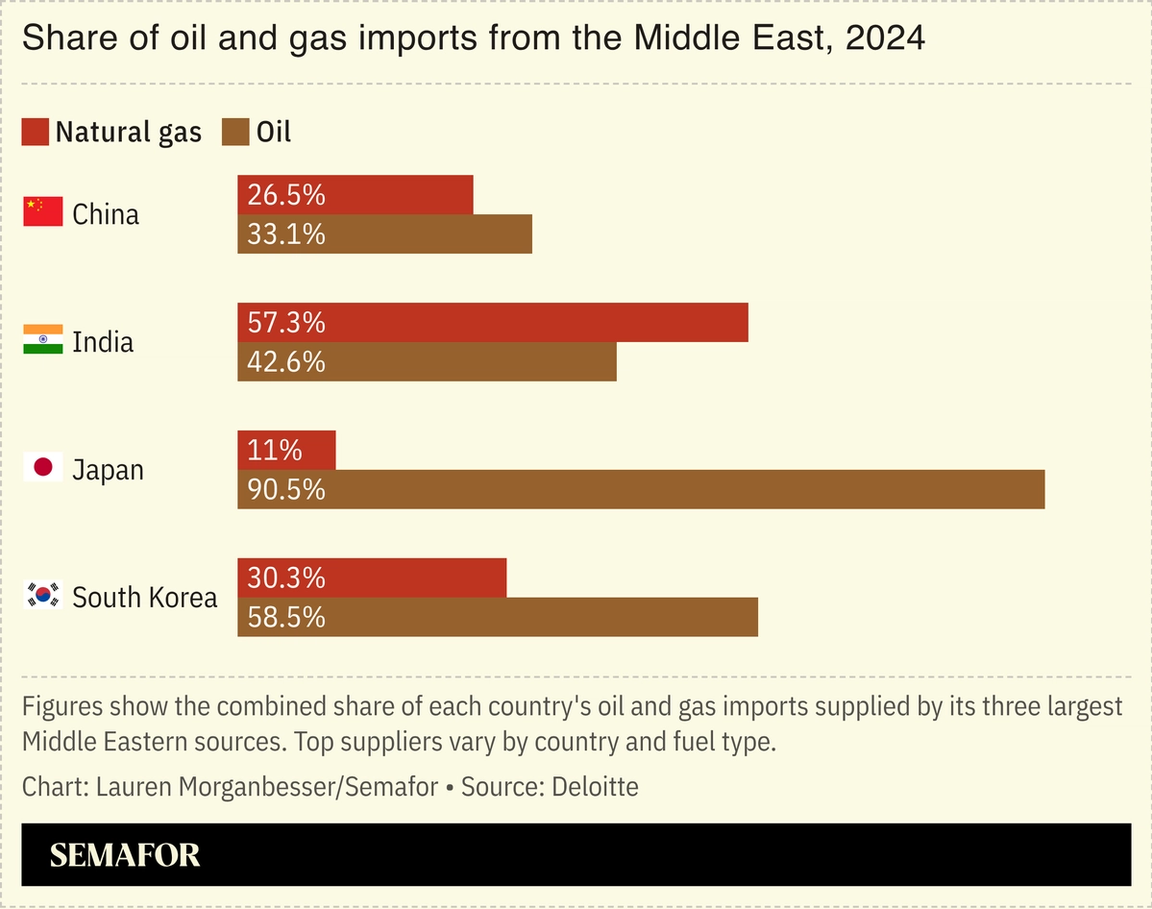 The US temporarily waived sanctions on Iranian oil that’s already at sea, boosting the war economy of the nation Washington is waging war against. The move marks an effort to relieve pressure on global energy markets, as the conflict spurs major supply disruptions and sends prices soaring. White House officials argue the waiver allows US partners to buy oil that China would have purchased anyway. India is set to be a major beneficiary of the policy, and refiners are planning to resume Iranian crude purchases. But the Strait of Hormuz closure continues to weigh on the South Asian nation: A cooking gas shortage has forced some hotels to shift to firewood, pushing up costs, The Times of India reported. |
|
Economic fallout from war could be lasting |
 Benoit Tessier/File Photo/Reuters Benoit Tessier/File Photo/ReutersExperts are reckoning with the long-term economic impacts of the Iran war. Analysts had broadly predicted at the start of the war that markets could shake off short-term disruptions from US and Israeli strikes, but the effective closure of the Strait of Hormuz, coupled with attacks on energy production infrastructure, are causing supply shocks that could persist for months, or in some cases years, Axios wrote. The blockage of fertilizer, helium, and sulphur shipments is “alarming industries from chipmaking to farming,” the Financial Times editorial board wrote. “The worst-case scenarios for investors and policymakers are now coming into view.” Energy shocks will translate to prices rising “high enough that people stop consuming,” an investor warned. |
|
Nations’ energy prices vary wildly |
 Bruna Casas/Reuters Bruna Casas/ReutersEnergy prices in different countries have varied wildly since the Iran war began, with market design and levels of renewable energy playing a role. Gas sets the price of power in many markets. Electricity costs are set by the price of the last unit sold; renewable energy is often cheapest and gas most expensive, so gas gets used last. When it is used, everyone pays more. Such a structure is hard to avoid; without it, renewables producers would charge the market rate anyway. In France, with abundant nuclear, and in Spain, with abundant solar, gas is rarely used, so energy prices rose only slightly; in the UK, gas sets prices regularly, Carbon Brief noted, although the country’s growing wind capacity has weakened the link. |
|
Ukraine gains as Russia loses Starlink |
 Inna Varenytsia/Reuters Inna Varenytsia/ReutersUkraine has achieved its largest domestic territorial gains in more than two years after Elon Musk cut off Starlink internet service to Russian forces, showing how digital infrastructure is redefining the modern battlefield. The satellite internet service was vital for Russian drones, troop communications, and real-time battlefield surveillance; Moscow’s forces had been using unauthorized connections, but Musk cut them off in February. Ukraine’s subsequent gains show how “a private company is now a gatekeeper in orbit,” two experts argued in Foreign Policy, “helping decide who connects as well as where, under what conditions, and with what technical constraints.” Starlink has also aided Iranian protesters evading government blackouts, illegal miners in the Amazon, and jihadi terrorist groups in Africa’s Sahel. |
|
Beijing draws contrast with US volatility |
 Ng Han Guan/Pool/Reuters Ng Han Guan/Pool/ReutersChina pitched itself to global executives as a “harbor of stability,” drawing a contrast to US volatility. Premier Li Qiang’s speech in Beijing on Sunday came as the world’s second-largest economy works to turn around a decline in foreign investment, which fell 9.5% in 2025. Li also pledged to pursue more balanced trade after China logged a record $1.2 trillion trade surplus last year, underscoring concerns in Beijing that the trade imbalances could disrupt ties with other countries amid a trade truce with the US. President Donald Trump’s visit to China is reportedly on hold until the Iran war is over, a delay that likely strengthens Beijing’s hand in geopolitical negotiations, analysts said. |
|
Trump to send ICE agents to airports |
 Megan Varner/File Photo/Reuters Megan Varner/File Photo/ReutersUS immigration agents will be deployed to airports on Monday, President Donald Trump said, escalating a standoff in Washington over a government funding deal. Long lines at airports caused frustration among travelers over the weekend as a partial government shutdown forces Transportation Security Administration agents to work without pay. More than 400 TSA workers have quit, and if a funding deal is not reached soon, experts expect a surge in resignations. As Democrats push for tighter limits on how immigration agents operate nationwide, the US border czar said they will conduct only “non-significant” tasks at airports, such as guarding exits. There are few signs that lawmakers are close to a breakthrough to end the shutdown. |
|
 This April, Maria Luís Albuquerque, Commissioner for Financial Services & the Savings & Investments Union, European Union, will join global leaders at Semafor World Economy — the largest convening of top global CEOs and government officials in the United States — to sit down with Semafor editors for conversations on the forces shaping global markets, emerging technologies, and geopolitics. See the full lineup of speakers, including Global Advisory Board members, Fortune 500 CEOs, and top elected officials from the US and across the G20 here. |
|
OpenAI to double headcount |
 Kylie Cooper/Reuters Kylie Cooper/ReutersOpenAI plans to nearly double its headcount to 8,000 employees this year, as the startup ramps up a push to sell its AI products to businesses, the Financial Times reported. The ChatGPT creator has been losing out on business customers to rival Anthropic, credit card payment data suggests, even as OpenAI’s chatbot remains popular among individual users. The company’s hiring spree comes amid a dampened US labor market, as more companies pursue layoffs and pause hiring, often citing AI as the reason. But the AI boom will drive “an increase in demand for workers with AI knowledge and associated skills,” Goldman Sachs researchers wrote last week. It is also creating more blue-collar construction roles tied to the data center buildout. |
|
AI nears ‘intelligence explosion’ |
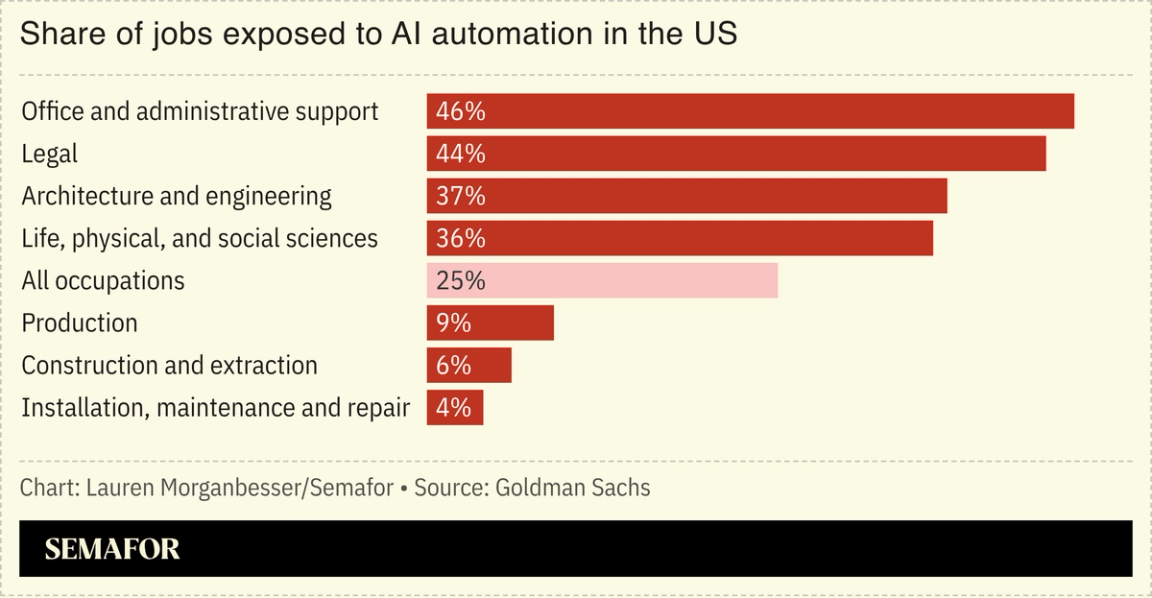 AI’s explosive stage could be beginning. Computing pioneer I.J. Good said in 1965 that when intelligent machines could design even more intelligent ones, there would be an “intelligence explosion,” and this powerful AI would be “the last invention” humanity would need to make. Some researchers think such “recursive self-improvement” is here; Anthropic, Google DeepMind, and OpenAI report that much code used to improve their models is AI-written; staff at Anthropic told Time that full research automation could be a year away, and recursive self-improvement is not a future phenomenon but a present one. Political institutions are not ready for the pace of change this could usher in, Transformer wrote: Imagine enormous breakthroughs “not every few months, but… every few days.” |
|
|


