Hi! Concerning… A truck loaded with a cryogenic box containing 92 antiprotons — negatively charged subatomic particles that instantly “annihilate” ordinary matter upon contact — took a half-hour drive around the CERN campus yesterday. Today we’re exploring:
|
- Cash on the barrel: Energy is only about 6% of the Consumer Price Index, but that’s not the full picture.
- Think different: Apple’s introducing ads to Maps, building on its high-margin Services business.
-
Taking notes: As New York’s acceptance law passes, will cash make a comeback?
|
How much does oil matter for inflation anyway? |
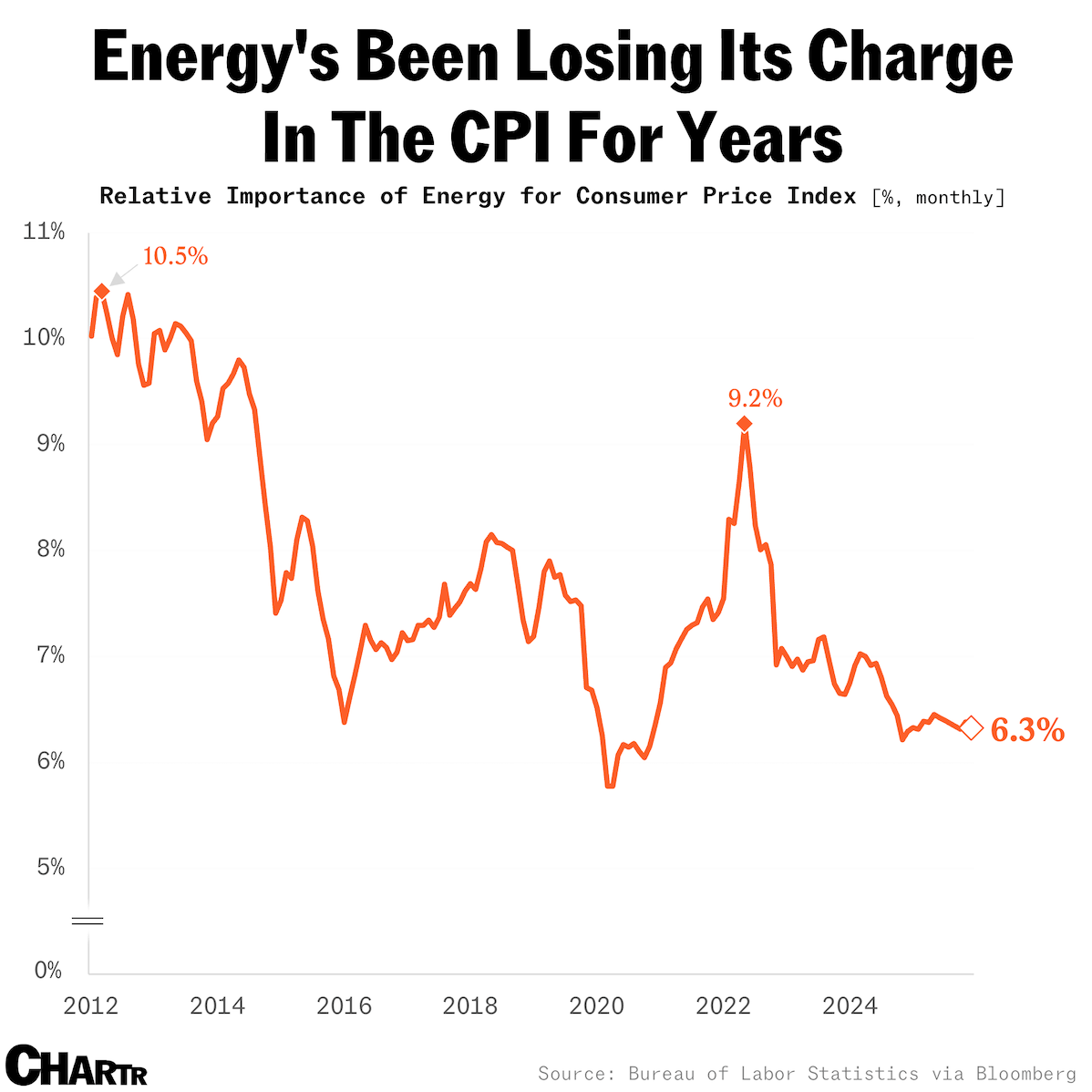
As markets await the first CPI print measured since the start of the Iran war, slated for April 10, it’s worth stepping back and asking one important question: how much does oil matter for inflation anyway?
The basket of goods and services that measure price rises changes over time to best reflect what America is actually buying: for example, tinned foods make up a very small share of the index today, while items like payphones, video rentals, and floppy disks have disappeared from the basket altogether. Over the years, the Bureau of Labor Statistics has allocated less importance to energy, with the latest weighting, published December 2025, putting the component at just 6.3% of the index.
|
Of course, while the share of energy contributing to the CPI directly might be lower than what many people expect, higher oil and energy prices affect nearly everything else indirectly. For one, food prices, comprising ~15% of the index, are sensitive to fertilizers, which are often produced using natural gas and subject to transportation costs.
Indeed, RBC analysts project that if oil prices settle around $100 per barrel, US inflation would rise above 3.5% by Q2, about 0.7 percentage points higher than the base case. Meanwhile, both Brent crude futures and West Texas Intermediate futures have sunk to ~$100 and ~$88 a barrel, respectively, after the US reportedly sent a 15-point plan to Iran to end the conflict.
|
Apple says it’s bringing adverts to its Maps app this summer |
Apple Maps users just trying to find their way in the world might soon discover their paths cluttered by paid suggestions, as Apple announces new plans to introduce ads into its Maps app.
Through a new free platform called Apple Business, the company will allow retailers to buy priority placements for search queries and its new “Suggested Places” list in the app — and US and Canadian users can expect to see the sponsored spots crop up by summertime. Rival Google Maps, which Apple has been contending with for years, introduced a similar suggestion-based bidding system back in 2013.
|
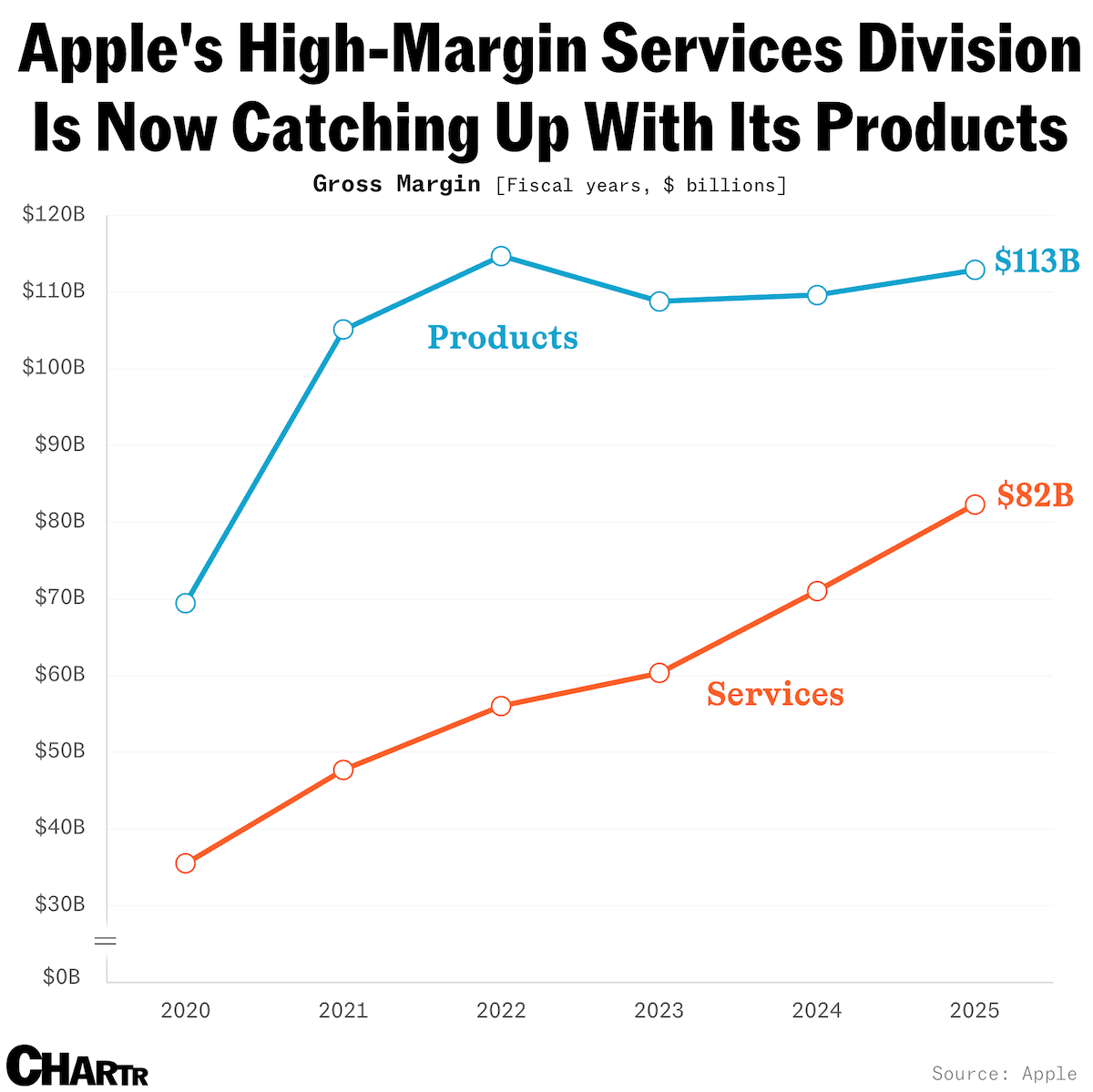
The move is just the latest in Apple’s push to squeeze advertising sales from its apps and services, having added advertising slots within the App Store, Apple TV, and News in recent years. Those efforts have been paying off, helping to boost margins in the company’s Services division to an eye-popping 75% — more than double the margin it ekes out from the Products segment, home to its iPhones, iPads, Macs, and other devices.
While Products brought in almost $200 billion more in sales than Apple’s Services last year, there was only a little over $30 billion worth of difference between the divisions’ gross margin figures. |
The App Store remains at the core of Apple’s Services business, bringing in some $20 billion in annual revenue, thanks to the cash it takes from in-app purchases and the controversial “Apple Tax” — the 15-30% commission the platform pockets from paid downloads. The iCloud+ storage subscription, which a whopping 70% of recent US Apple device buyers paid for in Q4 2025, per CIRP estimates, also chips in, alongside subscription and advertising revenues from News, Music, TV, and other services.
|
|
|
AI Won't Replace Your Workforce. But a Bad AI Strategy Could Replace You. |
Across businesses, the AI race has shifted from adoption to value realization.
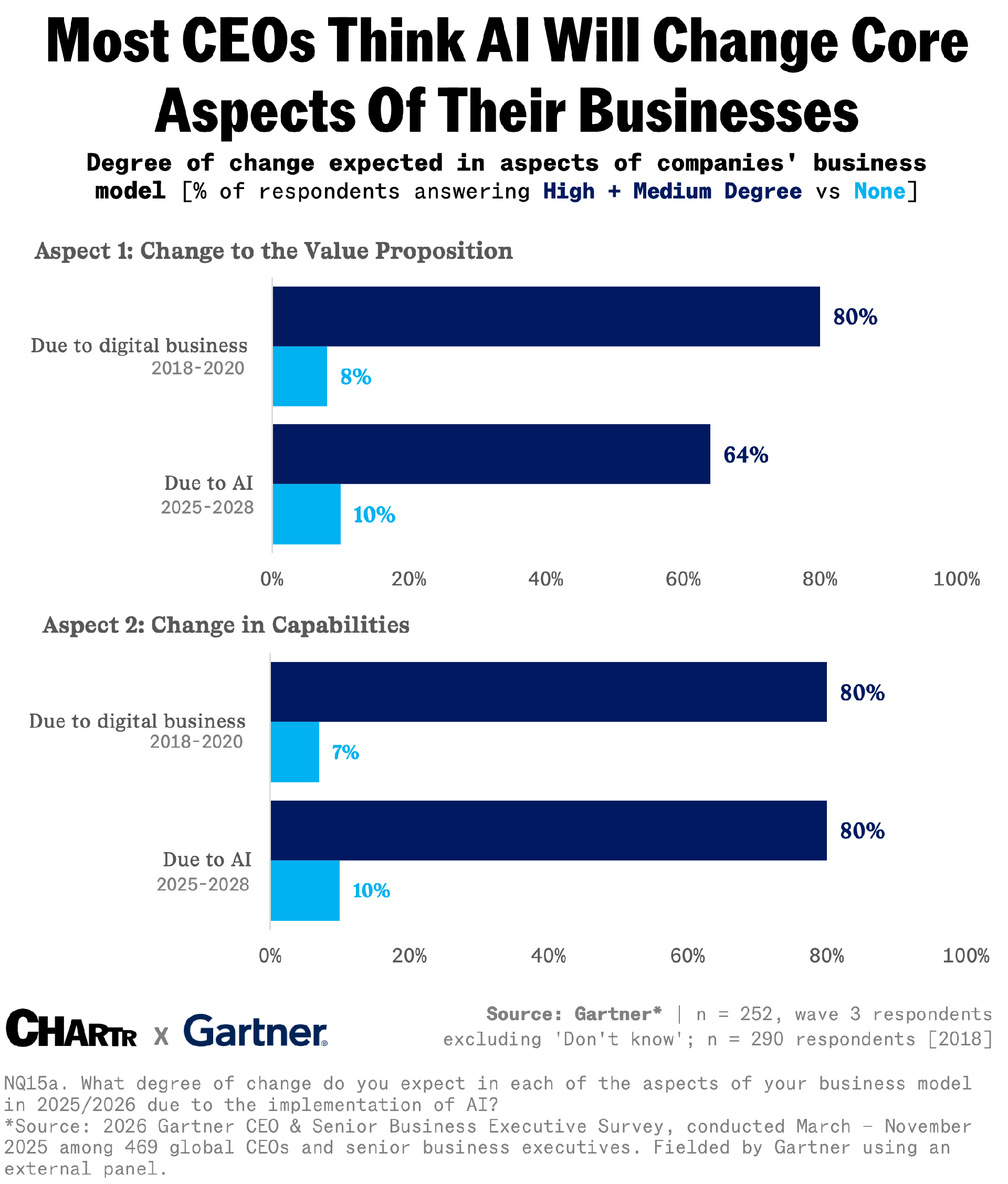
New research from Gartner indicates that CEOs expect AI to fundamentally change their business models. Contrasted with CEO views from a 2018 study, the degree of change anticipated from AI compares similarly to the impact of digital business. |
In the context of changing value propositions and business capabilities, integrating AI into the flow will be critical. CIOs and tech strategists must be ready to harness the current momentum and lead the charge in capturing real AI value.
With 200,000+ in-depth client conversations on AI, 6,000+ AI-related written insights and 1,000+ use case analyses, Gartner is an indispensable resource in navigating everything AI. Gartner helps C-Level leaders — from marketing, HR and finance, to supply chain, sales and legal — find real ROI. |
|
|
With New York’s acceptance law coming into effect, could cold hard cash stage a comeback? |
The familiar jangle of coins and pocket-padding of banknotes have become much rarer sensations for Americans today, as tapping and swiping have all but replaced the need for traditional wallets. But while digital payments have become the go-to for the sake of convenience, a large share of US adults still believe cash is king (or at least deserves a seat at the table).
|
A survey conducted by the Siena Research Institute, published in January, found that 84% of Americans opposed moving to a cashless society.
That sentiment is echoed in a new statewide law that came into effect in New York on Saturday, requiring stores to allow customers to pay in cash — mirroring the law that’s been in place in NYC since 2020. However, the rule doesn’t apply to bills in denominations above $20... which aligns with the Big Apple’s street food culture, but doesn’t speak to the wider currency landscape in the US.
|
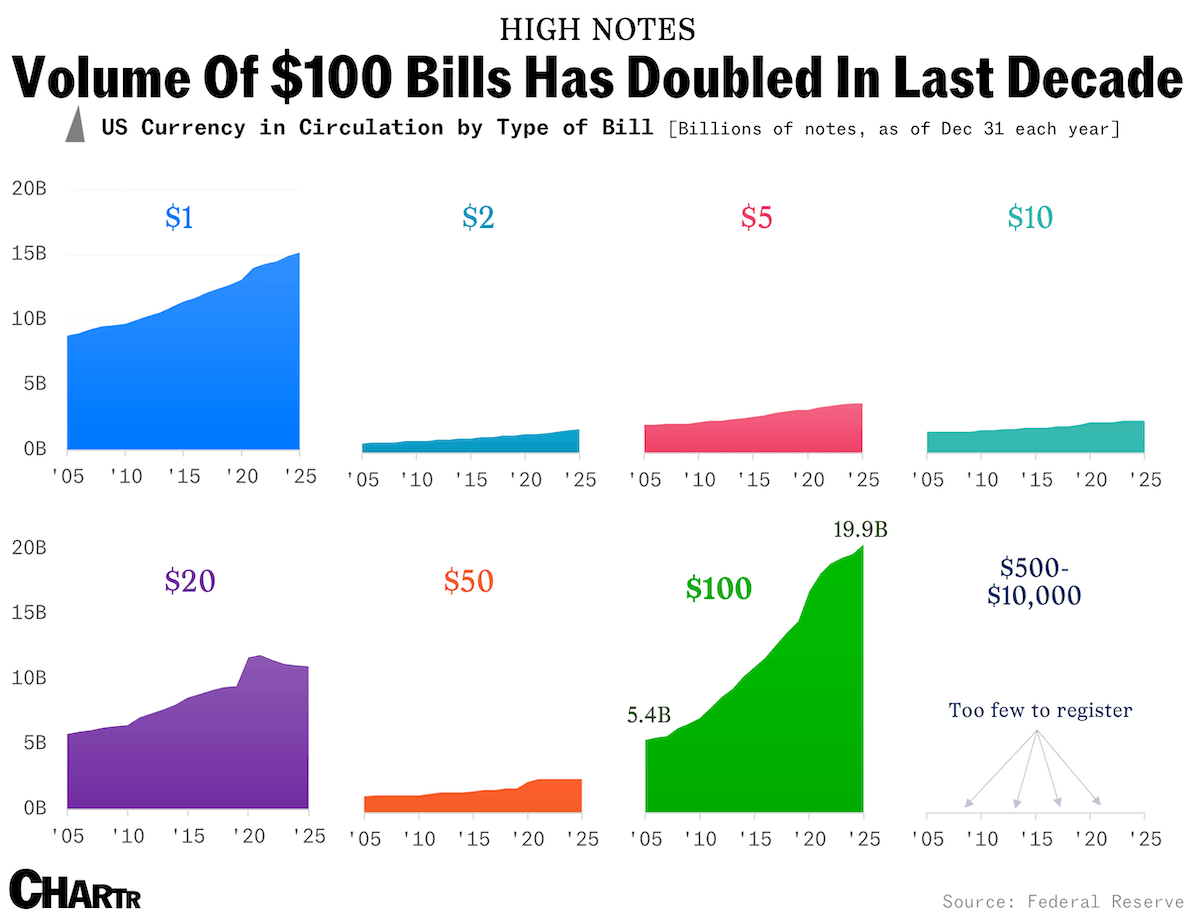
Data from the Federal Reserve on the volume of currency in circulation shows that the national wallet is stuffed with $1 and $20 notes, with 15.2 billion and 11 billion in circulation, respectively, as of December 31, 2025. But it’s $100 bills that have really taken off, having surpassed the $1 bill by circulation volume back in 2017 and nearly doubling in volume from 2015 to 19.9 billion at the end of last year.
There are several reasons why the Fed keeps printing so many hundies: for one, $100 bills tend to be saved at a higher rate; international demand for US currency sees a large share of $100 bills being held abroad; and, though a shift toward digital payments is still being observed, cash remains generally relevant to paying Americans, accounting for 14% of all US consumer payments in 2024.
|
|
|
-
Boba boom: China’s biggest bubble-tea chain Mixue Group beat earnings expectations for 2025, with both revenue and profit climbing over 30%.
-
United Airlines’ CEO said airfares may need to climb another 20%, even after double-digit increases in recent weeks, to offset rising fuel costs.
-
While egg prices are finally cooling down, chocolate egg prices certainly aren’t… the NRF predicts that Americans will spend $3.5 billion on Easter candy this year.
- America’s construction spending on data centers reached a record annualized rate of $45 billion in December, per Census Bureau data, surpassing the amount spent on offices for the first time.
-
Reality check: The number of unscripted series in the US has dropped by a third since 2022, according to Luminate data cited by the NYT, falling 15% last year alone.
|
|
|
-
An interactive journey through IVF, told from either the parent’s or the child’s point of view.
- Pikas and troughs: The most popular Pokémon ever, according to Google Trends.
|
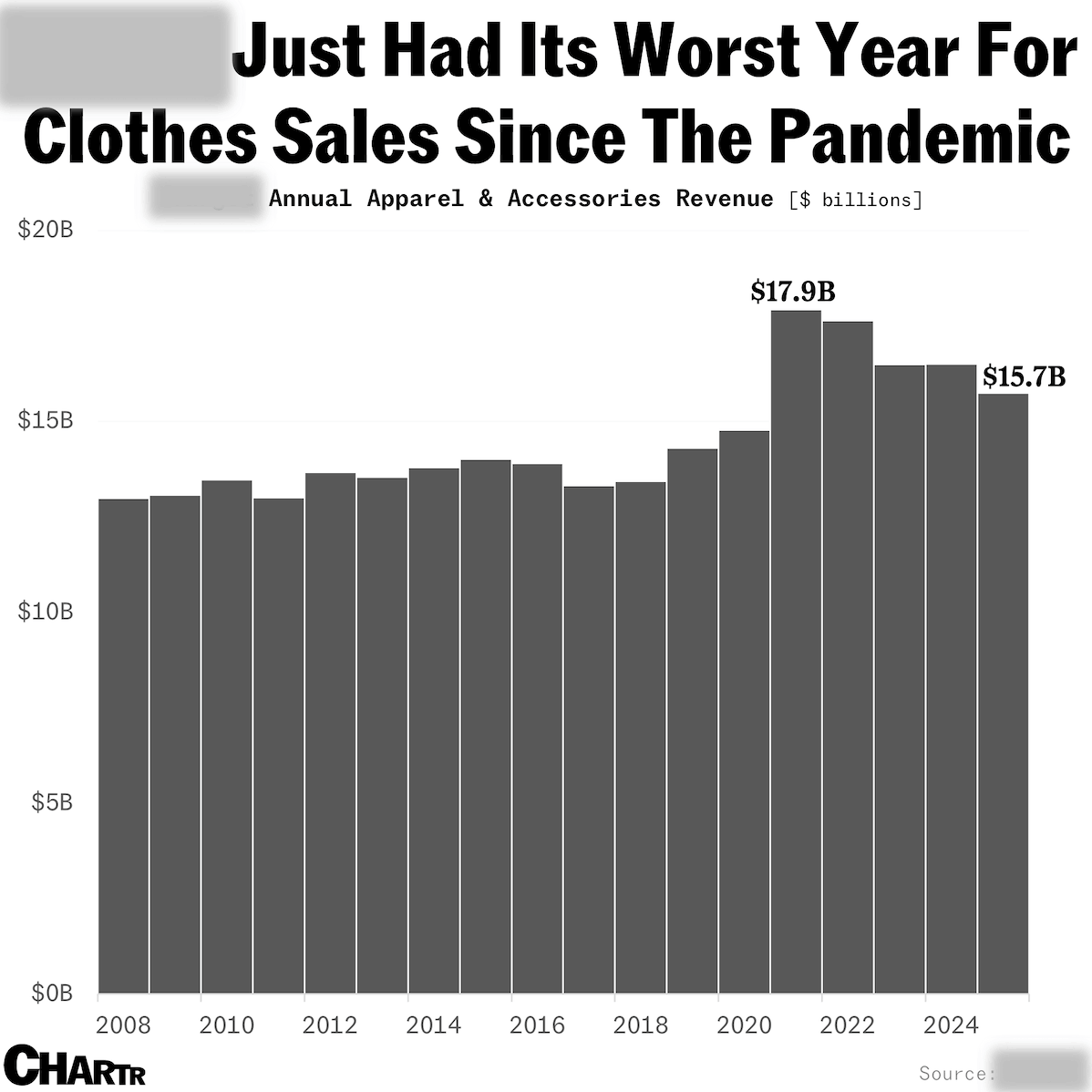
Off the charts: Which major US retailer last year posted its lowest apparel and accessories sales since 2021? [Answer below]. |
Not a subscriber? Sign up for free below. |
|
|
|