Sora, we hardly knew ya. On Tuesday, OpenAI announced that it will be shutting down its once viral AI-generated text-to-video app, Sora, joining the hallowed halls of short-lived video concepts like HQ Trivia, Meta’s Lasso (a TikTok clone before Instagram Reels), and the most famous flame-out, Quibi. (Disney invested $25 million into that one.) But move over, Quibi — Sora beat your speedrun to failure.
The S&P 500, Nasdaq 100, and Russell 2000 all rose on Wednesday amid renewed hopes that the conflict in the Middle East could draw down after it was reported late Tuesday that the US sent Iran a 15-point plan to end the war. Reports that Iran would not accept the plan seemed to dampen the rally, but the market remained cautiously optimistic.
|
|
|
Investors remain on the hunt for companies positioned at choke points in the AI investment frenzy, allowing them to vacuum up a healthy share of the cash pouring into the great AI build-out.
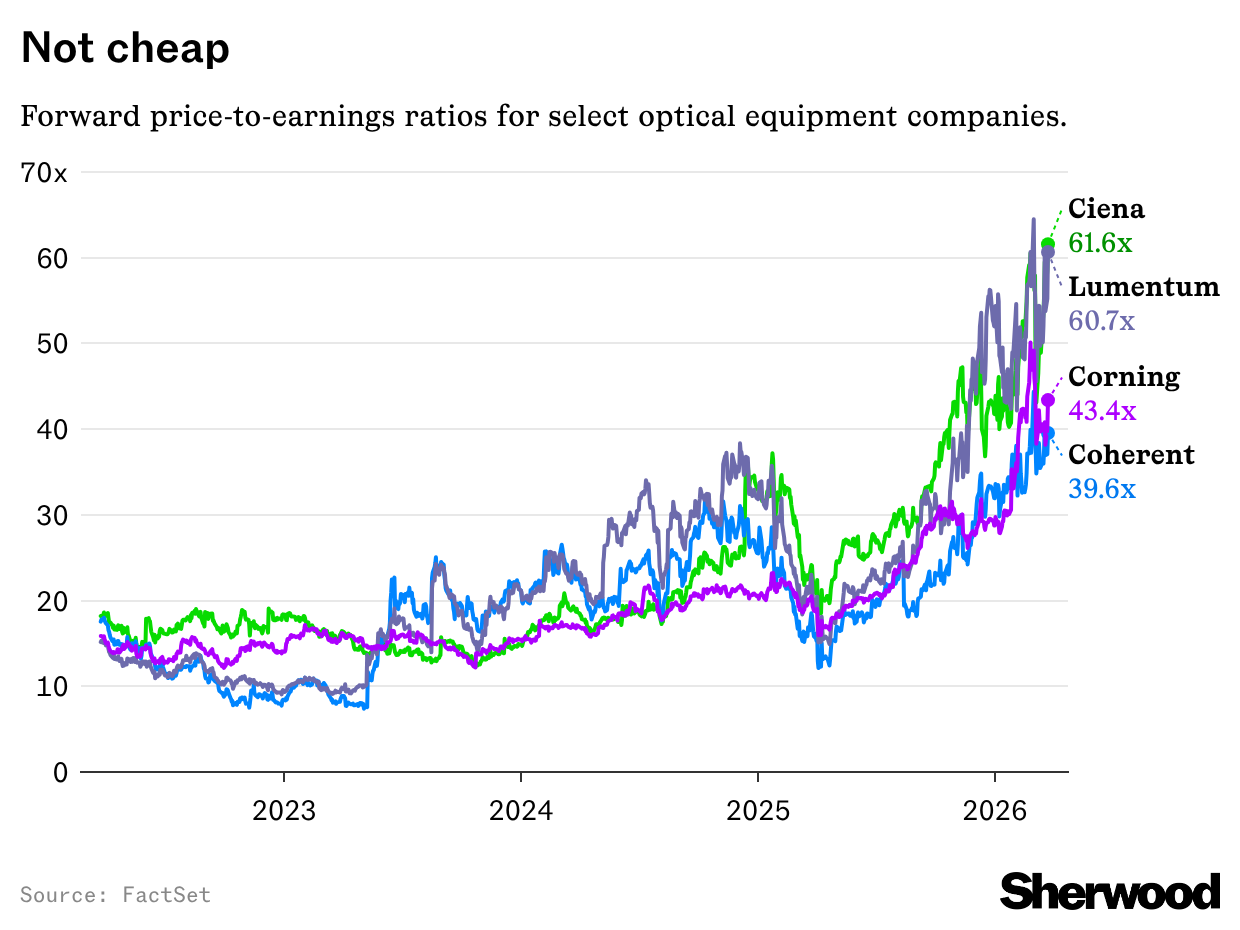
When that wave of capital hits such a bottleneck, it causes product prices to surge, explodes profit margins, and often sends stocks soaring. All three of those things have happened for the companies that produce optical components for AI, and they’ve caught another leg up in recent days after looking wobbly at the start of the Iran war. |
- These so-called optics companies all handle slightly different aspects of the same undertaking: using light and electrical signals to almost instantly transfer the data that AI technology both consumes and produces.
-
And over the past few months, the cluster of optical stocks — Lumentum (up 989% over 12 months), Coherent (up 255%), Ciena Corp. (up 518%), and Corning (up 185%) have elbowed their way toward the top of the heap of AI-related trades.
- Analysts say the scale of the AI boom — and AI’s requirements for bandwidth, speed, and power — is beyond the capacity of some long-standing networking technologies, such as the copper cables that carry signals using electricity.
-
“Copper is an excellent medium at short reaches (<10 meters),” wrote Bank of America analyst Vivek Arya. “But as hyperscalers build larger compute nodes, interconnect even more nodes, and link geo-dispersed data centers, the role of optics expands.”
|
The gains accelerated Tuesday when Lumentum — which was only officially added to the S&P 500 at the start of the week — jumped 10% and Corning rose 8.4%, making them the two top gainers in the S&P 500 for the day. Coherent, which also just joined the blue-chip index, rose nearly 7%. Lumentum closed at an all-time high, up a whopping 44% off its post-war low just 19 days prior.
|
|
|
The largest part of the optical technology market related to AI is in so-called transceivers. These devices transform electrical signals into light that can be sent through fiber-optic cables. Transceivers also transform light back into electrical signals that computers can read as data.
Morgan Stanley analysts estimate the AI-related transceiver market amounts to roughly $50 billion, and is a particular strength for companies like Lumentum and Coherent. The data center build-out has been huge for the sector, as transceivers account for roughly 10% of the cost of a typical data center, according to Morgan Stanley. |
|
|
Invest in the stability of America’s corporate giants |
DIA offers cost-efficient, liquid exposure to 30 US blue-chip stocks. It is the only ETF tracking the Dow, the oldest and most widely quoted indicator of US stock market activity. The mega-caps that comprise the Dow offer revenue exposure to 177 countries and 152 different industries.1
DIA has been helping investors reach their goals by providing broad exposure to a global market and 30 of the world’s most recognizable companies.
Find out how DIA can help you achieve yours. Getting there starts here. |
|
|
-
Through a new free platform called Apple Business, available in more than 200 countries and regions starting April 14, Apple will allow retailers to buy priority placements in search queries and its new “Suggested Places” list in the app — and US and Canadian users can expect to see the sponsored spots crop up by summertime.
- Rival Google Maps, which Apple has been contending with for years, introduced a similar suggestion-based bidding system back in 2013.
-
The move is just another part of Apple’s push to squeeze advertising sales from its apps and services, having added advertising slots within the App Store, Apple TV, and Apple News in recent years.
|
Those efforts have been paying off, helping to boost margins in the company’s Services division to an eye-popping 75% — more than double the margin it ekes out from the Products segment, home to its iPhones, iPads, Macs, and other devices. |
|
|
Apple, broadly conspicuous by its absence from the rest of Big Tech’s unending AI spending party, has cashed in on the craze in other ways, with reports that the company is expected to make $1 billion in App Store fees this year just from other companies’ generative-AI apps.
Maybe with the buffer of having just posted its best quarter for iPhone sales on record, and an increasing cash pile mounting behind its ultra-profitable Services division, Apple might not completely mind being left out of some parts of the AI journey — especially if it can just ask Maps for some paid recommendations along the way.
|
|
|
Tesla’s upcoming chip plant, Terafab, is expected to dwarf anything the company has built before. For comparison, its flagship factory, Gigafactory Texas, comprises roughly 10 million square feet across multiple floors on a 2,500-acre campus. Terafab could be close to 100 mi |
|
|
|