|


 |
Friends,
Yesterday, millions of us once again affirmed the foundation of the common good.
Across America, people showed their solidarity — in opposition to Trump’s ill-considered war in Iran, with immigrants being targeted by ICE and Border Patrol agents, with current and former public officials whom Trump is prosecuting, with the students and universities whose freedom to learn and speak continues to be threatened by Trump, in favor of the earth and stopping climate change, and with every American who’s determined to reject dictatorship.
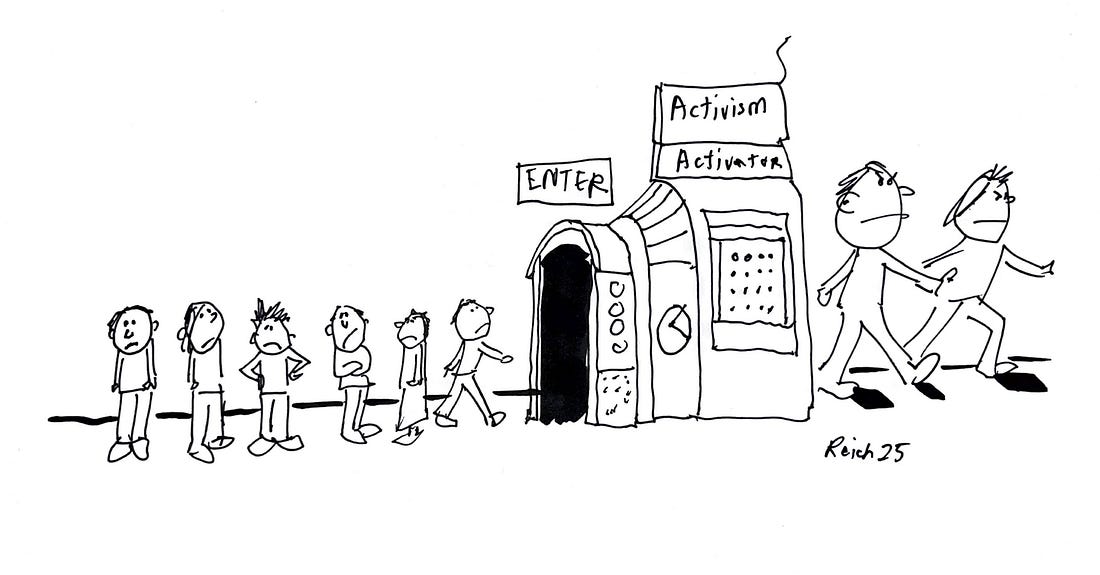
But how do we turn yesterday’s solidarity into political power?
Three suggestions. All depend on our working with activists we already know, added to those we met yesterday, and the activism of our local Indivisible chapter and other groups we participate in.
1. Target vulnerable Republican senators and House members. Either get them to switch parties or become independents who caucus with Democrats, or flip their seats.
Republican majorities are razor-thin in both chambers, and some Republicans who represent purple districts and states are struggling to keep their Republican supporters behind them. (They’re also struggling with their own consciences in continuing to support Trump’s authoritarian fascism.)
In the House, according to the Democratic Congressional Campaign Committee and political analysts, the following Republican members are considered particularly vulnerable.
Arizona: David Schweikert (AZ-01), Eli Crane (AZ-02), Juan Ciscomani (AZ-06).
California: David Valadao (CA-22), Young Kim (CA-40), Ken Calvert (CA-41), Mike Garcia (CA-27).
Colorado: Gabe Evans (CO-08).
Florida: Cory Mills (FL-07), Anna Paulina Luna (FL-13), María Elvira Salazar (FL-27).
Iowa: Mariannette Miller-Meeks (IA-01), Ashley Hinson (IA-02), Zach Nunn (IA-03).
Michigan: Bill Huizenga (MI-04), Tom Barrett (MI-07).
Nebraska: Don Bacon (NE-02).
New Jersey: Thomas H. Kean Jr. (NJ-07).
New York: Mike Lawler (NY-17), Anthony D’Esposito (NY-04), Brandon Williams (NY-22).
Pennsylvania: Brian Fitzpatrick (PA-01), Ryan Mackenzie (PA-07), Rob Bresnahan Jr. (PA-08), Scott Perry (PA-10).
Wisconsin: Bryan Steil (WI-01), Derrick Van Orden (WI-03).
In the Senate, these Republicans are considered vulnerable.
Maine: Susan Collins.
Texas: John Cornyn.
Louisiana: Bill Cassidy.
2. Begin organizing and mobilizing now to get out the vote for November’s midterm elections — aiming for Democratic takeovers of both chambers of Congress by wide margins, which will severely limit what Trump can do after January 2027.
The key will be to get out the vote. Make a plan. Use phone trees. Write postcards. Arrange transportation for people who need it.
Since January 2025, Democrats have won special elections in districts Trump won in 2024, and by an average margin of 12 percentage points better than he did. Just this past Tuesday, Democrats outperformed Trump in three special state legislative elections in Florida, even flipping the home district of Trump’s Mar-a-Lago.
Meanwhile, Trump’s polls continue to tank. In the new Reuters/Ipsos poll, only 36 percent approve of his performance while 62 percent disapprove, a new record low for Trump. In the latest Quinnipiac poll, 38 percent approve of him; 56 percent disapprove. Even the latest Fox News poll shows Trump approval at only 41 percent; disapproval at 59 percent; and fully 58 percent of Americans opposing U.S. military action in Iran.
All this augers well for the midterms, but there’s no substitute for concrete planning to get out the vote — identifying likely Democratic voters, making sure they’re registered and motivated, and helping them get to the polls (or, assuming it’s still legal, making sure they mail their ballots in, in time).
3. Root out and challenge any Trump Republican attempt to intimidate likely Democratic voters or manipulate the election process.
It’s important that neither Trump nor his state lapdogs diminish the turnout of likely Democratic voters in the weeks leading up to the November midterms — by stationing ICE or Border Patrol agents near polling places, interfering with the counting or certifying of ballots, or altering laws and rules to make it harder to vote.
If you have any reason to be concerned about these tactics, check in with your state and local party officials and election officials. Make sure they’re being as vigilant as they need to be. If they’re concerned and cannot assure you that we will have a free and fair election, urge them to challenge what’s occurring in the federal courts.
Or alert your local chapter of the American Civil Liberties Union. Visit the ACLU's affiliate map website to locate one of the 54 state-level offices, which often have local chapters underneath them. (You can search by state to find nearby chapters, which handle local advocacy, events, and volunteer engagement.)
**
If you were inspired by yesterday’s No Kings Day demonstration, know that millions of others were, too. Let’s build on that inspiration by turning it into concrete political action to take back power from Trump and his treacherous regime.
So glad you can be here today. Please consider becoming a paid subscriber of this community so we can do even more.
|