Hi! Houston, we have a hit… Sci-fi movie “Project Hail Mary” has grossed more than $300 million globally in only two weeks, becoming Amazon MGM’s biggest box-office success ever. Today we’re exploring: |
-
iVolution: As Apple turns 50 today, we explore its changing business through the decades.
- FatcatGPT: Just how big is OpenAI at its fresh $852 billion valuation?
- Laborious: Only a quarter of all US workers think it’s a good time to find a quality job.
|
Apple is turning 50 today and it doesn’t look a thing like its younger self |
Around half of startups in the US disappear within five years, just a third survive a full decade, and only about 13% make it past 30 years — with new tech companies faring even worse on average. One name in the space, however, has made it to its 50th birthday today, growing from a scrappy computer maker run out of a garage in California to a $3.7 trillion behemoth.
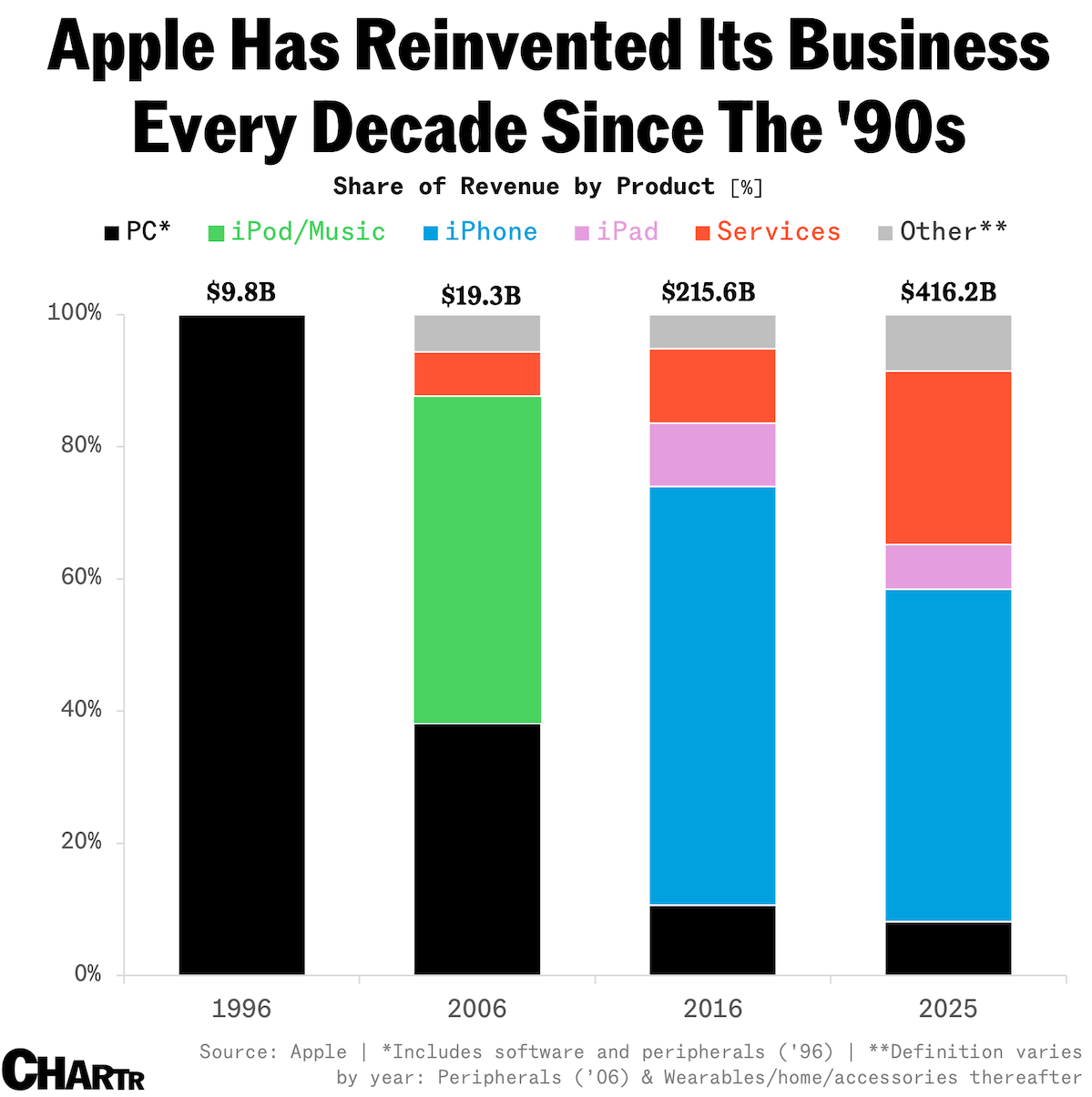
For its first 20 or so years, Apple was essentially a one-product company, with its annual reports through the mid-1990s and into the early 2000s consistently stating that “substantially all of its net sales” came from personal computers and related peripherals.
It wasn’t until a few years after the turn of the century that Apple, barely recovered from near bankruptcy, started making money from things that weren’t the Mac. Following the launch of the iPod in 2001, and later the iTunes Music Store in 2003, Apple’s music business was generating $9.6 billion in sales by 2006, or roughly half of the company’s total revenue.
|
The era of the iPod didn’t last all that long though, as the iPhone’s debut in the summer of 2007 quickly rendered the music player all but obsolete. By 2016, the iPhone alone made up nearly two-thirds (63%) of total company sales, while the Mac, iPod, and other products that once defined Apple contributed just ~15%. |
Fast forward another decade, and Apple remains an iPhone company… at least in most people’s minds.
In reality, the company has been slowly trying to reduce its reliance on physical devices in favor of recurring revenue streams, with its Services segment — the non-product side that includes the App Store, advertising, iCloud, AppleCare, and Apple TV+ — generating over a quarter of total revenue and running at a roughly 75% gross margin. That’s more than double the ~37% margin that the iPhone and other physical products deliver.
|
OpenAI is now valued at $852 billion — that’s about five Disneys |
Imagine what it could have been worth if it hadn’t shut down Sora!
OpenAI, the behemoth behind ChatGPT and still very much the cash-burning mass at the center of the AI universe, just closed out the biggest funding round in Silicon Valley history, raising a total of $122 billion and taking its current valuation to a genuinely staggering $852 billion.
The vast majority of the latest round comes from just three companies — Nvidia and SoftBank stumped up $30 billion apiece, while Amazon chipped in (a quite conditional) $50 billion — with the remainder made up of smaller sums from Andreessen Horowitz, MGX, and a host of other investors, per Bloomberg reporting.
Sam Altman’s company is now expected to IPO before the end of the year, according to reports, and the latest raise puts it well ahead of competitor Anthropic, which raised a somewhat-paltry-by-comparison $30 billion last month at a $380 billion valuation.
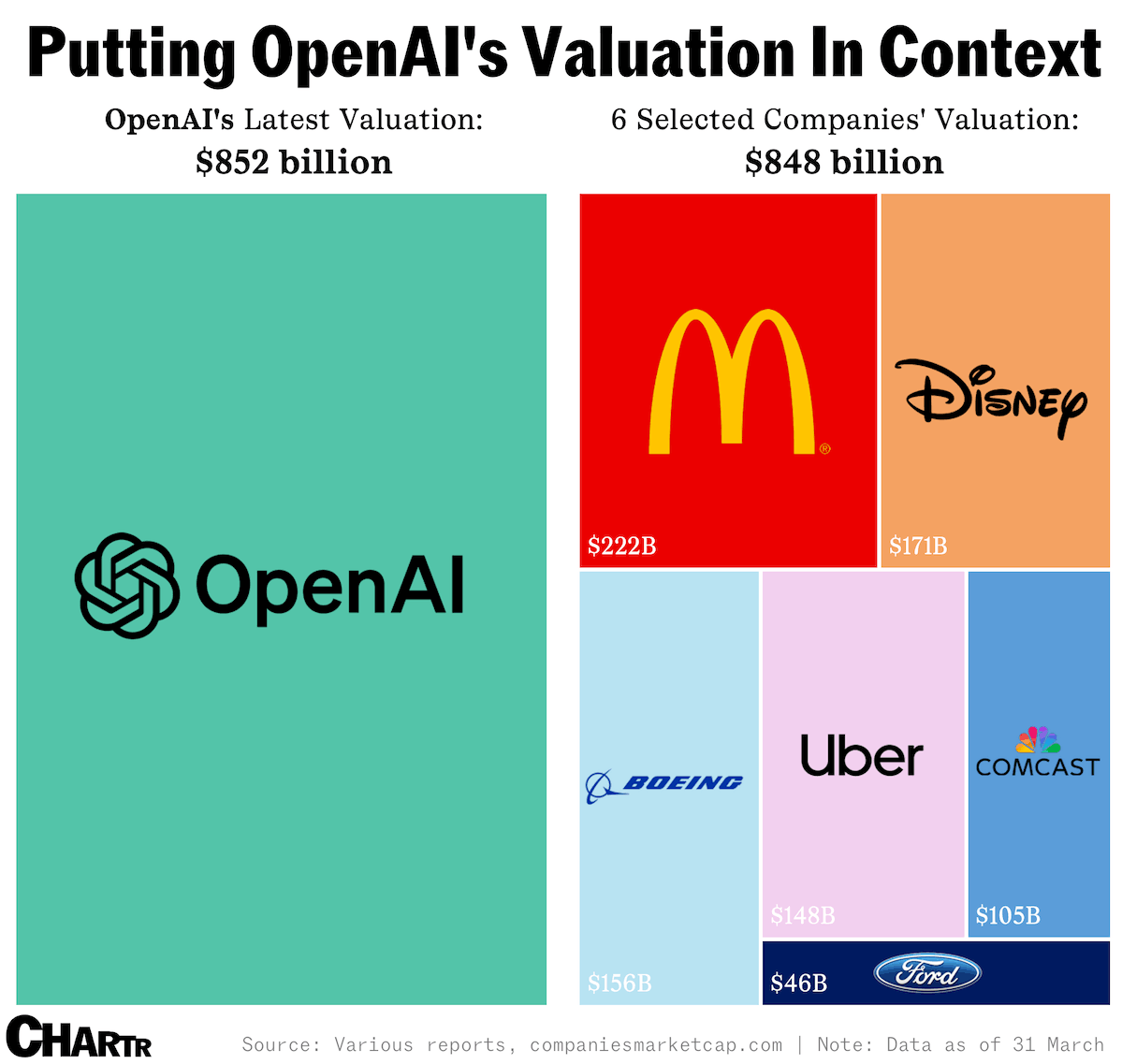
With its new jaw-dropping valuation, OpenAI is also now worth a great deal more than some of the biggest names in US business history. |
All told, the AI giant is now valued at roughly the same as McDonald’s ($222 billion), Disney ($171 billion), Boeing ($156 billion), Uber ($148 billion), Comcast ($105 billion), and Ford ($46 billion)... combined. Considering the insane deals the company has struck as of late, it shouldn’t find it too difficult to part ways with its newly raised capital. |
|
|
Balancing Pursuit of Income with Equity Exposure |
Seeking income but want to stay invested in stocks?
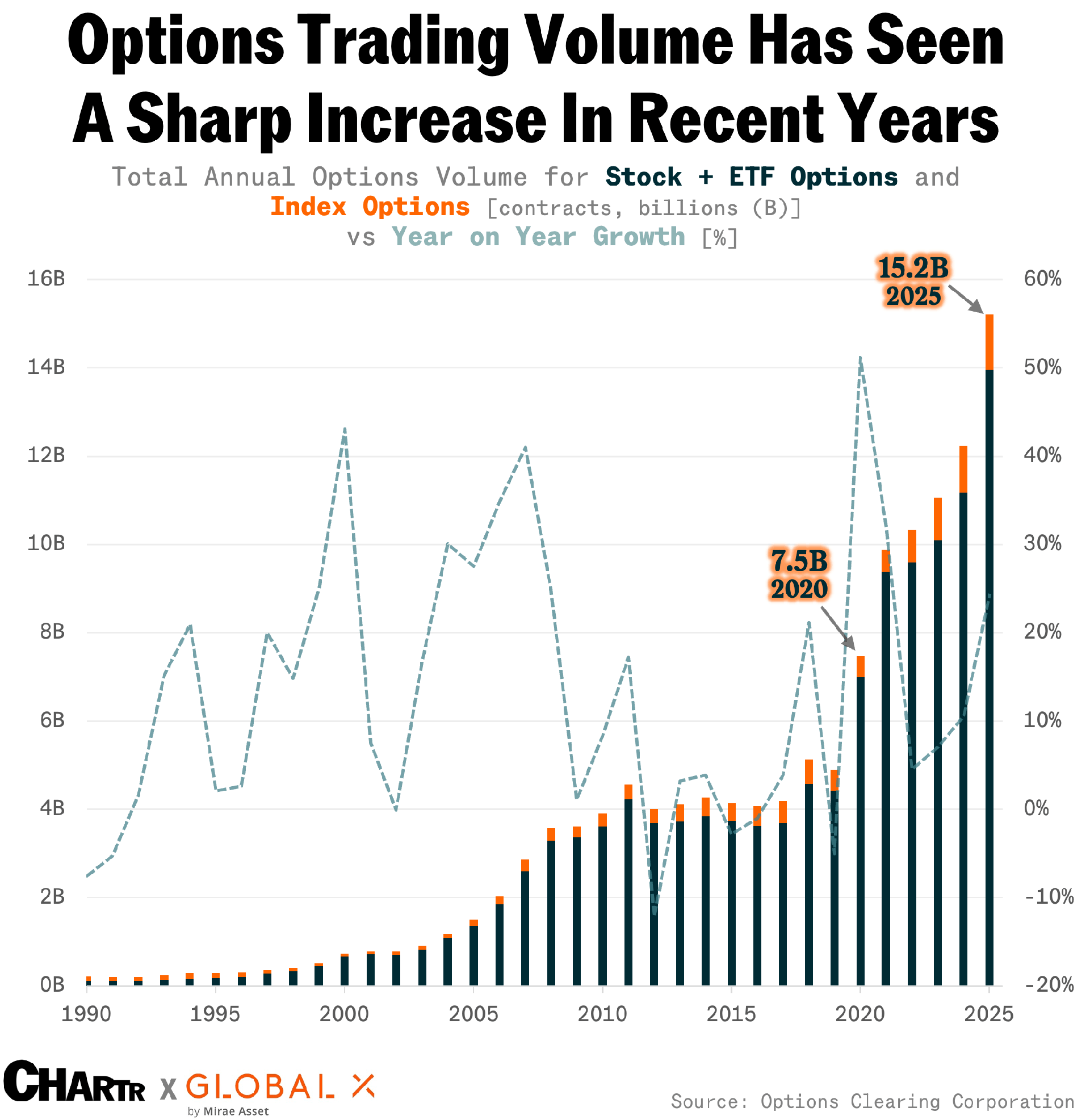
As the U.S. options market has grown, more dynamic income strategies have become available through ETFs. Annual options volumes have increased materially over the past decade, where 2025 notched the highest annual volume ever seen. |
The Income Edge℠ Suite from Global X leverages a covered call strategy within two actively managed ETFs. This approach seeks to combine income generation with equity exposure and some equity market upside.
Global X’s Income Edge Suite℠ comprises EDGX, offering large-cap U.S. equity exposure, and EDGQ, focused on the Nasdaq-100. Both EDGX and EDGQ seek current income by writing call options and targeting weekly distributions.
Discover Global X’s IncomeEdge Suite: Two ETF investments for pursuing income alongside large-cap equity exposure. |
|
|
Almost three-quarters of US workers think now’s a bad time to find a quality job |
The so-called “Great Resignation,” when millions of Americans quit their jobs during Covid in pursuit of greener pastures, now feels a long time ago indeed.
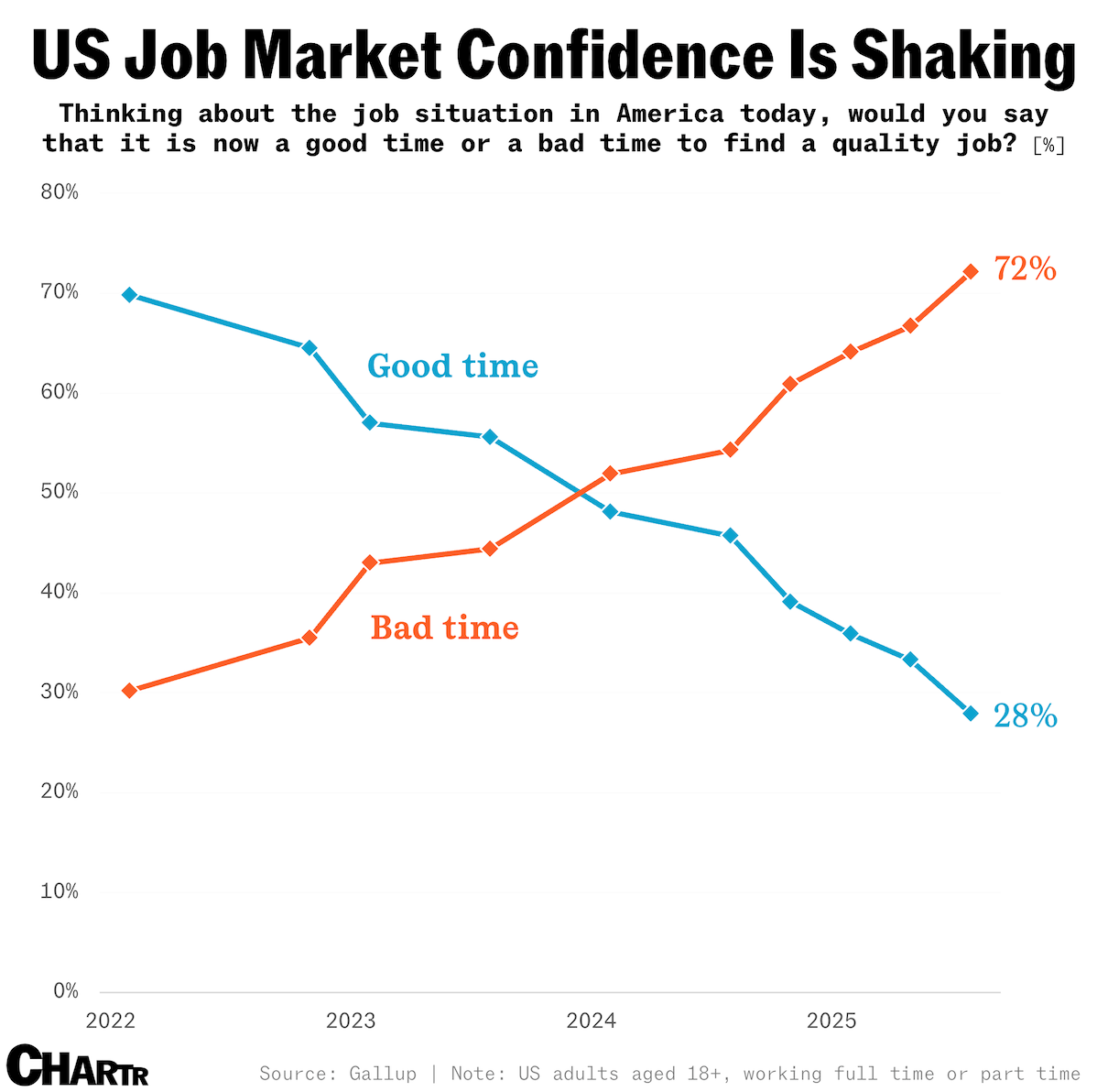
Per a new Gallup workplace survey, confidence in the job market has sunk in the last few years, with only 28% of workers at the end of 2025 saying that now is a good time to find a quality job, down from 70% a little under four years ago. |
College-educated workers — a group that had previously been slightly more optimistic than other demographics — are feeling particularly pessimistic about the job market at present, with just 19% of respondents saying that now is a good time to find a quality job, compared to 35% of workers without a college degree.
The latest results “point to a workforce that is restless but largely stuck,” Gallup outlined in the report, adding: “Many workers who want to leave cite economic constraints — from pay and benefits to the difficulty of finding a comparable role — as the primary barriers to making a move.” |
As the poll tracked job confidence until the end of last year, the results don’t reflect the consequences of recent geopolitical turmoil.
It therefore seems more likely that the malaise could be an indication of weak hiring across white-collar fields, concerns about AI automation, and high-profile layoffs in both the private and public sectors. March’s Conference Board report had the highest share of workers saying jobs were “hard to get” seen in more than five years, despite more people saying that jobs were “plentiful.”
|
|
|
-
US average gas prices topped $4 a gallon for the first time since 2022, surging roughly 35% since the Iran war began.
-
Astronomical? Virgin Galactic soared after the space tourism company said it’s ready to start taking customers to infinity and beyond again… for just $750,000 a ticket.
-
A supermarket in Orkney, an archipelago off the coast of Scotland, erroneously ordered a shipment of 38,000 bananas — nearly twice as many as the number of people who live there.
-
Eli Lilly is moving beyond obesity to develop treatments for sleeping disorders, after the Zepbound maker closed a $7.8 billion deal to buy Centessa Pharmaceuticals.
-
Mayo + Hot sauce: Unilever, which owns Hellmann’s, is combining its food biz with Cholula-maker McCormick to create a condiment giant worth ~$65 billion.
|
|
|
The Global X IncomeEdge℠ suite offers two ETFs with an actively managed income strategy, that target annualized distribution rates – 9% for EDGX and 13% for EDGQ. Explore the IncomeEdge. |
|
|
-
World class: How much income goes to the richest 1% in your country?
- Reuters explores how China can survive a prolonged shutdown of the Strait of Hormuz.
|
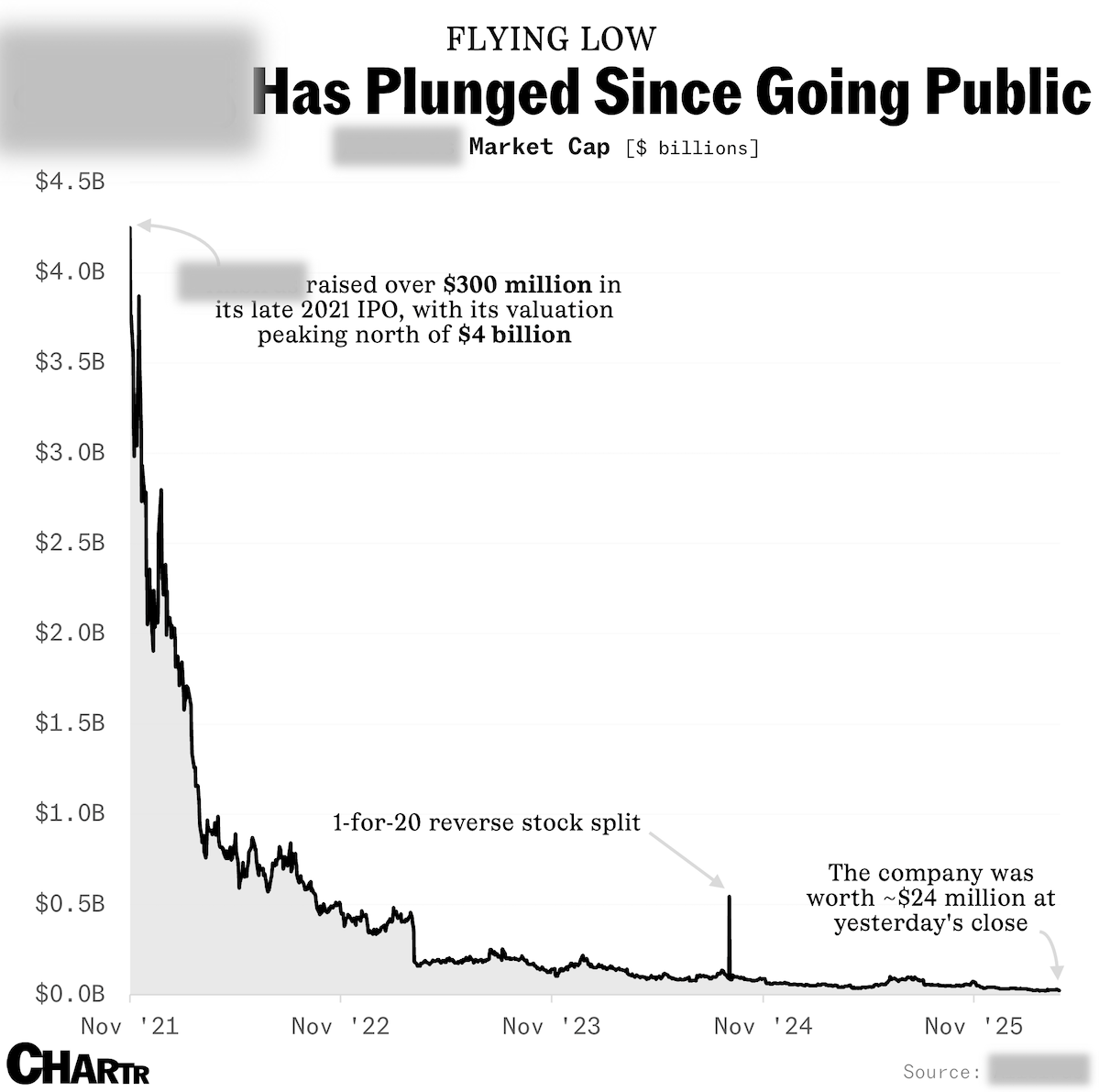
Off the charts: Which Silicon Valley fashion darling, once valued at more than $4 billion, just sold for less than 1% of that peak? [Answer below]. |
Not a subscriber? Sign up for free below. |
Important Information:
Investing involves risk, including the possible loss of principal. There is no assurance the Global X Income EdgeSM ETFs will achieve its target annualized distribution rates. The actual distributions the Fund makes over a one-year period may deviate from its intended target annualized distribution rate. Concentration in a particular industry or sector will subject the funds to loss due to adverse occurrences that may affect that industry or sector. Investors in the funds should be willing to accept a high degree of volatility in the price of the fund’s shares and the possibility of significant losses.
An option is a contract sold by one party to another that gives the buyer the right, but not the obligation, to buy (call) or sell (put) a stock at an agreed upon price within a certain period or on a specific date. A covered call option involves holding a long position in a particular asset and writing a call option on that same asset with the goal of realizing additional income from the option premium. By selling covered call options, the fund limits its opportunity to profit from an increase in the price of the underlying index above the exercise price, but continues to bear the r |
|
|
|