| | In this edition, why laggards still have a chance in the AI race, and Anthropic is getting closer to͏ ͏ ͏ ͏ ͏ ͏ |
| |  | Technology |  |
| |
|
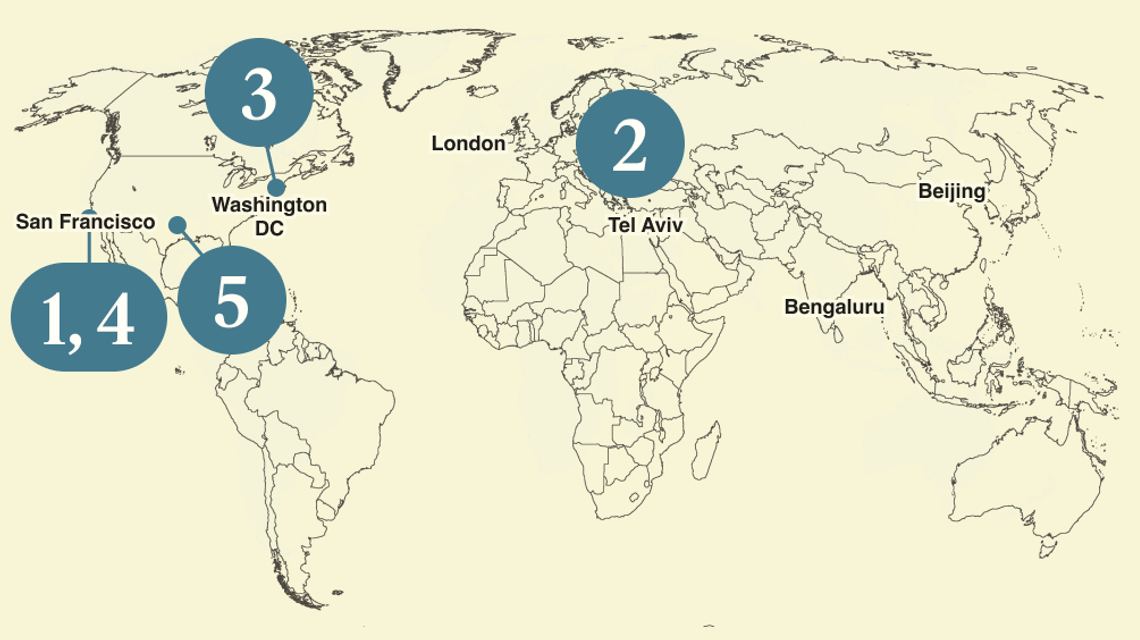 - Anthropic’s own agents
- War robots are coming
- Vibe-coding generation
- OpenAI buys TBPN
- SpaceX preps for IPO
 Why AI laggards still have a chance, and research suggests sycophantic chatbots are making us meaner. |
|
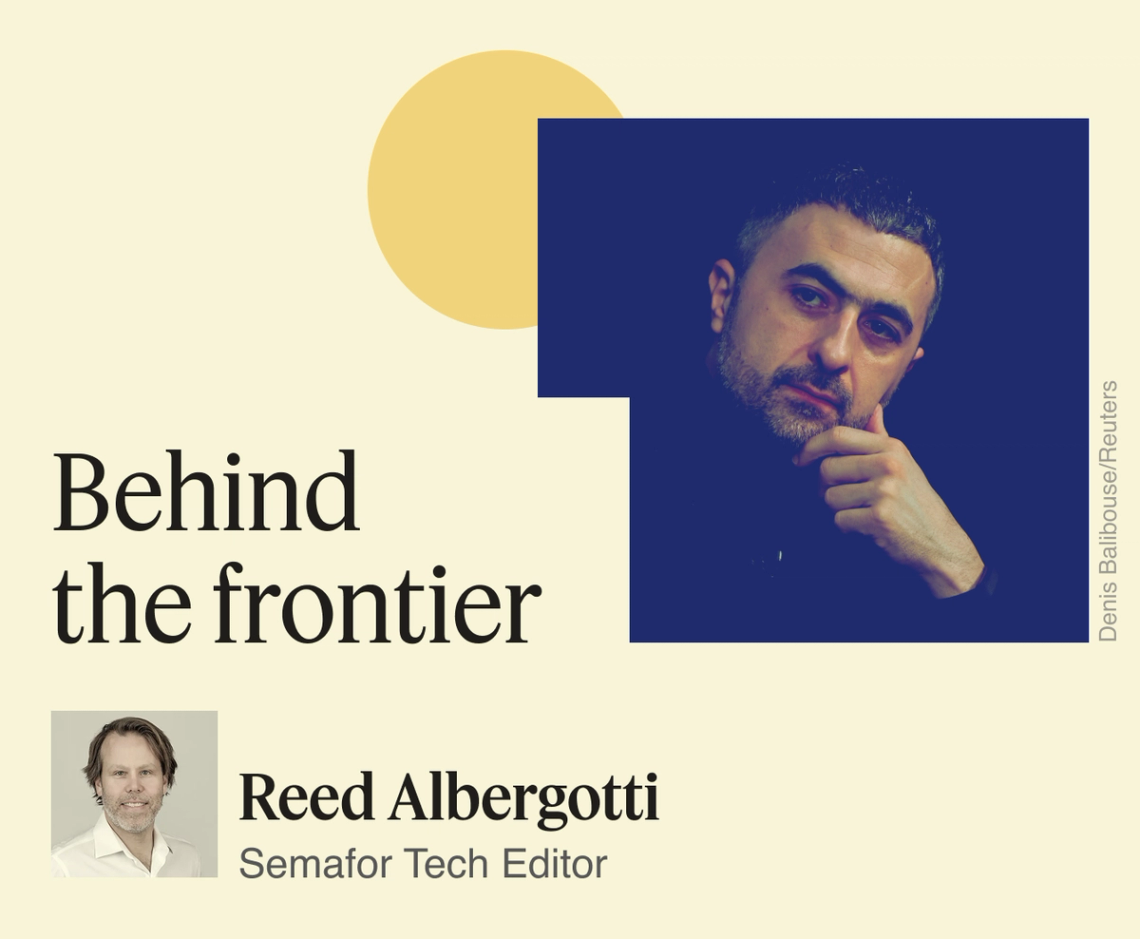 Being first isn’t necessarily the same as winning. Just look at OpenAI. They defined the AI frontier when ChatGPT went mainstream in 2022, but recently, their biggest headlines haven’t been about groundbreaking new models, but rather acquiring niche media startups to feed their data engine. Meanwhile, their biggest backer is playing a very different game. “There’s actually an enormous advantage in being just behind the frontier,” Microsoft AI CEO Mustafa Suleyman told me earlier this week. “We basically get to use all the preview versions of the best models in the world, both for our in-house development and for our first party consumption.” There’s a generous serving of cope in that statement. Suleyman, who co-founded DeepMind, surely wants to be leading the frontier of AI. But his admission exposes a new AI reality: There’s a market for models that do the job a touch worse than competitors, but run more efficiently. While the cost per token is dropping, overall AI inference costs are soaring. Why? Because developers are generating exponentially more tokens to drive performance and agentic behavior. The game of AI right now is about efficiency and availability. (And based on the current constraints of energy, memory, chips and other components — not to mention the Iran war — it will remain that way for a couple of years.) Microsoft’s ability to get behind-the-scenes access to OpenAI’s models does help its own AI researchers shortcut development of models that only lag the best ones by a small margin. But it’s the measured, deliberate and risk-averse attitude that stands out. And in an era of scarcity and uncertainty, staying right behind the leaders could be a smart play. |
|
Anthropic’s version of OpenClaw is coming |
 Courtesy of Anthropic Courtesy of AnthropicThe popularity of OpenClaw, the agent platform that OpenAI acquired, has crystallized another big AI race. First it was Nvidia, rushing to announce NemoClaw, which markets itself as the security-enhanced version of OpenClaw. Then, Anthropic rushed to push out new features in Claude Cowork — called Dispatch — which lets you message Claude from your phone while it works on your desktop, turning it into a fairly competent AI assistant. There are signs more agent alternatives are coming. When asked if customers are asking Anthropic to create its own version of OpenClaw, Chief Commercial Officer Paul Smith told Semafor, “They are. Without speculating too much on our product roadmap, [it] evolved pretty quickly.” While he declined to provide more details, my take was that it was more a matter of when — not if — Anthropic introduces a more direct OpenClaw competitor, or embeds a lot of that stuff into its current products. (Even more details came out when 500,000 lines of Anthropic code were leaked). “Think of the features that people found useful — the ability to have a whole bunch of agents working on my desktop but remote control from my mobile device,” he said, referring to Dispatch. “The models are getting smarter and they’re coming faster.” Still, just because Anthropic is moving quickly doesn’t mean its customers can keep up. When asked whether Anthropic’s own customers — big companies and government agencies — can keep up with the pace of change, Smith brought up the analogy: “Rolling out broad-based AI to an entire employee base is like putting a Peloton in everyone’s sitting room. It doesn’t mean everyone’s going to start to get fit.” — Rachyl Jones |
|
The war robots are coming |
 Courtesy of Foundation Courtesy of FoundationGun-shooting humanoid robots fighting on the front lines are becoming less of a dystopian fantasy. Robot startup Foundation Future Industries recently inked a $24 million deal with the Pentagon and has begun tests in Ukraine with its robots, which can inspect and transport weapons. The two-year-old company is among a number of startups trying to build robot armies with the Pentagon. Scout AI emerged last year, and the US military is also testing quadrupeds, or robot dogs, for reconnaissance missions. Foundation is training robots to survey enemy territory and plans to move into front-line deployments, where civilians are out of reach. “We want to be able to validate this year and scale next year,” founder Sankaet Pathak told Semafor. Pathak also has something to prove. His previous startup, Synapse, which offered banking services, filed for bankruptcy in 2024, with creditors and users still fighting for millions of dollars in funds. — Rachyl Jones |
|
Next-gen Silicon Valley garage startups |
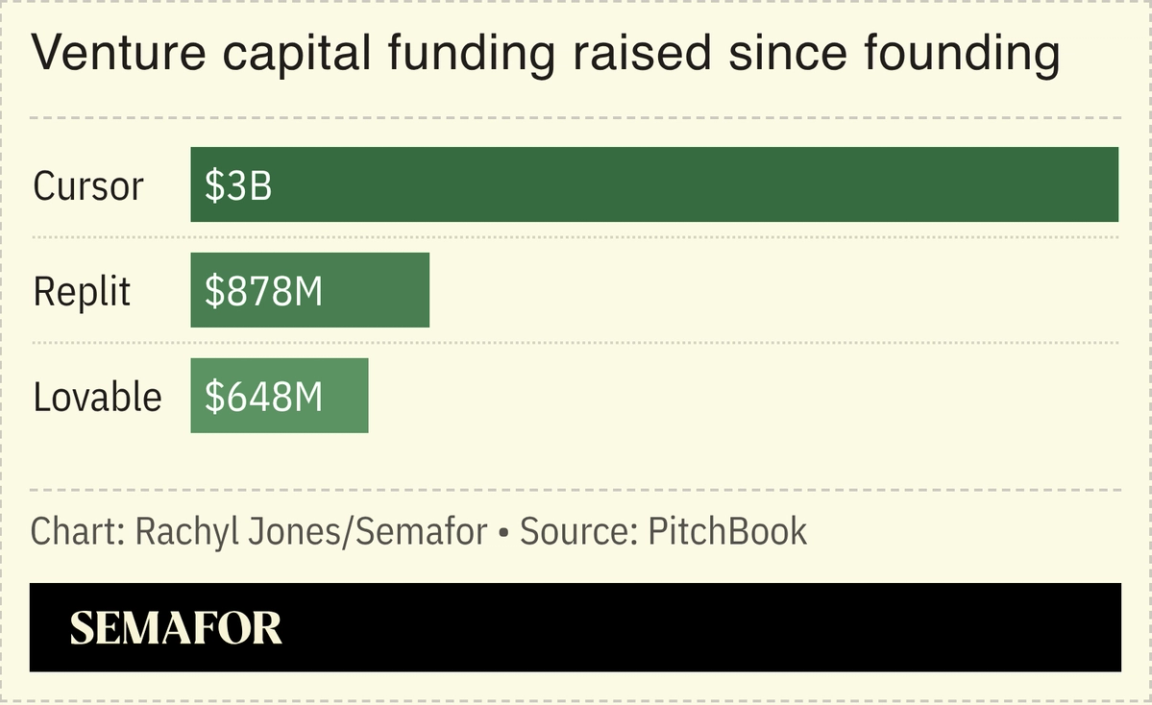 Welcome to the era of vibe-coding millionaires and billionaires. A new generation of Silicon Valley garage startups has arrived, but this time it’s the bedroom coders, some of whom are still in their teens. In a popcorn-ceilinged event venue in Flatiron, 19-year-old Armaan Aggarwal told me how he worked on an AI-powered note-taking app that was sold to education company Quizlet and sold a grade-tracking app before that. “It was originally just built for my friends — surprisingly did pretty well. I was able to monetize it and sell it. Completely changed my life,” he said, without saying how much he sold the app for, beyond calling it “life-changing” money. Aggarwal, who initially sparred with the event’s bouncers just to let him into the venue — he was under 21 — now works for Replit, a company which lets users build apps with AI. The company is helping seed this next generation of vibe-coding entrepreneurs, joining the ranks of vibe-coding apps Lovable and Cursor, also made by Gen Zers. (At 29, Alexander Wang, the billionaire who sold Scale AI to Meta, sits on the cusp.) — Rachyl Jones |
|
 Semafor is expanding its presence in the Gulf, accelerating investment in one of the world’s most consequential economic and geopolitical regions. Beginning this spring, Semafor Gulf will publish every weekday, alongside expanded reporting and a growing slate of live convenings for regional decision-makers. Since launching in 2024, Semafor Gulf has delivered essential, independent journalism in a region at the center of the global economy. This next phase will expand Semafor Gulf’s independent reporting and analysis as the region’s business and economic news platform of record. |
|
 Courtesy of OpenAI Courtesy of OpenAIOpenAI is building superintelligence. So why is it wasting time on talk shows? AI-focused daily tech show TBPN had cultivated a modest but high-value audience with its loose, sports-style coverage, but in the cutthroat post-traffic digital media era, it’s easy to see why TBPN would bite on an offer reportedly in the “low hundreds of millions” for an operation that’s essentially just a few guys with a YouTube channel and an X account. Harder to parse is OpenAI’s rationale, given that transforming the channel from a buzzy central tech hub into the influence arm of one tech giant is likely to turn off at least some guests and viewers. Founders Jordi Hays and John Coogan didn’t respond to requests for comment from Semafor, but OpenAI’s Chris Lehane shot down the naysayers. “We do have an editorial independence commitment that’s built into the agreement,” Lehane told Semafor, citing the resurgence of Elon Musk’s X as an example of what happens when a big company owns a media property. “If you want to have an alternative out there where you can have these conversations, the more independent [it is], and the more it’s recognized and understood to be independent, the more effective it’s going to be.” The advantage of Musk owning X is debatable at best, but what’s clear is that OpenAI recognizes what’s become a central issue for the industry: The story around AI has turned negative in many corners of the world outside of Silicon Valley, and OpenAI wants to take a stronger hand in changing that narrative. “A big focus of this is helping to provide the resources so that they can really scale the number of folks that they’re communicating with,” Lehane said. — Max Tani and Reed Albergotti |
|
SpaceX’s IPO is a big bite at a hard time |
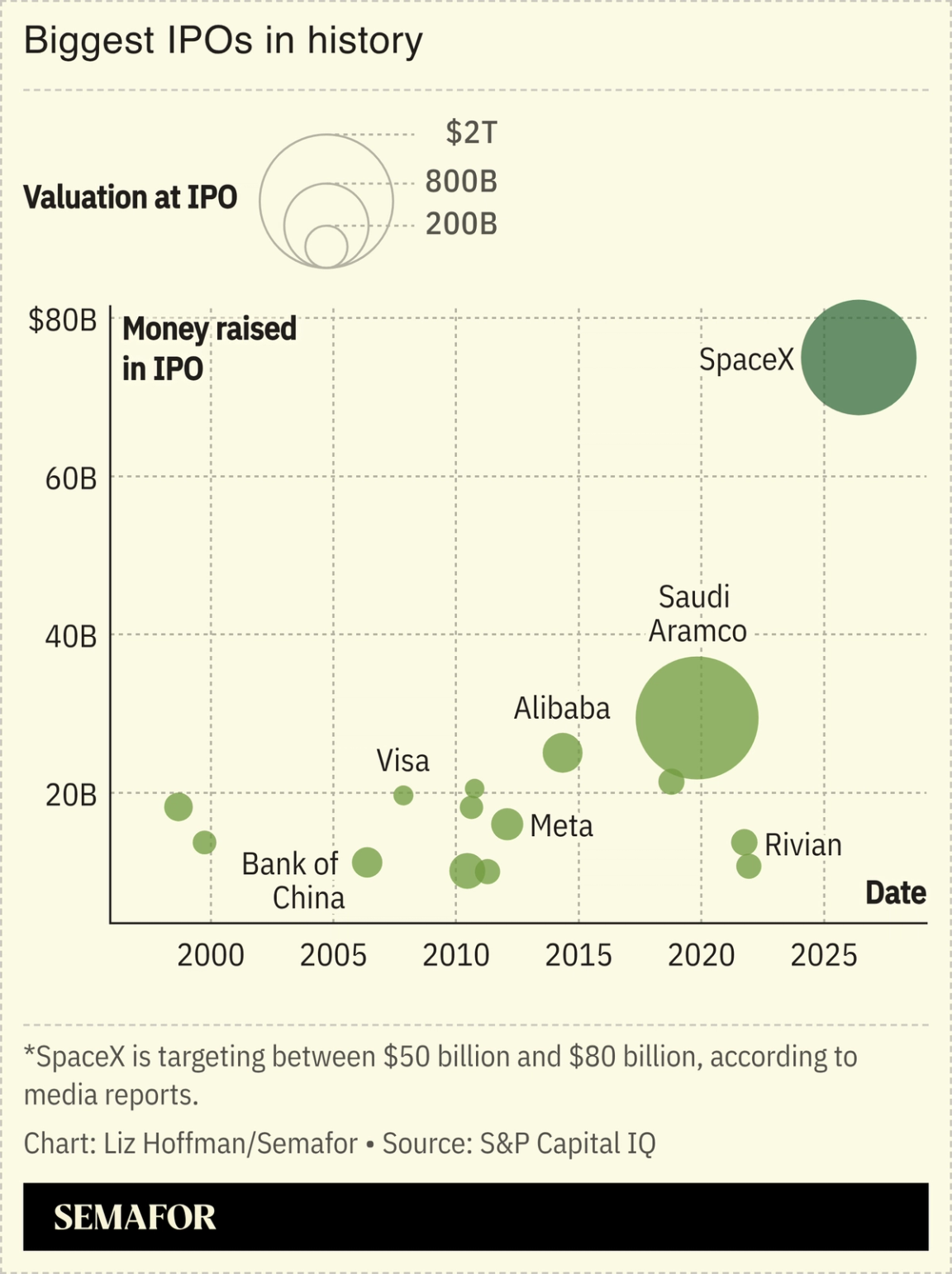 The giant sucking sound you’re going to hear this spring in the markets is banks assembling $75 billion of investors’ money to take SpaceX public. Elon Musk’s rocket company filed this week for an IPO that is expected to be three times bigger than the largest IPO on record — Saudi Arabia’s 2019 listing of its national oil company — and 350 times bigger than the average since 2000, Semafor’s Liz Hoffman writes. Demand is expected to be high: SpaceX is profitable and crucial to the US government. It also benefits from Musk’s undimmed ability to rally investors to his ambitions. But $75 billion is a lot of money, enough to be noticed if it’s pulled from other market bets. If stock prices are still beaten down by the war in Iran and AI fears, investors will likely be reluctant to crystallize their losses by selling, which could put pressure on other investments like Treasury bonds. SpaceX is “an incredible company, but one has to wonder where that $75 billion is going to come from,” Mitchell Green, managing partner of Lead Edge Capital, a $9 billion tech growth equity firm, told Semafor. “It’s one thing raising $1 to $2 billion. It’s another thing raising $75 billion.” |
|
 On the Leap Forward podcast, David Rusenko interviews entrepreneurs behind companies like Airbnb, Y Combinator, and Twitch, alongside someone who knew them before the headlines. A mom. First boss. A co-founder. They reveal the intimate, unpolished, unpredictable stories behind how success actually happens. Listen to the first episode — out now. |
|
 Priyanshu Singh/Reuters Priyanshu Singh/ReutersSycophantic AI might make us meaner, research suggested. A study found that AIs fed interpersonal dilemmas from the subreddit r/amItheasshole were twice as likely as humans to endorse the user’s behavior. They also found that humans who interacted with a sycophantic chatbot were less likely to apologize or take steps to make amends. On the other hand, the Financial Times’ data editor argued, AIs tend to drive users toward mainstream consensus and expert judgement, where social media drives them towards the fringes: The latter rewards attention and can blame content on users, while AI’s customers usually want factual information, often for business-critical decisions, and the companies that make it are on the hook for any errors it makes. — Tom Chivers |
|
|


