| | In today’s edition: Media battles in Baltimore.͏ ͏ ͏ ͏ ͏ ͏ |
| |  Baltimore Baltimore | New York |  San Francisco San Francisco |
 | Media |  |
| |
|
 - The Sun’s heat
- Mixed Signals
- Team Elon
- AI writers
- AI sources?
- Streaming churn
- OpenAI TV
|
|
 Why would anyone want to buy a media company? I was wondering this, once again, upon learning this week that LinkedIn discussed a potential acquisition of Beehiiv, the newsletter platform that is increasingly trying to be the payment and distribution hub for modern media companies and independent creators. Neither company responded to a request for comment, but it seems LinkedIn may have been looking to bolster the tech behind its growing newsletter arm. The conversations also serve as an acknowledgement of the continued dominance of newsletters among the professional class, or at least among consumers who still get their news by reading. Much of the rest of recent news media M&A has been less about business and profit than reputational clout and messaging. That was certainly the driving force behind OpenAI’s stunning acquisition last week of the AI-focused streaming show TBPN for something in the “low hundreds of millions.” The AI giant asserted its dominance by buying up the industry’s favorite insider media property. One big open question: Who’s going to buy Beehiiv’s bigger, more mature rival, Substack? Also today: Other types of influence-seeking are driving media acquisitions — like in Baltimore, where the 2024 sale of the city’s flagship paper to a conservative media baron is shaping local and national politics. |
|
The Sinclair Sun vs. Wes Moore |
 Jim Watson/AFP via Getty Images Jim Watson/AFP via Getty ImagesInvestigative journalists with The Baltimore Sun and the local TV station that shares the same owner are digging into Maryland Gov. Wes Moore’s records — and keeping their owner in the loop. Since last fall, the team of investigators from the Sun and Sinclair have been pressing the governor on everything from his service in the Army to the basketball scholarships he’d been offered, at times going as far as to threaten Moore with military discipline. (“Would You Be More Comfortable Answering These Questions As Part Of A Deposition Or In A Court Of Law?” the investigators at one point asked.) Sinclair executive chairman David Smith, who bought the paper in 2024, has been directly involved, at one point attempting to unsend an email from one of the paper’s reporters, according to records shared with Semafor. Current and former staffers at the Sun say it’s part of the news outlet’s new, more ideological thrust, as the once old-school paper increasingly merges with Sinclair’s right-leaning TV and digital operations in Baltimore. |
|
Joanna Stern on ‘Mixed Signals’ |
 After more than a decade at The Wall Street Journal, tech journalist Joanna Stern is leaving to launch her own venture, The New Things, using AI as her “co-founder.” On this week’s Mixed Signals, she joins Ben and Max to talk about what it really takes to bet on yourself in today’s media landscape, and what she learned from spending a year immersed in artificial intelligence for her new book, I Am Not a Robot. |
|
 Bhawika Chhabra and Denis Balibouse/Reuters Bhawika Chhabra and Denis Balibouse/ReutersJournalists covering Elon Musk’s running lawsuit against OpenAI have noticed recently that press releases from Musk lawyer Marc Toberoff, which used to come from a PR firm, are now being sent by the Hollywood talent giant WME. Musk is ostensibly seeking to challenge OpenAI’s reversal of its nonprofit status, and is overtly attacking a competitor to his lagging (for now) AI company, xAI. Musk’s new PR strategy is a hint of executive chairman Ari Emanuel’s continuing deep involvement in one of corporate America’s bitterest feuds, though the relationship, a WME source says, is not formal. It’s “fair to say Ari is team Elon,” they added drily. Responded an OpenAI source: “It all makes sense, they deserve each other.” — Ben Smith |
|
Tucker’s praise for Fortune |
 John Lamparski/Getty Images John Lamparski/Getty ImagesWall Street Journal editor-in-chief Emma Tucker is impressed by Fortune’s integration of AI into its newsroom. Last month, the Journal reported that Fortune editor Nick Lichtenberg had used AI to produce 600 stories and counting, and that AI-written stories now accounted for 20% of the publication’s overall traffic. In an encouraging personal email to Fortune editor Alyson Shontell shared with the publication’s staff and passed along to Semafor, Tucker said she “absolutely loved Isabella’s piece about your reporter Lichtenberg.” She noted that even among newsroom leaders, there is broad AI resistance and skepticism to AI that neither editor shared. “I love your totally clear-eyed, unsentimental approach to AI in newsrooms. It makes you pretty unique among our cohort. I just did an All Hands meeting with our APAC staff (I’m in Tokyo) and told them they all had to read it. Anyone who doesn’t get what you are doing at fortune, or thinks it is ‘wrong’, should get out of journalism fast!” |
|
AI is getting a voice in stories |
 Denis Balibouse/Reuters Denis Balibouse/ReutersAI is becoming a character and a narrative device in journalism. In March, Vanity Fair published an interview with what first appeared to be Dario Amodei; the piece later revealed the “interview” was actually conducted with a chatbot trained on the Anthropic CEO’s public comments. It was intended as a comment on Amodei’s own flakiness, but it immediately stirred criticism among journalists who felt the reporter had crossed an ethical line. A senior editor at Vanity Fair defended the use of AI, calling the interview “one literary device in a wide-ranging, 9500-word narrative story about AI and the future of creativity.” Elsewhere in media, AI is playing the role of both source and reporter. Vermont Sen. Bernie Sanders interviewed Claude as if it were a person, and David Frum of The Atlantic posted about his conversations with the chatbot to make a point about Twitch streamer Hasan Piker. I even found it narratively useful to include ChatGPT’s voice in a story I wrote last year about people dating chatbots. AI is changing the way journalists report, but its voice is also seeping into published stories in a way that wasn’t obvious a few years ago. The standards for AI in journalism are changing — and where they land is still being decided. — Rachyl Jones |
|
Cord-cutters cutting back |
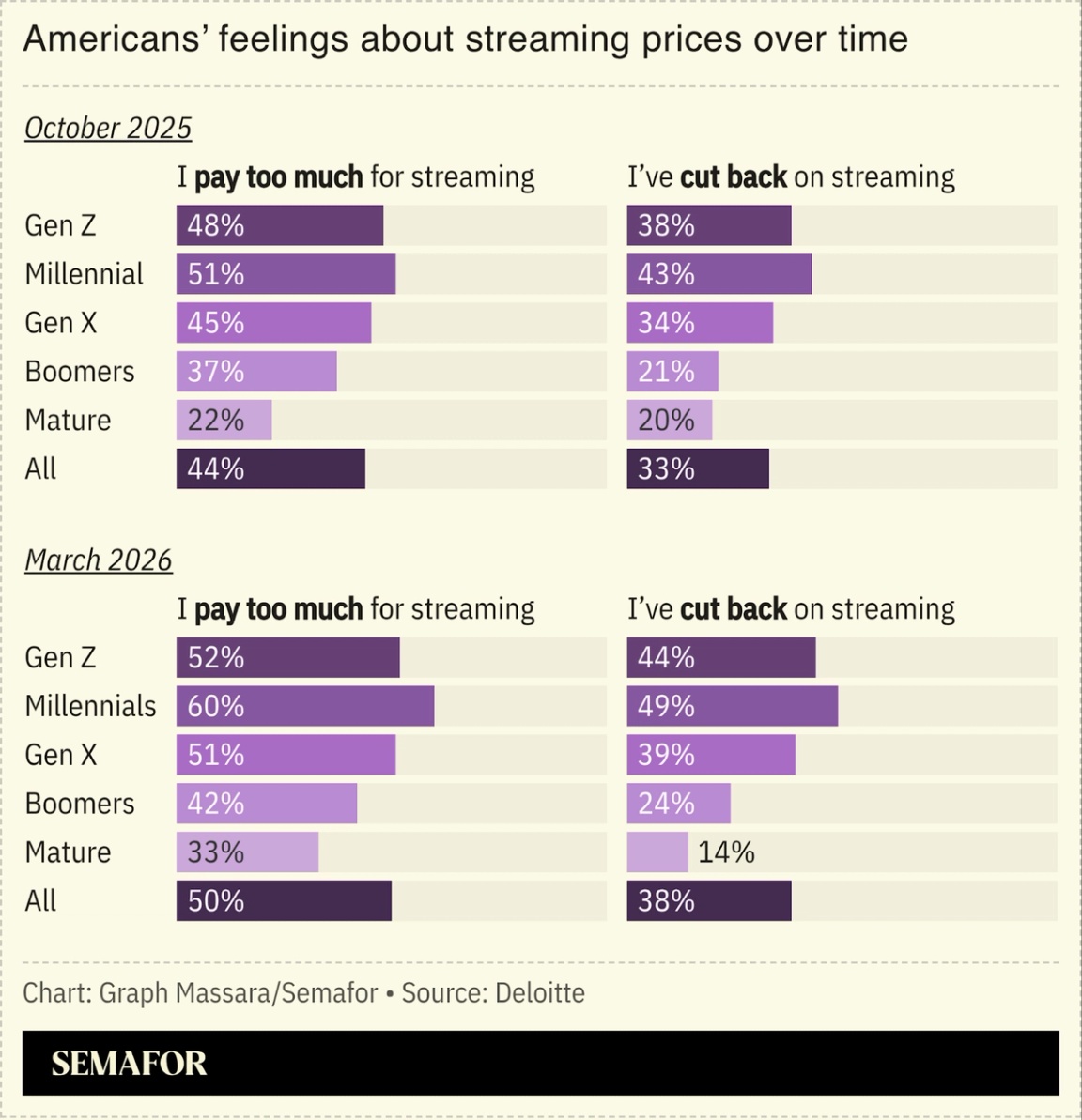 Poll after poll shows Americans are anxious about their budgets, and high gas prices and looming knock-on effects from the Iran war are poised to squeeze them further. Fresh data from Deloitte suggests they’re now looking to pause streaming services to save a few bucks. Thirty-eight percent of Americans surveyed said they’d cut back on entertainment subscriptions to save money, up 5 percentage points from October, and half now say they’re paying too much for streaming overall. Those numbers jump for the younger age brackets that tend to prefer streaming (and that advertisers covet): Half of Millennials and 44% of Gen Z said they’ve cut back. The exception seems to be Gen Z high-earners. — Graph Massara |
|
 Screenshot/YouTube/TBPN Screenshot/YouTube/TBPNOpenAI is building superintelligence. So why is it wasting time on talk shows — especially if transforming TBPN from a sports-style tech program into the soft power arm of a single tech giant is likely to turn off at least some guests and viewers? OpenAI’s chief global affairs officer, Chris Lehane, said OpenAI wants the company to remain editorially free from influence. “We do have an editorial independence commitment that’s built into the agreement,” Lehane told Semafor, citing the resurgence of Musk’s X as an example of what happens when a big company owns a media property. “If you want to have an alternative out there where you can have these conversations, the more independent [it is], and the more it’s recognized and understood to be independent, the more effective it’s going to be.” The value of Musk owning X is debatable, but what’s clear is that OpenAI recognizes what’s become a central issue for the industry: Sentiment around AI has turned negative in many corners of the world outside Silicon Valley, and OpenAI wants to take a stronger hand in changing that narrative. “A big focus of this is helping to provide the resources so that [TBPN] can really scale the number of folks that they’re communicating with,” Lehane said. — Max Tani and Reed Albergotti |
|
Axios: Jamie Dimon told Jim VandeHei that his next project after he leaves JPMorgan could be a media venture. Breaker: The New York Times has hired an “elevator consultant,” Lachlan Cartwright reports. New Yorker: Kyle Chayka speaks to the team behind Explosive News, the obscure site churning out Lego-themed pro-Iran AI slopaganda videos. Paris Review: Krithika Varagur offers a retrospective of Aramco World, the Saudi oil giant’s in-house magazine and a “defiant relic of midcentury publishing.” |
|
|


