| | In today’s edition: Riyadh orders workers to leave its financial district, and Abu Dhabi’s Masdar pa͏ ͏ ͏ ͏ ͏ ͏ |
| |  | Gulf |  |
| |
|
 - Trump’s latest demands
- Hormuz intelligence
- Saudi offices evacuate
- Tehran’s exposed civilians
- Masdar’s Asian energy venture
 No tankers? Iraqi oil takes a roadtrip. |
|
Trump sets another deadline |
 The B1 bridge damaged by a strike, in Karaj, Iran. Majid Asgaripour/WANA via Reuters. The B1 bridge damaged by a strike, in Karaj, Iran. Majid Asgaripour/WANA via Reuters.A weekend of threats and action was accompanied by confirmation that the US, Iran, and their mediators are discussing a deal — but all sides are still taking maximalist positions in public. US President Donald Trump warned in an interview with The Wall Street Journal that “if they don’t make a deal, I am blowing up everything over there,” building on a vulgar social media post in which he said the US would attack power plants and bridges in Iran if no deal was struck to reopen the Strait of Hormuz by 3 am on Wednesday, Arabian Standard Time. A proposal promoted by Pakistan calls for an immediate ceasefire and a reopening of the strait, followed by talks on a broader settlement. Iran has already rejected trading its control of Hormuz for a short-term ceasefire, and has matched US threats. After more than a month of war and thousands of US and Israeli strikes, Iran shot down US planes on Friday, prompting a rescue mission deep inside Iranian territory. The downing and extraction — whose early version already reads like a screenplay — point to two conclusions: Iran’s air defenses are not completely obliterated, but its severe weaknesses in air and ground response times still allow the US to seize territory, at least for a short period. — Mohammed Sergie |
|
Wall Street analyst’s Hormuz stakeout |
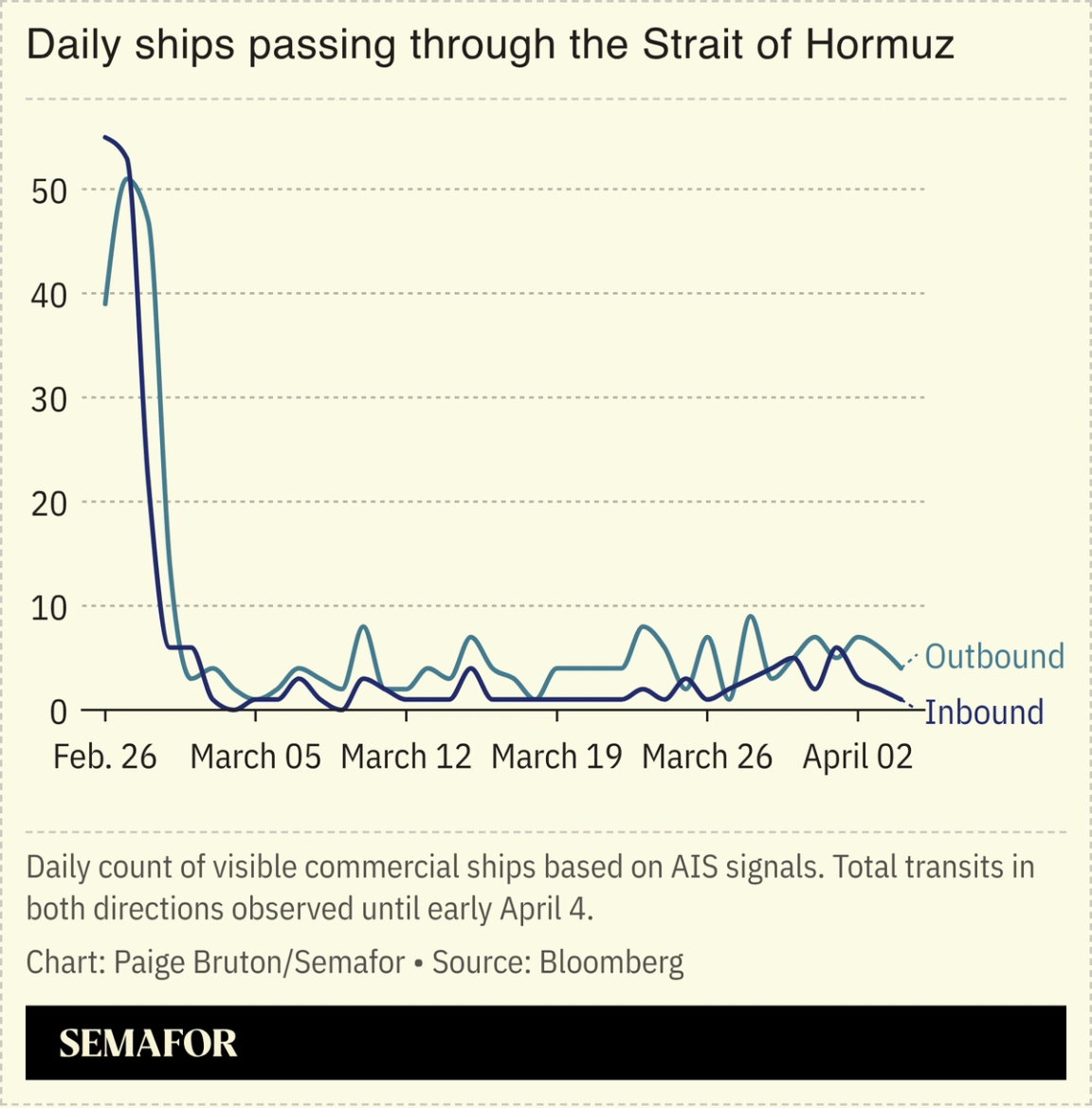 There’s been a trickle of traffic through the Strait of Hormuz in recent days, mostly in Iranian waters but some in Oman’s. Iran provided an exemption for Iraqi tankers, adding to the vessels from Asian countries that have gained safe passage. With Bahraini-led efforts at the UN Security Council to build a global coalition to take control of the strait stalling, a coordinated military effort isn’t imminent. Instead, plans to reopen the waterway will likely come through a ceasefire and diplomacy, possibly policed by an international force. Finding out what is happening in Hormuz has largely been a matter of relying on satellite imagery and ship-signal tracking. But the strait’s strategic importance has made some on Wall Street desperate to gain an edge. New York-based Citrini Research — which rose to prominence this year for its terrifying projection of an AI-driven economic calamity — sent an analyst to the northern UAE, according to New York magazine, and the analyst reported that there have been more attacks than publicly reported. He also sent photos of a tanker crossing the main, non-Iranian-controlled part of Hormuz — along with a shot of the beer, cigars, and Zyn he brought for a boat cruise through the waterway. — Mohammed Sergie |
|
Saudi evacuates business hub |
 Isabel Infantes/Reuters Isabel Infantes/ReutersSaudi Arabia ordered an evacuation of its key financial hub amid threats from Iran, puncturing the kingdom’s attempts to project “business as usual” during the conflict. Officials ordered workers to leave Riyadh’s King Abdullah Financial District — which includes the offices of the country’s sovereign wealth fund and international firms like Goldman Sachs and Deloitte — to evacuate on Thursday and not to return until at least today, according to people familiar with the matter and an internal memo seen by Semafor. Other firms say they have been informally told not to send staff to offices in KAFD for several weeks. Office buildings elsewhere in the city, including the Al Faisaliah Tower that houses JPMorgan and Apple, were also evacuated over the weekend. The evacuations are part of the new normal for businesses in the Gulf, which are having to deal with expatriate staff that want to leave the region, office towers that have been damaged in Iranian attacks, and parents juggling work with remote learning mandates for schools. Riyadh has not, however, been attacked as much as other cities, including Doha and Dubai, enabling life to continue largely undisturbed by the war. Its airport has mostly remained open, helping the city to act as a transit hub for people trying to leave the Arabian peninsula. Still, Iranian attacks have hit the US Embassy in Riyadh and injured US personnel at an airbase south of the city. — Matthew Martin and Manal Albarakati |
|
 Semafor is expanding its presence in the Gulf, accelerating investment in one of the world’s most consequential economic and geopolitical regions. Beginning this spring, Semafor Gulf will publish every weekday, alongside expanded reporting and a growing slate of live convenings for regional decision-makers. Since launching in 2024, Semafor Gulf has delivered essential, independent journalism in a region at the center of the global economy. This next phase will expand Semafor Gulf’s independent reporting and analysis as the region’s business and economic news platform of record. |
|
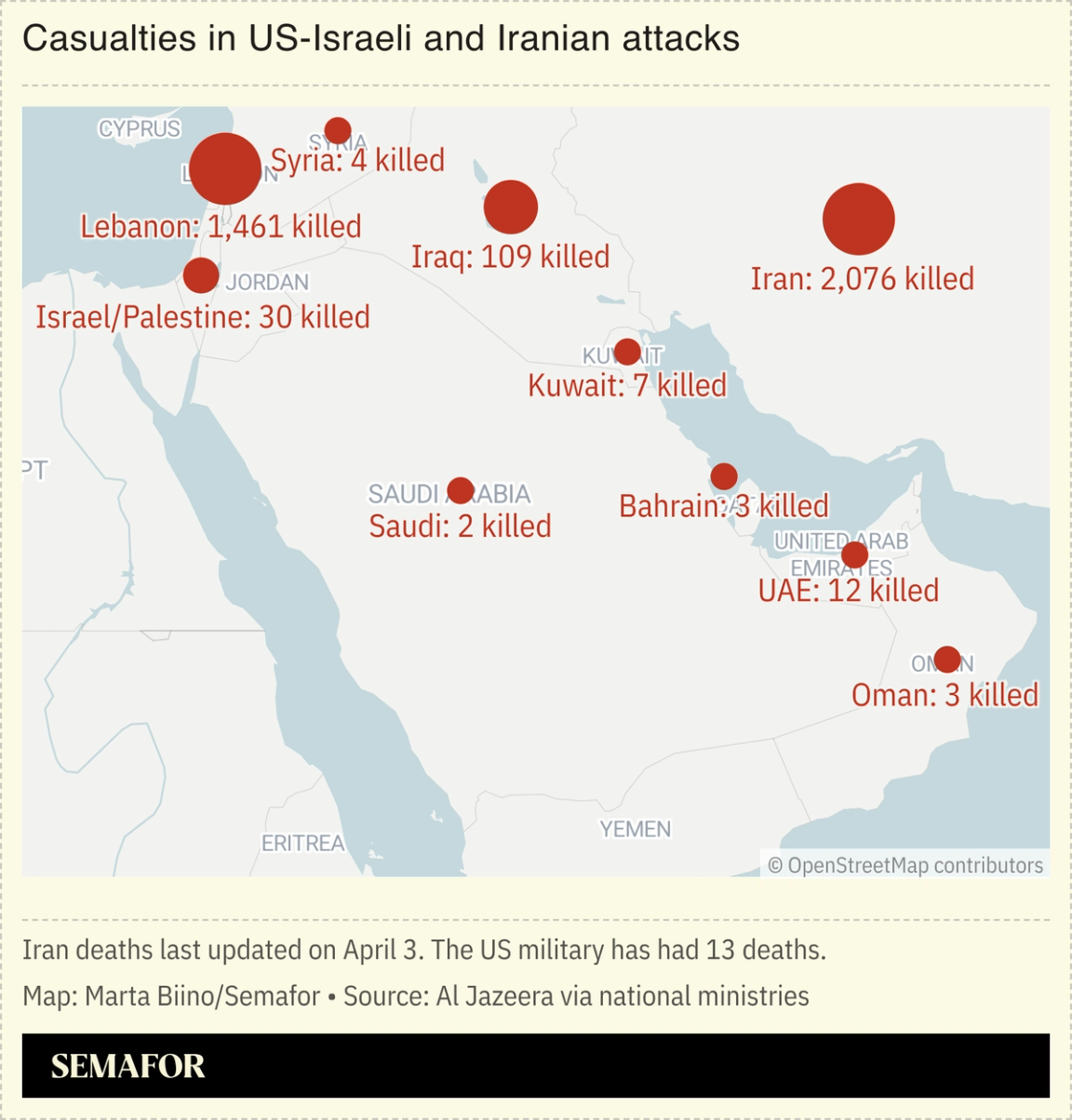 In Tehran, a city of nine million people, schools are closed, businesses are shuttered or struggling, and locals are living without a functioning air-raid warning system or public shelters. In many areas, the first sign of an incoming strike is the explosion itself. There have been twice as many US and Israeli attacks on Iran compared to the number of Iranian retaliatory strikes since the war began — and the numbers killed in Iran have been orders of magnitude greater than in the neighboring Gulf states. A nationwide internet blackout, now entering its second month, has left civilians unable to access information about safety, shelter, and food and has meant some are unable to work. But while millions have fled Iran’s cities, many more are staying where they are. Some residents are hoping the US and Israeli bombs will cause the regime to collapse; others are left wondering if they are at risk if their neighbors are targeted. For the many Iranians with ties to Dubai, there are other pressures, with Iranian nationals now barred from entering or transiting through the UAE. Residency permits, even for those with long-term Golden Visas, are reportedly being revoked without notice. |
|
Masdar, TotalEnergies team up for Asia |
 The value of a proposed joint venture between Abu Dhabi’s Masdar and France’s TotalEnergies, which will see them merge their onshore renewable projects in Asia. The new 50/50-owned firm will develop, own, and operate onshore solar, wind, and battery storage projects in nine countries from Azerbaijan to South Korea. The joint venture will have a portfolio of 3 gigawatts of operational assets, with a further 6GW due online by 2030. The Strait of Hormuz closure has made Masdar’s international expansion more urgent. Gulf investors have, in recent years, been accelerating their bets on overseas renewable and conventional energy plants, moves that seem prescient given these revenue streams don’t depend on the Gulf shipping lane. Masdar plans to invest up to $35 billion over the next four years toward a target of 100GW of renewable energy capacity by decade’s end. It is roughly two-thirds of the way there. — Kelsey Warner |
|
 Ken Griffin, founder and CEO of Citadel; Jean Hynes, managing partner and CEO of Wellington Management; Sim Tshabalala, CEO of Standard Bank Group; Andrea Orcel, CEO of UniCredit; Gabriel Makhlouf, governor of the Central Bank of Ireland; and more will join The Future of Global Finance session at Semafor World Economy. The discussion will focus on how markets balance openness with resilience, and which regions will cultivate the transparency, scale, and confidence global capital demands. April 14, 2026 | Washington, DC | Apply to attend |
|
 - Council on Foreign Relations: The National’s Editor-in-Chief Mina Al-Oraibi discusses life in Abu Dhabi, the UAE’s position on the war, and how China views the conflict, in this podcast episode.
- Foreign Affairs: Gulf energy exporters will speed up their diversification efforts and seek to play an even greater role in global energy supply chains when this war ends, writes Karen E. Young of the Center on Global Energy Policy at Columbia University.
- The National: Iranian Kurdish groups have not launched a ground offensive from Iraq, as some had expected at the start of the war, held back by limited international backing and pressure from other regional states, but say they would move if unrest inside Iran creates an opening.
- The New Yorker: The team behind Explosive News, whose pro-Iran, Lego-themed videos have become a viral hit during the war, are catalogued in this profile.
- Observer Research Foundation Middle East: Calls are growing for a UN-backed coalition to secure the Strait of Hormuz, but any military solution would be risky and potentially open-ended given Iran’s geographic advantage and asymmetric tactics.
- Reuters: Qatar leaned on its sovereign wealth fund to shore up its banking sector in 2017, when its Gulf neighbors embargoed it. Doha may need to use its foreign assets again if depositors pull their cash from local banks.
|
|
Iraq built a border wall after the fall of the Assad regime in Syria, based on fears of the Sunni-dominated armed groups that took power in Damascus. With the Strait of Hormuz largely closed, Iraq is now trucking its oil through the country to the Baniyas oil export terminal on the Mediterranean coast, escorted by the Syrian government that Baghdad had feared.  Iraqi oil tankers in Syria. @SPC_syr/X. Iraqi oil tankers in Syria. @SPC_syr/X. |
|
|


