| | In this edition: Republicans lag even in victory, Rev. Al Sharpton on 2028, and Democrats debate Isr͏ ͏ ͏ ͏ ͏ ͏ |
| |  NEW ORLEANS NEW ORLEANS |  NEW YORK NEW YORK | RICHMOND |
 | Americana |  |
| |
|
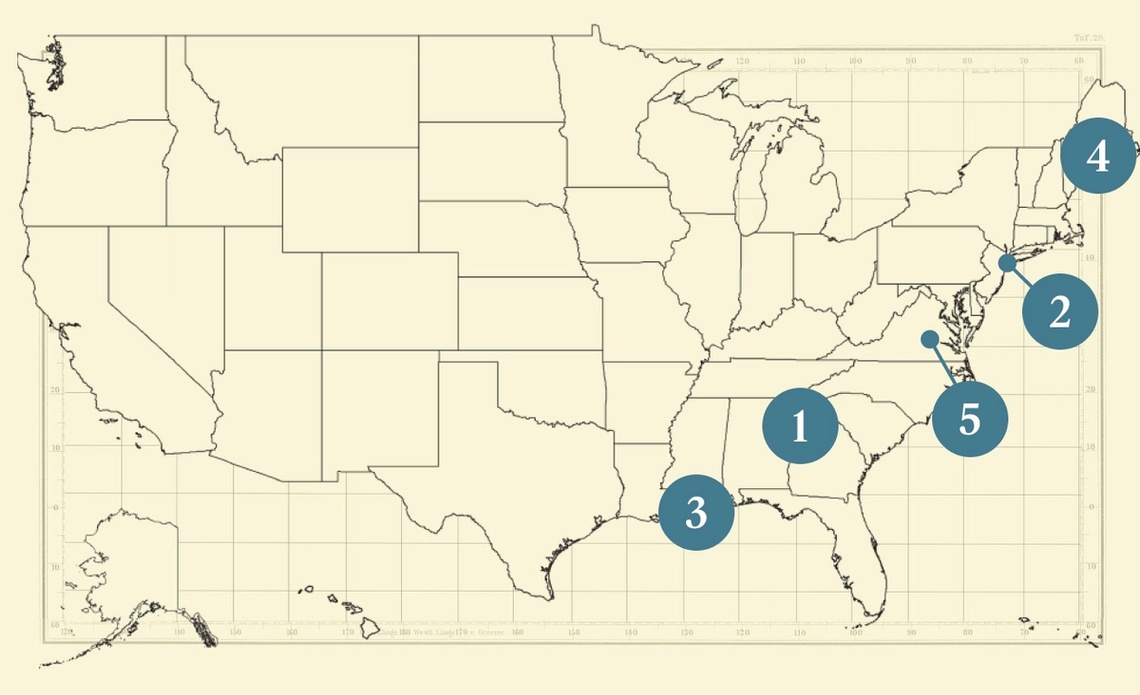 - Kinds of blue
- Sharptoncon draws Dems
- Family meeting
- Maine Dem ad watch
- Virginia redistricting, polled
|
|
 Republicans are very comfortable using AI for almost anything in politics, and they’ll say so. Democrats are not very comfortable, and they won’t talk about it. We’re only starting to see how those different views might change campaigning. But Republicans are optimistic that their approach will win out. “Professionally we have an advantage, because we’re willing to push the envelope on this stuff and take risks,” said GOP strategist Eric Wilson, an AI evangelist. “The professional class on the Republican side is very much saying: ‘Yeah, let’s use everything we have to our advantage. There’s no prize for running an artisanal campaign.’” In Democratic shops, the conversation about whether to use AI tools internally is quiet and cautious. One example: I’m told the Democratic National Committee has approved the use of only Google’s Gemini LLM, and not its competitors, for official work like data analysis and coding. Other Democratic groups have used AI tools to build campaign sites more quickly, replacing some hours of busywork. But there is Democratic dread about the consequences of widespread AI use, like employment loss for visual artists and camera crews, that the GOP doesn’t share. While data center construction and favorable tax subsidies for the AI industry are politically unpopular, only Democrats have a faction that wants to stop the bulldozers. Democrats have introduced the sole successful proposals to restrict AI in political messaging. Rep. Julie Johnson, D-Texas, author of a bill that would let candidates sue for damages if their opponents ran “materially deceptive” AI ads, told me that such deception was already a problem in her primary. “It depends on if it’s based in fact, or if it’s just made up bullsh*t,” she said, a few days before being forced into a runoff with former Rep. Colin Allred. “Colin has done some AI-generated ads with my face in them; I don’t like it, but I don’t have a huge problem with it. That is, in fact, me. What I don’t like is using AI to create an image of me with Trump and Kristi Noem, because that’s just never happened.” That defense of observed reality doesn’t have much power on the right, which has fully embraced AI image generation. The tears of liberal-leaning artists who won’t get paid to make those images are a bonus. |
|
Even in victory, Republicans lag |
 Photo by Joe Timmerman/Wisconsin Watch via Getty Images Photo by Joe Timmerman/Wisconsin Watch via Getty ImagesDemocrats overperformed in Tuesday’s state and special elections, winning a 5-2 liberal majority on Wisconsin’s supreme court while losing Georgia’s most safely Republican House seat by just 12 points. Both results were widely expected, even if the margins weren’t. The president carried the Georgia district by 37 points in 2024 (when the seat was held by now-retired Marjorie Taylor Greene), but Republican Clay Fuller notched a far smaller margin of victory this time against Greene’s last Democratic opponent. National Republicans ignored the Wisconsin race, even though winner Chris Taylor would get to replace a conservative justice, after Elon Musk embarrassed himself by pouring money into a failed 2025 campaign for another court seat. Taylor, a former Planned Parenthood state policy director, narrowly carried Ozaukee County — one of the suburban Milwaukee “WOW counties” that Republicans have dominated for decades. GOP turnout was sluggish everywhere. Wisconsin Democrats ousted multiple conservative school board members, and won the mayoralty of Waukesha, an iconic Republican suburb whose retiring mayor had endorsed Kamala Harris. (Harris lost the city by 6 points.) In Tulsa, Okla., voters ousted a conservative school board member who was first elected in the Biden-era backlash to progressive curricula. |
|
Potential Democratic 2028 contenders address Black voters |
 Kevin Lamarque/Reuters Kevin Lamarque/ReutersNine Democrats who might run for president will head to New York this week to address Rev. Al Sharpton’s National Action Network — the first stop on the invisible campaign trail that will connect the maybe-candidates to Black voters from around the country. Sharpton told me that he plans to ask about a topic that’s proven tricky for the party — how to restore Biden-era racial equity policies that Trump erased. “I want to know how they will deal with issues like DEI, which has been a major template of Trump 2.0,” Sharpton told Semafor. “How will they deal with hate crimes? How will they deal with the fact that we’re seeing, in the military, people not promoted based on gender and on race?” Kamala Harris, who has stepped up her political activity since finishing her 107 Days book tour, will address the conference on Friday. The Biden-Harris administration got a very friendly reception from attendees at the Sharpton event, dating back to its work on civil rights and voting rights. Much of that’s been reversed by the Trump administration, of course. In addition to Harris and former Transportation Secretary Pete Buttigieg, other well-known Democrats will be making their first appearance at the conference — including Pennsylvania Gov. Josh Shapiro, Kentucky Gov. Andy Beshear, Arizona Sen. Ruben Gallego, and California Rep. Ro Khanna.
|
|
Democrats’ slow-mo Israel debate |
 Marco Bello/Reuters Marco Bello/ReutersThe Democratic National Committee is meeting in New Orleans to plug away on its 2028 primary calendar, discuss its next convention site, and debate more progressive resolutions asking for a stricter stance on US-Israel relations. Of the 32 resolutions approved for debate in New Orleans, three edge into foreign policy. That includes an anti-AIPAC resolution, one that calls for “pausing or conditioning” weapons transfers to units “credibly” connected to violating international law, and one that calls for “full, transparent, and independent investigation” of the airstrike in the Shajareh Tayyebeh girls’ school in Iran. A working group on Gaza, announced eight months ago after a DNC compromise that killed resolutions about the war, will meet for its second unofficial in-person dinner — a pace that’s not unusual for party working groups, but a reminder of how fraught Democrats are on the question. “We want a frank and honest conversation about where our voters are,” said Allison Minnerly, a Florida DNC member who’s part of Martin’s working group.
|
|
Team Mills and Platner both hit costs of war |
 Majority Forward Videos/YouTube Majority Forward Videos/YouTubeSomewhat famously, Senate Democratic leaders would prefer that Maine Gov. Janet Mills, not Graham Platner, won the party’s Senate primary this summer. But here’s something interesting: DC strategists are currently using the same message as Platner’s insurgents when it comes to Iran. In “That Money,” the Democratic super PAC Majority Forward attacks Sen. Susan Collins, R-Maine, for allowing the president to pursue “another war in the Middle East, costing Americans nearly a billion dollars a day.” In Platner’s new ad, “Wars Back Home,” the outsider candidate says he’ll “focus on the wars Maine families are facing here at home,” to lower their cost of living. Democrats aren’t getting the vote they want on Iran but they’ve dusted off an argument that worked well for them in the Bush years. This same argument, to an extent, worked for Trump in the Biden era — when he suggested that any money spent in Ukraine would be better spent in America. |
|
Why Va.’s new maps are still coming out ahead |
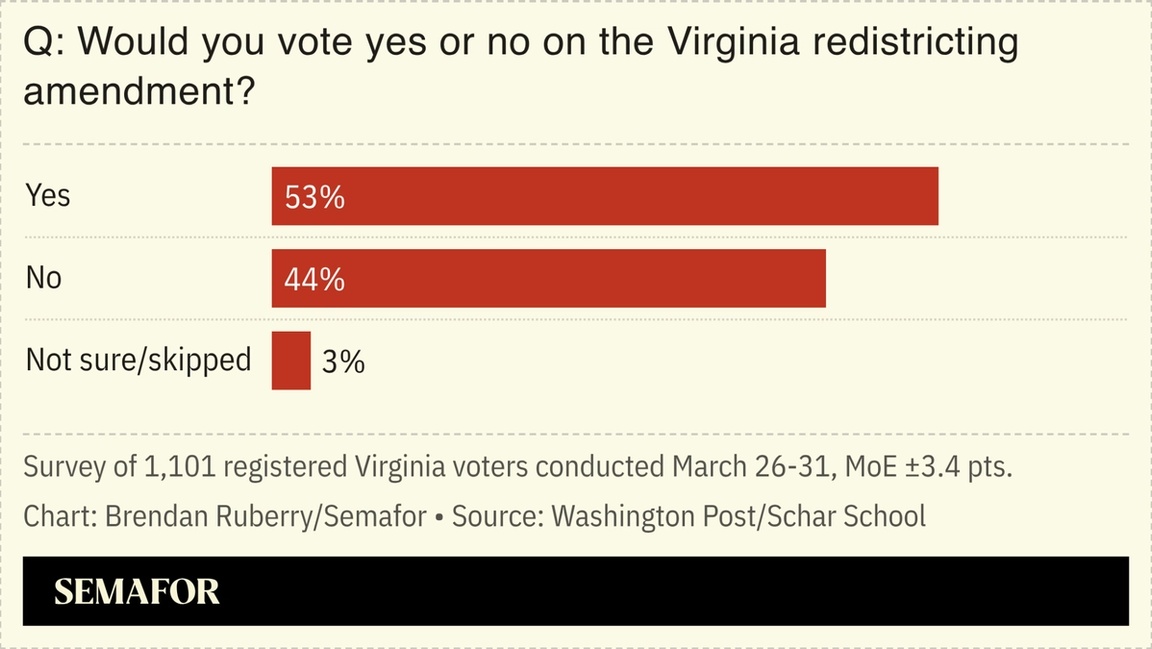 California Democrats briefly panicked last year that they might lose their redistricting referendum, which asked voters to undo their past nonpartisan work to help Gov. Gavin Newsom’s party claim more seats. Instead, they rallied and won by a bigger margin than they beat Trump by in 2024. This month, Virginia Democrats are trying to convince a less liberal state to enact a map that’s even better for their party, reducing Republicans to one out of 11 House seats. Pure partisanship is pushing Virginia redistricting to a narrow lead: Ninety-one percent of Democrats support it, joined by a majority of independents. At the same time, just 81% of Democrats and 40% of independents say the measure is “fair.” The crucial bloc of voters here are people who both dislike Trump and dislike that they have to vote for this in order to wound him. |
|
 Gary Peters, Senator, D-Mich; José Muñoz, CEO, Hyundai; Ariane Gorin, CEO, Expedia Group; Olugbenga Agboola, Founder & CEO, Flutterwave; Vicki Hollub, President & CEO, Occidental Petroleum; and more will join The Future of Mobility session at Semafor World Economy. This session will examine how entire transportation ecosystems from supply chains to charging networks to city infrastructure must evolve to meet rising expectations for speed, sustainability, and accessibility. |
|
 Amanda Andrade-Rhoades/Reuters Amanda Andrade-Rhoades/ReutersPolitico’s Sam Benson is always finding rich stories from the states, and I loved what he reported from Utah: How Rep. Blake Moore’s advocacy for a 2018 gerrymandering ban now infuriates his fellow Republicans. Moore isn’t facing serious primary danger, yet. But after the state supreme court ended the GOP’s gerrymander and drew a new Democratic congressional seat to represent Salt Lake City — followed by a failed effort to get a new ballot measure undoing all that — he is being blamed for the redistricting rule working as intended. It’s a fairly new frontier in state politics, as the Trump-led GOP demands as many seats as possible from red states. |
|
 Like many people — like you, maybe — I bought a good English translation of “War and Peace” years ago. I started it a few times but gave up at the first moat full of Russian names to remember and French sentences to translate. This time, I took a day to finish the first part, and I was hooked. You can also do this. It turns out that one of the greatest novels ever written in any language is very good, with the power to freeze you in place as you contemplate the search for purpose, the randomness of history, and what happens in the mind as death approaches. (No spoilers.) I went with the Richard Pevear and Larissa Volokhonsky translation, but do your own research. And if you’re pressed for time, here’s something shorter: Antonia Hitchens on the groyperization of the young GOP. |
|
|


